

[비즈한국] Although the fall semester has begun, the return rate for medical students remains stagnant. On a visit to the Yeongeon Campus of Seoul National University (SNU) Medical School on the 2nd, only the occasional graduate student was visible, rather than undergraduate medical students. According to the school's course registration system, one mandatory major course for second-year undergraduates, which has a capacity of 160, had only about 11 students enrolled. While education authorities have introduced measures to prevent mass academic failure (year-retention), medical students have not responded, leading to concerns that the prospect of "7,500 first-year medical students next year" could become a reality.
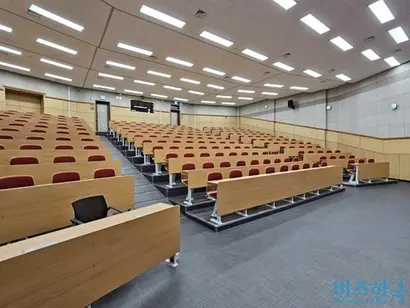
Only '11 students' enrolled in a mandatory major course
On the afternoon of the 2nd, the Yeongeon Campus of Seoul National University in Jongno-gu, Seoul. Although the campus should have been bustling with students attending classes, a quiet atmosphere permeated the air. While the pre-med and graduate programs started their semesters on this day, the undergraduate medical program had begun its semester earlier in July and August by grade level. The only place where voices could be heard that day was a lecture hall in the Education Building. A graduate-level class was in session, with about 60 students in total, including those attending online. The sight of students sitting packed from the first row to the last stood in stark contrast to the empty undergraduate lecture halls.
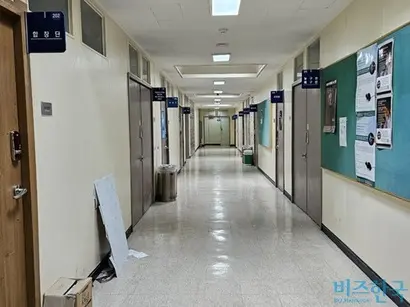
A notice regarding undergraduate classes was posted in a lecture hall in the Student Center. According to Seoul National University's course registration system, a 3-credit mandatory major class for second-year students had a capacity of 160, but only about 11 students were enrolled. The same course for first-year students also had only 7 enrollees. A search of other mandatory major courses for first-year undergraduates showed enrollment numbers ranging from 1 to 7. A school official passing by remarked, "I understand that theoretical classes are held here in the morning, and labs take place in other buildings in the afternoon."
Beyond the lecture hall buildings, sandwich shops, convenience stores, and other facilities had almost no customers. A graduate student, identified as 'A', who had just finished an orientation session, cautiously agreed to an interview. Only after finding a secluded spot within the building did 'A' speak up, saying, "On campus, you only see graduate students and doctors who are studying and doing clinical work. If the first semester felt chaotic, now the situation itself seems to have settled, and everyone has clarified their positions." They added, "I have a friend who is an undergraduate, and from what I hear, almost no one is returning."
Medical Professor: "Worried that next year's incoming freshmen might also refuse to attend class"
In reality, the return rate for medical students who participated in the collective leave of absence last February remains at around 2%. According to data on the "Status of Medical Student Returns" submitted by the Ministry of Education to the office of People Power Party lawmaker Jeon Sung-guk last month, as of July 22, only 495 (2.6%) out of 19,345 registered students across the nation's 40 medical schools were attending classes. By grade, the return rate for first-year pre-med students was the lowest at 53 out of 3,361 (1.58%), while the return rates for second-year pre-med students and first-to-third-year undergraduate medical students were between 2.5% and 2.8%. Fourth-year undergraduates had the highest return rate at 3.4%.
Previously, groups like the National Association of Medical Student Parents and the Korean Medical Student Association (KMSA) had expressed their intention to refuse tuition payments for the second semester. Last month, the parents' association and the Gyeonggi Medical Association held a "Rally to Appeal for the Normalization of Medical Education," featuring performances such as refusing to pay tuition. The KMSA also released a press statement, criticizing the situation: "Demanding students return when the situation is such that we cannot even guarantee the right to learn for current students, let alone incoming freshmen, is like asking someone to return to a barn that has been completely destroyed. The academic schedule itself is ruined to the point where education is impossible; why would they return to take classes, and what would they be paying tuition for?"
A professor at a medical school in a major city expressed concern, saying, "I have met with student representatives, but their thinking has not changed at all. In our school's case, the year-system that the government introduced as a measure to prevent academic failure was already in place, so there was no significant impact." They added, "I worry that we might end up in a situation where the incoming freshmen starting next March also refuse to attend class." Regarding the Ministry of Education's budget, the professor noted, "For a medical school to be maintained, the hospital must function well. Professors' salaries are paid from the money the hospital earns. But now, the hospital is on the verge of closing." They pointed out, "The government seems to be trying to reassign hospital-affiliated professors to the university, but if you look at the budget, I think there will be difficulties given that scale."
Universities are planning to respond by extending grade-processing deadlines and using 'I' (Incomplete) grades for uncompleted courses in accordance with the Ministry of Education's "Guidelines for Flexible Operation of Medical School Academics" to prevent mass failure. Seoul National University announced that it would extend the first-semester grade-processing deadline to the end of October and operate the second-semester academic schedule flexibly. Kangwon National University is considering granting 'I' (Incomplete) grades instead of 'F' grades. Chungbuk National University sent notices to students and encouraged them to register for courses by the 6th, the end of the course-change period. The deadline for tuition payment has also been extended to the end of December.