

[비즈한국] There is a saying that staying in the middle is the safest path. It means that if you don't overreach and just handle your given tasks reasonably well, you can get by without any trouble. However, this maxim does not seem to apply in our universe. This is especially true in the world of black holes.
The world of black holes has no middle ground. Black holes have only been discovered at the extreme ends of the mass spectrum—either extremely light or extremely heavy. Intermediate-mass black holes, which fall in between, have rarely been found. It remains unclear whether their absence is because these black holes are simply hiding in strange, hard-to-reach places, or if they don't exist in the universe at all. Many astronomers are still searching for intermediate-mass black holes to bridge this empty gap in the black hole mass distribution. Perhaps they have been chasing the ghosts of black holes that never existed in the first place.
However, a compelling site suspected of hosting an intermediate-mass black hole has recently been captured! Although we have only added one to the list of black holes, there is a world of difference between something whose very existence was uncertain and finally discovering at least one. We can now shed the worry that intermediate-mass black holes might just be non-existent phantoms. While they remain difficult to find, we can now be certain that they are hiding somewhere, waiting for us.
Black holes are generally classified into two types based on their mass. There are black holes that are several dozen to a maximum of about 100 times the mass of the Sun. These are formed when very massive stars finish their evolution and undergo gravitational collapse. These are called stellar-mass black holes. You can think of these as the black holes people refer to when they say, "a star dies and becomes a black hole." They are the lightweights of the black hole world.
There are also heavyweight black holes that are much heavier than these. These are the supermassive black holes typically found at the centers of galaxies. They possess overwhelming masses, ranging from millions to billions of times the mass of the Sun. Naturally, such massive black holes were likely not formed by the death of a single star. It is possible that stellar-mass black holes, which crowded the centers of galaxies long ago, merged and grew to become the massive supermassive black holes we see today. Alternatively, it is possible that shortly after the Big Bang, in the early universe, massive gas clouds collapsed all at once to form supermassive black holes directly.
In short, when a single massive star dies, it becomes a stellar-mass black hole. Supermassive black holes live at the centers of massive galaxies. If so, shouldn't there be middle-weight black holes—neither very heavy nor very light—in between? It would be natural for black holes with masses around a thousand to a million times that of the Sun to exist. However, until now, these intermediate-mass black holes have almost never been found.
Their absence raises questions about the hypothesis that supermassive black holes are simply the result of light stellar-mass black holes merging together. If the current heavyweights are the result of lightweights gathering and slowly growing in size, they would naturally have to pass through a middle-weight stage in the process. The fact that middle-weight black holes are not being found casts doubt on whether supermassive black holes were created by the merger of lighter black holes at all.
If intermediate-mass black holes are truly hiding somewhere, where should we look? Since supermassive black holes reside in the centers of massive galaxies, we might expect to find smaller ones in the centers of dwarf galaxies or globular clusters. Indeed, some recent observations have captured various signals suspected to be traces of intermediate-mass black holes in the centers of dwarf galaxies that are nearly 1,000 times lighter than our own galaxy. However, those results are not yet conclusive.
In searching for intermediate-mass black holes, we can learn from history, specifically the observation that first confirmed the existence of the Sagittarius A* supermassive black hole at the center of our galaxy. German astronomers Reinhard Genzel and Andrea Ghez began observing the monster living at our galaxy's center in the 1990s. Using the Keck Observatory in Mauna Kea, Hawaii, and the Very Large Telescope (VLT) in Chile, they tracked the movements of stars orbiting the galactic center. To clearly distinguish the movement of each individual star in the high-density environment of the galactic center, high-resolution observations were necessary. Thus, the help of massive telescopes like Keck and the VLT was essential.
They persistently observed the movements of various stars until 2000. As a result, they discovered that the stars confirmed in the center of our galaxy were moving at very high speeds in highly elongated elliptical orbits. These orbits were packed into a very narrow region within just a few light-years. Even more surprising was that there was no bright object visible at the center of the elliptical orbits traced by all the stars.
The stars were presumably being held in orbit by the gravity at the center of our galaxy. However, the fact that the central stars were orbiting at such high speeds, as observed by Genzel and Ghez, meant that something hidden was holding the surrounding stars with immense gravity. The mass of this terrifying gravitational clump they estimated at the time was roughly 4 million times the mass of the Sun. An immense mass had to be concentrated at a high density within a very small area.
If this were a supermassive star or a star cluster of that mass, it should have been emitting bright light. Yet, no light was visible. Only one thing fit the bill: a mysterious entity where matter was gathered and kneaded into an extremely high density—a supermassive black hole. Later, in 2020, the two astronomers who proved the existence of the black hole at our galaxy's center were awarded the Nobel Prize in Physics, along with physicist Roger Penrose, who mathematically defined the singularity at the heart of black holes.
Similarly, if an intermediate-mass black hole exists inside a globular cluster, which is slightly smaller in scale than a galaxy, couldn't we prove its existence in a way similar to what Genzel and Ghez did? It would involve tracking the movements of stars quickly orbiting around empty space that emits no light in the very center of a globular cluster.
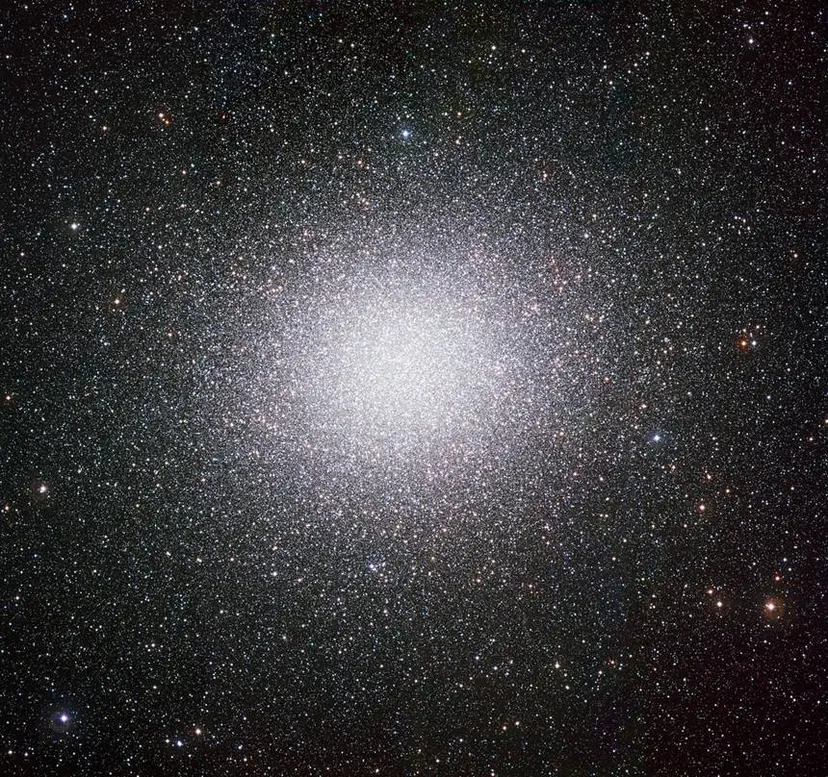
For this purpose, astronomers in this study utilized data from the Hubble Space Telescope, which observed the Omega Centauri cluster—known as one of the brightest and most massive globular clusters roaming the halo of our galaxy. This cluster is about 18,000 light-years away from Earth and contains nearly 10 million stars packed into a range of several dozen light-years. On a very clear night, it can even be seen with the naked eye.
It is more reasonable to view this not as a parent cluster, but as what was originally a larger dwarf galaxy. As a dwarf galaxy that was orbiting our galaxy had its form shattered by the gravity of the Milky Way, its outer stars were dispersed, leaving only the galaxy's nucleus, where stars were gathered at a high density. In fact, comparing the chemical compositions of stars within Omega Centauri reveals that stars with highly diverse chemical compositions coexist. This is an important characteristic easily seen in galaxies where many generations of stars live together.
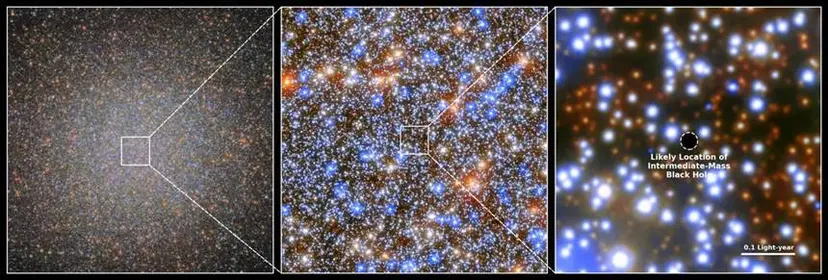
For 20 long years, the Hubble Space Telescope has been consistently observing stars within Omega Centauri. Twenty years! It is by no means a short amount of time. This is enough time to monitor changes in the positions of stars orbiting the center of the cluster. Through Hubble's 20-year observational data, astronomers identified seven stars orbiting at very high speeds.
Surprisingly, these stars were traversing the space within the cluster at truly tremendous speeds. Their speeds had long surpassed the cluster's escape velocity, calculated by considering only the mass of the stars shining within the cluster! A speed exceeding the escape velocity means they are moving fast enough to be flung outward, free from the cluster's gravity. However, these stars were clearly not being flung out but were well-captured by the cluster's gravity. This means that an unknown, additional gravity—not detectable just by the bright stars alone—is acting at the center of the cluster. And it is acting within a very narrow range of less than a few light-years!
Based on this, astronomers concluded that a massive, high-density mass must exist at the very heart of the Omega Centauri cluster. Its mass is roughly 8,200 times that of the Sun. It is precisely the intermediate-mass black hole we have been looking for—a mass corresponding to the middle-weight class!
Stellar-mass black holes left behind by old stars that finished their evolution long ago may be gathered at high density in the center of a globular cluster. Black holes with overlapping orbits can interact gravitationally and eventually be kneaded into a single, larger black hole. If this is happening frequently at the center of the cluster, we can expect the existence of middle-weight black holes thousands to tens of thousands of times the mass of the Sun.
Furthermore, this process can happen faster as more stellar-mass black holes cluster together in the center. Perhaps the reason we have not easily discovered intermediate-mass black holes until now is because the growth speed from stellar-mass black holes to supermassive black holes is simply too fast. Also, because we had to look at the centers of relatively small clusters where stars are packed at high density, it may have been difficult to confirm the existence of intermediate-mass black holes using existing telescope observations with lower resolution.
Through this observation, the credibility of intermediate-mass black hole candidates, which had been reported only very occasionally, has increased. Astronomers have previously captured candidate objects suspected of being intermediate-mass black holes with 20,000 to 100,000 times the mass of the Sun in the centers of several dwarf galaxies. Of course, compared to the countless stellar-mass black holes and the numerous supermassive black holes at the centers of galaxies discovered so far, the number of intermediate-mass black holes discovered—even including these candidates—is still minuscule. It still does not perfectly bridge the empty mass gap in the black hole mass distribution.
In the world of black holes, being in the middle is not allowed. At least, that still seems to be the case.
Reference
https://www.nature.com/articles/s41586-024-07511-z
Who is the author, Ji Ung-bae? He loves cats and the universe. After watching "Galaxy Express 999" as a child, he dreamed of sharing the beauty of the cosmos. He currently researches galaxy evolution through galactic interactions at the Center for Galaxy Evolution and the Near-Cosmology Laboratory at Yonsei University. He also engages in various science communication activities, including lecturing and writing. He has authored books such as "The Observatory Where You Flirt," "Thinking About the Universe All Day Long," and "Stars, the Science of Light."