

[비즈한국] As several insurance companies have recently appeared on the M&A market, controversy surrounding job security is intensifying. Although MG Non-Life Insurance has been up for public sale, it has yet to find a buyer. With Meritz Fire & Marine Insurance000060, a peer in the industry, emerging as a candidate in the final public bidding round, anxiety among MG employees that job succession will not be guaranteed is mounting. Tongyang Life Insurance082640 and ABL Life Insurance are also nearing their sale from China’s Dajia Insurance Group to Woori Financial Group316140, but concerns persist that they may be resold after the acquisition.
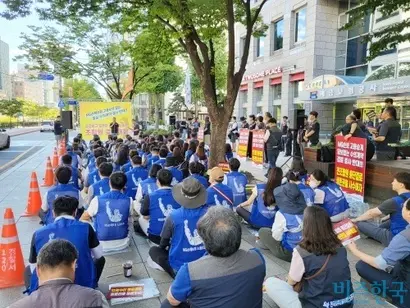
Following MG Non-Life Insurance’s failure to find a new owner after three rounds of open competitive bidding, the Korea Deposit Insurance Corporation (KDIC) has shifted to a private contract method as of August 16. Since MG was designated as an insolvent financial institution in April 2022, the KDIC has been managing the liquidation process (public sale) under a mandate from the Financial Services Commission (FSC).
In response, the MG Non-Life Insurance labor union has been fiercely protesting, holding rallies and picket demonstrations in front of the FSC and the KDIC. Their protests are driven by job insecurity. When peer company Meritz Fire & Marine emerged as an acquisition candidate in the third public bidding round held in August, concerns arose that they would not guarantee the succession of employees.
The KDIC offered two methods for the sale of MG: a stock sale (M&A) or an Asset and Liability Assumption (P&A). P&A refers to an acquisition method where the acquiring institution selectively takes over the assets and liabilities of the insolvent institution. If Meritz Fire & Marine acquires MG via P&A, it could secure MG’s insurance contracts and prime assets at a relatively low cost through public fund support, while avoiding the obligation of employee succession.
The Korean Financial Industry Union held a "Resolution Rally to Stop Secret Private Contracts at MG Non-Life Insurance" in front of the KDIC on August 30, demanding that the private contract process be made transparent. At the site, a union official emphasized, "MG and Meritz have similar insurance portfolios. Since succession would increase costs and risks, they are unlikely to take on all MG staff," adding, "This applies not just to Meritz but also to private equity firms. Whoever the acquirer is, they must guarantee job succession."
Bae Young-jin, head of the MG Non-Life Insurance union, also argued, "The similarity in long-term insurance product portfolio ratios—89% for Meritz and 92% for MG—is high. Because Meritz already has over 3,000 employees, they would likely try to absorb MG’s contracts internally. Since the re-announcement of the bid, the KDIC and the FSC have refused to engage in dialogue with the union. They are turning a blind eye, claiming they cannot intervene because employment is not a condition of the acquisition." However, according to the KDIC, there is no legal basis to demand employee succession from an acquirer when a P&A sale is conducted.
The MG union plans to continue its protest until an official stance is released by the KDIC or financial authorities, or until Meritz Fire & Marine announces its withdrawal. They plan to hold demonstrations against Meritz as early as next week.
MG is not the only place where employees are trembling with fear over potential job losses ahead of a sale. Similar noise has occurred at Tongyang Life and ABL Life, previously owned by China’s Dajia Insurance Group. On August 28, Woori Financial Group’s board of directors approved the acquisition of Tongyang Life and ABL Life and signed a Stock Purchase Agreement (SPA). The combined acquisition price for both companies was 1.5493 trillion KRW, meaning Woori secured two life insurers for slightly less than 2 trillion KRW.
Woori Financial aims to finalize the acquisition of Tongyang and ABL, making them subsidiaries and leveraging synergies between affiliates once financial authorities grant approval. However, even before the acquisition was approved, the labor unions of Tongyang and ABL formed a joint committee to demand guarantees for workers' labor rights. The committee criticized the "secret sale," noting that even during the final stages of the process, such as when Woori conducted due diligence prior to signing the SPA with Dajia Insurance Group, there was no transparency regarding employment, working conditions, or the guarantee of independent management.
Concerns have also been raised about potential resale after acquisition, as there have been similar cases with other financial holding companies in the past. In 2015, KB Financial Group acquired both LIG Insurance and LIG Investment & Securities, but the outcomes for the two companies differed. While KB succeeded in integrating LIG Insurance staff and rebranding it as KB Insurance, LIG Investment & Securities was not kept as a subsidiary or merged into KB Securities; instead, it was sold to the private equity firm Cape Investment. At the time, it caused chaos within LIG Investment & Securities as it was sold twice within a year to a firm with no experience in the securities industry.
A financial industry official noted, "Typically, when private equity firms enter a bid, they take the company's 'prime' assets and then resell, but because there is a precedent among financial holding companies, it is possible it could happen again," adding, "For example, there is a scenario where a portion of Tongyang Life and ABL Life is incorporated as a subsidiary, while the remainder of the insurance contracts are transferred and the company itself is resold."