

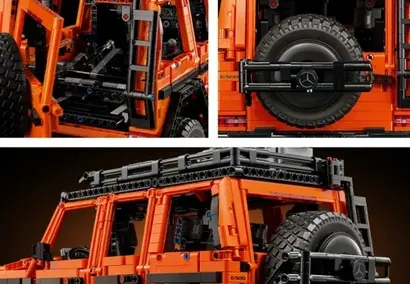
[비즈한국] The Mercedes-Benz G-Wagen, a luxury SUV, is a quintessential off-roader that maintains its boxy silhouette even in an era dominated by sleek, urban-style SUVs. Now, this consistently beloved model can be owned as a block-based model. Recently, the LEGO Technic G500 Professional Line (model number 42177), added to the lineup to celebrate the 45th anniversary of the G-Wagen, features a special 'Copper Orange Magno' paint finish, exuding a more intense impression than the achromatic colors typically associated with the G-Wagen.

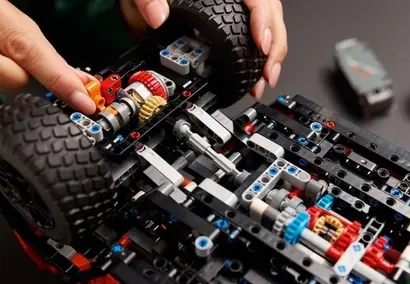
This model is not merely a toy car that comes to mind when you think of LEGO. Nearly 2,900 pieces, both large and small, are precisely assembled to function like a real vehicle. The steering wheel can be used to change direction, and it is equipped with a transmission capable of drive, neutral, and reverse settings, along with an inline 6-cylinder engine block, making it ready to be used as an RC car if a power source is added. Videos of it being fitted with a motor and driving outdoors are already appearing on YouTube. Key components such as the clutch, suspension, and differential gears are implemented with structures similar to those in actual vehicles, boasting mechanical characteristics comparable to the previously released Land Rover Defender.
In the past, many prestigious cars such as the Bugatti Chiron, Porsche 911, Ford GT, and Koenigsegg Jesko have been released through LEGO Technic. Honestly, however, I did not pay much attention to them. The reason lies in their inherent limitations. I felt that LEGO, which is assembled by connecting or stacking limited parts, is unsuitable for realizing vehicles with many curves. When looking at the assembled vehicles, one can usually only recognize the original through a few characteristic parts, such as the headlamps or wheels.
In miniatures, how closely the overall lines resemble the actual vehicle is more important than small details like lamps or logos. In that regard, the disjointed, fragmented surfaces did not leave a good impression. In particular, looking at the design of the Technic Lamborghini Huracán (42161), it is difficult to identify the car without an explanation.
On the other hand, I believe the combination of the linear, style-driven G-Wagen and LEGO is a highly refined match. Because the original model's design is inherently simple, the feel of the original is naturally captured even with the use of chunky parts. The round headlamps, the square housing surrounding them, the trapezoidal fenders, the low-set rear combination lamps, and the details around the spare tire stimulate both automotive and toy enthusiasts alike. The yellow accents on the pistons that become visible when the engine hood is opened are also quite charming.
Of course, the exterior is not without its shortcomings. Like existing Technic models, the doors, which are made by stacking blocks, have such complex joint lines that they detract from the level of immersion. I can't help but think that at least this part could have been made as a single piece using a dedicated panel rather than universal parts. This stands in contrast to the previously released Land Rover Defender (42110), which enhanced immersion by using over-fenders designed specifically for that model. The side windows were designed by connecting parts to form a square space; while the G-Wagen's original side windows are square, they feature a design with slight rounding at each corner. The completion level would have been higher had these details been implemented.
Nevertheless, this G500 Professional Line is a product sufficient to awaken the primal assembly instincts of those who love cars and machines. I hope that the LEGO development team will continue to refine the styling of future Technic vehicles to be smoother while maintaining the current level of precision.
Who is Han Dong-hoon?
A typeface designer. Interested in everything related to letters, including writing, calligraphy, type design, and education. Currently, he designs various corporate-exclusive fonts and retail fonts at the typeface studio AlignType. He has contributed to 'Monthly Design' and the quarterly 'Design Review', and conducts typeface design lectures on both online and offline platforms. In 2021, he published the essay collection 'The Universe in Letters'.