

[비즈한국] Remodeling complexes have been in a state of confusion for a year now after the government included remodeling projects that involve installing pilotis (open ground-level spaces) and adding one floor at the top into the category of additional safety regulations. Previously, the Ministry of Land, Infrastructure and Transport did not classify vertical expansion resulting from piloti installation as "vertical expansion remodeling," which is subject to additional safety regulations such as secondary safety diagnostics or safety reviews. However, the ministry changed its stance after the Ministry of Government Legislation issued an interpretation of the relevant laws last August. Remodeling complexes are expressing their grievances, calling for the relaxation of the excessive safety regulations applied to piloti installation.
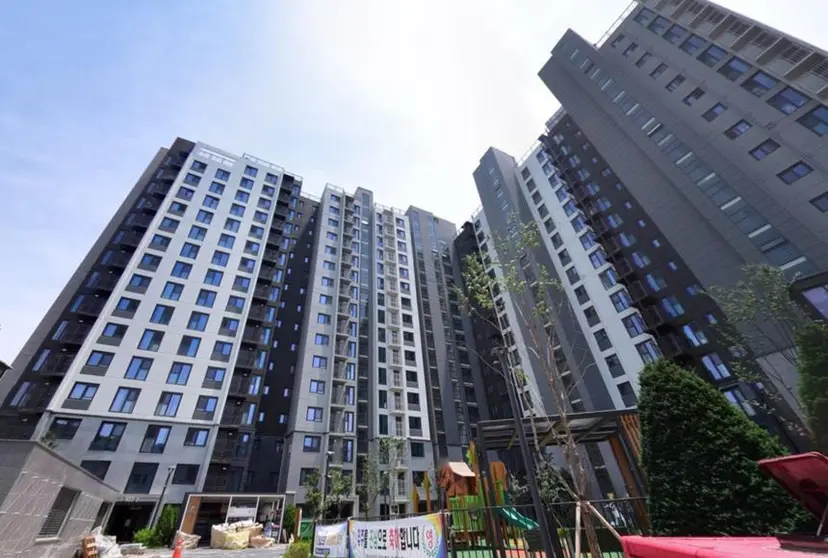
Remodeling refers to the act of majorly repairing or partially expanding an aging building. Under the Housing Act, apartment complexes that are 15 years or older can renovate their homes while increasing the number of units by up to 15%. Expansion methods include "horizontal expansion," which involves building a new structure adjacent to the existing building, and "vertical expansion," which increases the floor count by up to 2–3 floors by adding new frames on top of the existing apartment framework. Generally, vertical expansion is more effective for increasing the number of households, but it entails stricter safety regulations due to the increased load on the building. In remodeling safety diagnoses, horizontal expansion is possible with a grade C rating, while vertical expansion requires a grade B or higher.
The piloti, which has become a subject of controversy, refers to the open space created by lifting a building off the ground with pillars. It is typically used as a pedestrian path, parking lot, or for amenities for residents. Until now, complexes pursuing remodeling would open up the walls of the first-floor units—excluding load-bearing walls—to create pilotis, and then compensate for the removed units by adding one floor to the top of the building. This is known as "vertical expansion remodeling without an increase in the number of households." The Ministry of Land, Infrastructure and Transport had not previously viewed such vertical expansion as "vertical expansion remodeling" subject to the additional safety regulations under the Housing Act.
However, in July of last year, the Ministry of Government Legislation issued a legal interpretation stating that vertical expansion following the installation of pilotis constitutes vertical expansion remodeling under the Housing Act. To proceed with such remodeling, complexes must first receive a grade B or higher in the initial safety diagnosis to be cleared for "vertical expansion remodeling." Afterward, they must undergo: △a primary safety review during the architectural deliberation stage; △a secondary safety review during the remodeling permit application stage; and finally, △a secondary safety diagnosis after receiving the permit to confirm whether any design changes are needed. This effectively created a four-step hurdle for vertical expansion projects involving piloti installation.
With these additional safety regulations in place, some complexes have decided to abandon their plans for pilotis. The head of a remodeling union in Seoul, identified as 'A', said, "Half of our complex received a grade C on the safety diagnosis. After seeing the interpretation that piloti installation is impossible for grade C complexes, we decided to scrap the pilotis entirely. It took four months just for the design changes." The head of another remodeling union in Seoul, 'B', added, "We were considering pilotis, but since the legal interpretation came out around the time of our union establishment, we decided to go for horizontal expansion without pilotis. Our complex also has a mix of grade B and C buildings."
The Ministry of Land, Infrastructure and Transport, which had previously provided conflicting authoritative interpretations, did not issue clear guidelines to local governments following the new legal interpretation. In August last year, while notifying local governments of the Ministry of Government Legislation’s ruling and the ministry's own change in stance, the Ministry of Land, Infrastructure and Transport stated: "For complexes currently pursuing vertical expansion remodeling without increasing the number of households based on previous authoritative interpretations, local governments should implement safety confirmation procedures, taking into account the intent of the regulations, and may review and implement appropriate safety assurance measures such as safety reviews and structural deliberations if necessary."
Consequently, local governments issued mixed interpretations. This is because the ministry left it up to each local government to decide how to handle the safety confirmation procedures for complexes that already had their union establishment approved. The Seoul Metropolitan Government notified its autonomous districts in October last year that "safety diagnoses and safety reviews must be carried out regardless of whether the union has been established," whereas Gunpo-si in Gyeonggi-do implemented a relaxed policy, allowing complexes that had already received union establishment approval prior to the Ministry's change in stance to undergo a "safety consultation" determined by the city instead of the mandatory primary and secondary safety reviews.
Remodeling complexes in Seoul, hit hardest by the Ministry of Government Legislation's interpretation, are voicing their complaints. The head of a remodeling union in Seoul, 'C', said, "We are preparing to install pilotis and add one vertical floor to secure pedestrian flow between buildings and a sense of openness due to the apartment's structure. With the change in legal interpretation, we now have to prepare for the first and second safety reviews as well as a secondary safety diagnosis, which raises concerns about costs and project delays." The head of a remodeling union in Seoul, 'D', asked rhetorically, "I understand the intent of the interpretation, but it is unfair for each local government to operate differently. The structural safety of an apartment shouldn't change depending on the region, right?"
In response, an official from the Housing Maintenance Division of the Ministry of Land, Infrastructure and Transport explained, "There was an error in the previous legal interpretation, but we could not forcibly apply the new interpretation uniformly to remodeling complexes that were already proceeding with their projects based on the incorrect interpretation. To protect their trust, we left room for the local governments, which are the permit-granting authorities, to make the judgment." The official added, "(The safety reviews mandated by the changed interpretation) have the aspect of further securing the safety of the homes where residents will actually live, as the public sector performs a final verification of the appropriateness of the private design."
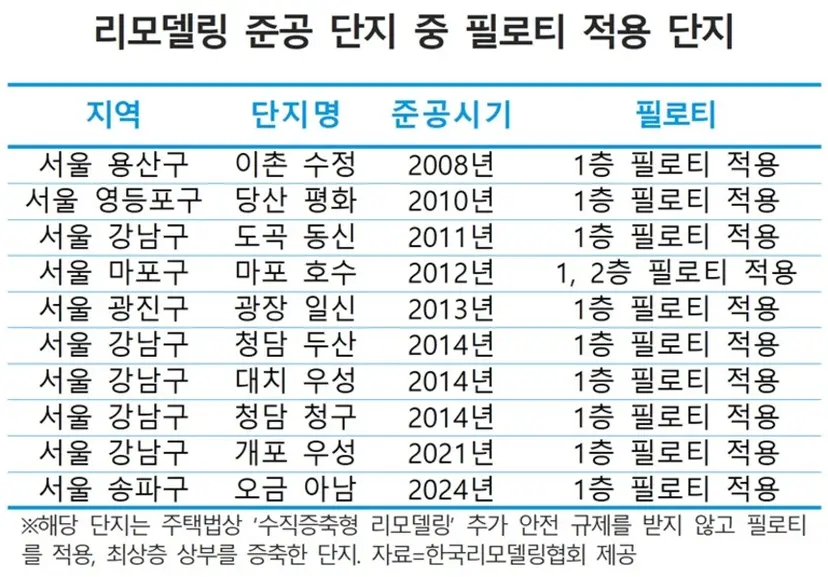
There are also voices arguing that the additional safety regulations for piloti installation and top-floor vertical expansion are excessive. They argue that in the process of installing pilotis, the first-floor load-bearing walls are maintained, and the added top-floor units do not put excessive strain on the building's load. Based on cases of already completed complexes, proponents argue that the safety of piloti and one-floor expansion can be verified through general remodeling deliberation procedures. According to the Korea Remodeling Association, there are about 10 complexes that have already been completed where pilotis were installed and a top floor was added without being subjected to the vertical expansion remodeling safety regulations under the Housing Act.
Lee Dong-hoon, chairman of the policy and legislation committee at the Korea Remodeling Association, argued, "Experts agree that the first-floor walls removed to create pilotis are non-load-bearing walls, and adding one floor to the top does not cause structural problems because of the increased use of lightweight materials. Even if a problem were to occur, it could be sufficiently reviewed through regular remodeling approval procedures like the architectural and structural deliberations performed before construction begins. Since about 10 complexes have been completed without issues in this manner so far, it is necessary to relax safety regulations by distinguishing between one-floor vertical expansion associated with piloti installation and standard 2-3 floor vertical expansions through official notification."