

[비즈한국] The general strike by the Korean Health and Medical Workers' Union (KHMU), which has been calling for relief from excessive workloads following the mass resignation of medical residents, is just one day away. The union is demanding, among other things, a 6.4% wage increase. With the Nursing Act passing the National Assembly plenary session today, 11 workplaces have reached settlement agreements so far, including Korea University Medical Center (Anam, Guro, Ansan), Ewha Womans University Medical Center (Ewha Seoul and Mokdong Hospitals), Chung-Ang University Medical Center (Seoul and Gwangmyeong), and the National Medical Center. Attention is now focused on whether the Nursing Act will lead to more settlements as negotiations progress.
KHMU: "Do Not Shift the Burden of Management Responsibility Caused by Healthcare Gaps onto Us"
The Korean Health and Medical Workers' Union announced on the 24th that after holding a strike vote across 61 hospital workplaces, the general strike was approved with a 91% approval rate (22,101 voters). The KHMU stated, "Do not shift the responsibility for management crises caused by the healthcare gap, which has persisted for over six months due to the collective refusal of doctors to provide treatment, onto healthcare workers any longer." They urged the government and employers to engage in sincere negotiations, adding, "It is time for the government and employers to respond to the desperate demands of healthcare workers who have silently sacrificed and remained on the front lines to protect patients' lives and safety, despite facing disadvantages such as forced annual leave, unpaid leave, unpaid time off, unwanted emergency time off, and reassignment."
The KHMU's demands include: early normalization of medical services, a prohibition on shifting responsibility for doctors' collective actions onto other staff, eradication of illegal medical practices and clarification of job scopes, increased staffing, implementation of a pilot 4-day workweek project, creation of a safe and healthy working environment, resolution of indirect employment issues, securing a standard cost of living and guaranteeing a living wage, and a 6.4% wage increase compared to the total budget. Nineteen university hospitals, including Korea University Medical Center, Ewha Medical Center, Chosun University Hospital, Chung-Ang University Medical Center, and Hanyang University Medical Center, as well as 31 public hospitals—including the National Medical Center and local medical centers—and 11 small-to-medium hospitals have announced their participation in the general strike. The "Big 5" hospitals (Seoul National University, Asan Medical Center, Severance, Samsung Medical Center, and Seoul St. Mary's) are not included.
Last year, the KHMU launched a general strike for the first time in 19 years. At that time, 45,000 workers from 140 locations participated in a strike that lasted for two days. This year's scale is less than half of last year's. However, as the medical vacuum caused by the mass resignation of residents has been prolonged, the role of nurses and other medical staff has grown, suggesting the impact of the general strike on medical sites will be significant. The union declared, "We will deploy essential personnel to areas directly related to patient life, such as emergency rooms, operating rooms, intensive care units, delivery rooms, and neonatal units." In response, the government requested restraint, stating, "We will actively pursue the enactment of a Nurse Act to further strengthen support for healthcare personnel and will prepare government measures to improve working conditions."
Negotiations Settling at Various Sites... Will the Momentum for a General Strike Wane?
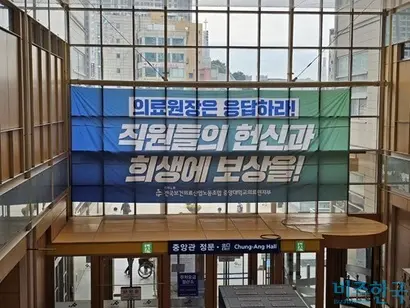
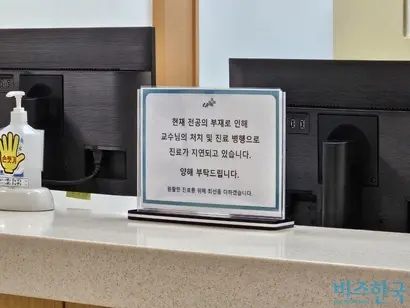
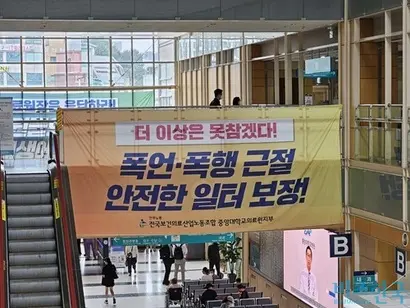
'Hospital directors must compensate employees for their dedication and sacrifice.' 'Eradicate verbal and physical abuse, ensure a safe workplace.' These were the messages on banners from the Chung-Ang University Medical Center branch of the KHMU hanging at the main entrance of the hospital in Dongjak-gu, Seoul, during a visit on the 27th. Otherwise, the atmosphere seemed no different from usual. The hospital was busy with patients seeking care. In the Otolaryngology-Head and Neck Surgery department, where a sign read, 'Due to the current absence of residents, treatment and procedures are being delayed as professors must handle them directly. We ask for your understanding,' six people were already waiting before the start of the afternoon clinic. The Ophthalmology department indicated a '60-minute wait time' on its internal signage.
On the basement floor, home to the staff cafeteria, restaurants, and cafes, the 'general strike' was the main topic of conversation. Staff members exchanged comments such as, "Did you hear about the strike on Thursday?" and "Why Thursday instead of Friday?" One group of nurses encouraged each other while saying, "I was just talking about the strike with my parents," "We did this for about a month before, didn't we?" and "It makes you worry thinking something bad might happen." A passing union branch official said, "Everyone is so exhausted that they want to take action. Physician Assistant (PA) nurses have been filling the gap left by residents, but the management doesn't acknowledge it. Our members just want to work in an improved environment."
Nurses have been shouldering the tasks previously performed by medical residents since their mass resignation. A survey conducted by the Korean Nurses Association from June 19 to July 8 across 385 medical institutions found that 6 out of 10 nurses were asked by their hospitals to perform duties belonging to residents. According to the association, these nurses are deployed after only 30 minutes to an hour of training. However, it was found that the lack of clear job scopes, ambiguity regarding legal responsibility, and a total absence of formal training programs are causing high levels of psychological stress. Amidst this, the average growth rate of nursing staff has fallen sharply as hospitals have postponed new hires due to financial difficulties.
Last-minute negotiations are currently underway at each workplace. As of 2:00 PM on the 28th, 11 workplaces had reached settlement agreements following a second mediation session. According to the KHMU, labor-management negotiations were settled at 11 workplaces across 7 hospitals, including Korea University Medical Center (Anam, Guro, Ansan), Ewha Womans University Medical Center (Ewha Seoul and Mokdong Hospitals), Chung-Ang University Medical Center (Seoul and Gwangmyeong), the National Medical Center, the Korea Institute of Radiological and Medical Sciences, Seoul Dongbu Hospital, and Daejeon Eulji University Hospital. Other workplaces are awaiting their second mediation sessions. If negotiations fail, strike eve events will be held at each location that evening as planned, and the strike will begin at 7:00 AM on the 29th.
Meanwhile, on the night of the 27th, the Nursing Act passed the subcommittee of the Health and Welfare Committee of the National Assembly. It was approved at the plenary session on the afternoon of the 28th. The bill focuses on legally protecting the medical activities of PA nurses. It mandates that the scope of their duties be defined by enforcement decrees. It does not include restrictions on educational requirements for nursing assistants. The KHMU released a statement immediately after, saying, "The task remains to clarify the scope of duties for PA nurses and incorporate strict qualification requirements into the enforcement decree. We must specifically stipulate qualification requirements for PA nurses, including clinical experience, education/training processes, and certification exams," adding, "This is expected to have a positive influence on the remaining labor-management negotiations."