

[비즈한국] As analysis suggests that the AI fever sparked by ChatGPT in late 2022 has cooled down this year, concerns are emerging that the high interest in AI might be nothing more than a bubble. However, whether it is a "fever" or a "bubble," AI-related topics remain a hot potato in every field. In particular, startups are appearing that leverage various AI-related technologies released in recent years to launch new services and products almost every day. In the startup world, AI is becoming increasingly segmented and specialized.
In this column, beyond the LLM-based AI field driven by ChatGPT, we will examine European startups that have brought AI-related technologies to the forefront and explore what new opportunities these innovations might offer.
The Dark Reality of the Poultry Industry: AI's Solution
Miners and nurses are famous groups of Korean workers who migrated to Germany. Though less known, the profession of "chick sexer" was also a common job for Koreans who moved to Germany. In the movie "Minari," the immigrant character also worked as a chick sexer while dreaming of the American Dream. The delicate dexterity of Koreans was so famous that it is estimated that 60% of chick sexers worldwide are currently Korean.
However, this job will be hard to find in Germany in the future. This is because they enacted the world’s first law in 2022 banning the mass slaughter of male chicks. While the slaughter was banned, the need for more egg-laying females remained unchanged. Consequently, the market has been consistently seeking new technologies to address this.
Orbem, a Munich-based startup, is attempting an innovative approach to solve ethical problems in the livestock industry through AI technology. Orbem has developed "In-ovo sexing" technology, which combines artificial intelligence and MRI to determine the sex of a chick before it hatches—while still inside the egg. The key is detecting the sex of the embryo developing in the ovary by the 12th day of incubation. This identification technology is fully automated and modular, capable of processing up to 24,000 eggs per hour.
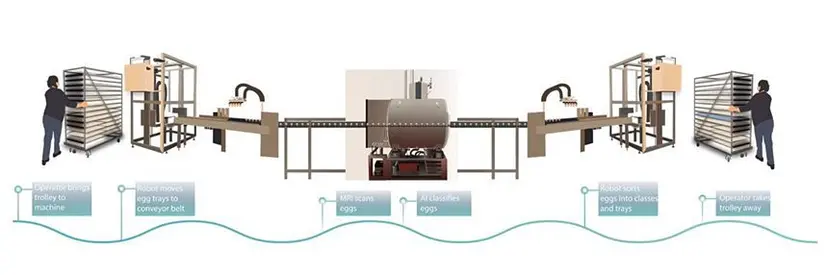
Until now, because the sex of unfertilized eggs could not be known, producers had to wait until hatching and then use chick sexing to selectively raise only the required gender. Orbem detects the fertilization status of eggs before hatching and helps separate eggs that would hatch into male chicks to be used as commercial eggs before they hatch.
Orbem’s technology plays a crucial role in fundamentally solving the problem of male chicks being killed after hatching. Currently, about 7 billion male chicks are sacrificed worldwide shortly after hatching each year because they cannot lay eggs and have low economic value as broilers. While there has been constant criticism of this inhumane practice, there has not been a solution that satisfies the poultry industry from an economic perspective—until now.
Following Germany, France has also enacted a law banning chick slaughter, and Spain is considering similar legislation. Due to regulations, the poultry industry has been seeking better alternatives with scholars and research institutes in various fields for years. In this process, Orbem’s AI technology has gained attention.
Orbem was founded in 2019 as a spin-off from the world-renowned Technical University of Munich. The company developed ideas that began as lab-based research and development activities into a business concept.
By utilizing AI technology to scan eggs and identify the chick's sex in one second, and using MRI technology to non-invasively analyze the embryo inside, they identify and remove male embryos before hatching, reducing unnecessary loss of life. Furthermore, they are exploring a new field: scanning and sorting nuts to classify deformed, discolored, or spoiled fruit.
One of the success factors for Orbem is its strategic partnership with Vencomatic Group, a Dutch company founded in 1983 that specializes in managing poultry and egg production operations in Europe, to design the entire process required for egg sexing together. This partnership with a solid mid-sized company has made it somewhat easier to enter the European poultry market.
AI Startups Utilizing Large Language Models (LLM)
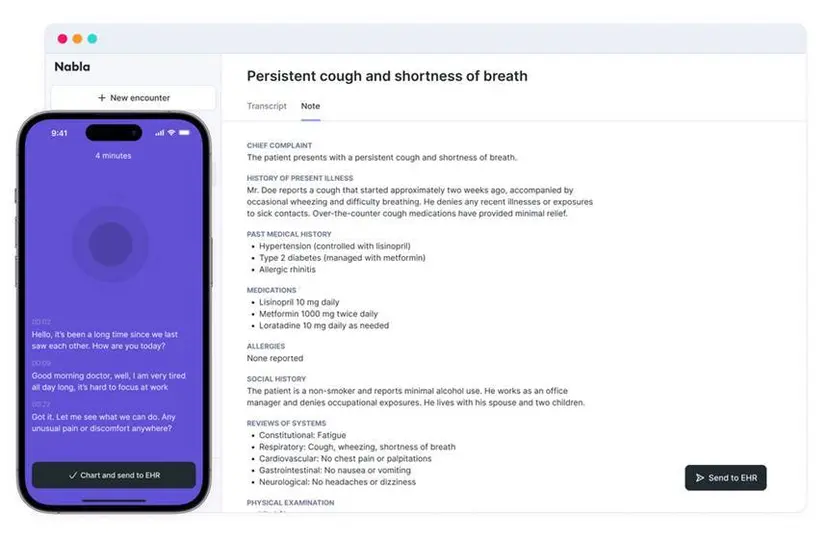
Nabla, a startup based in Paris, France, is contributing to reducing the time doctors spend on administrative tasks through an AI assistant in medical settings. This AI assistant records conversations between doctors and patients in real-time and automatically generates notes, helping doctors devote more time to patient care. This approach is called "ambient AI," meaning the AI is "there like the air or the environment, but feels like it isn't there."
Nabla was founded in Paris in 2018 and secured $24 million in a Series B funding round in January of this year. Considering English speakers as their top target group, this funding is specifically intended to accelerate their expansion into the US market.
The operating principle is as follows: Nabla's note-taking tool, Nabla Copilot, is installed on a doctor's computer as a web, app, or Chrome extension to record voice-based consultations with patients. Afterward, medical records are generated automatically without the doctor needing to record or input information manually.
To implement these features, Nabla uses off-the-shelf speech-to-text APIs developed by Microsoft and the Whisper model developed by OpenAI. The principle is to use GPT series Large Language Models (LLM) to convert the recordings into summarized clinical notes. To protect personal privacy, audio and summarized records are not saved unless the doctor and patient provide explicit consent.
On average, doctors spend 40% of their workday writing consultation notes. Nabla’s great advantage is its ability to reduce this administrative time by more than half. Due to this benefit, Nabla Copilot attracted 20,000 users within 10 months of its launch. Those 20,000 users have already utilized the service for 3 million consultation records.
Based on these records, all necessary information, from consultation content and patient medical history to prescribed medications/tests, can be managed systematically. The platform also generates prescriptions and advice content to provide to patients. It is also equipped with a PDF generation and storage feature to deliver this content directly to patients.
The investment secured this year is planned to be used not only for US expansion but also to launch additional language options for speakers of other languages. As the Korean language function continues to develop in not only ChatGPT but also translators like DeepL, the launch of Nabla for Korean doctors and patients is also anticipated.
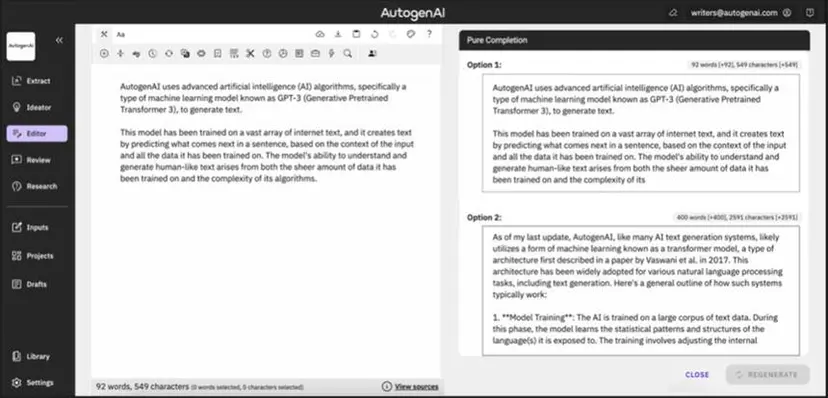
AutogenAI, a London-based startup, automates the process of writing public contract bidding proposals, significantly reducing repetitive and tedious work. The company utilizes AI models like GPT-4 to provide customized solutions tailored to customer requirements. They specialize in analyzing RFPs for bidding proposals and crafting proposals that meet regulations and requirements. By using the Smart Bid feature, they can even create strategic messaging that increases the success rate of bids.
AutogenAI CEO Sean Williams emphasized that their technology is specialized for solving specific problems, stating, "If OpenAI provides the electricity, we provide the power drill." He stated that through large language models, there will be more specialized AI technologies rather than simple AI chatbots or general AI solutions.
Founded in London in 2022, AutogenAI expanded its business to the US at the end of 2023 to create solid use cases in English-speaking countries first. Simultaneously, in December 2023, they successfully closed a $39.5 million Series B round led by Salesforce Ventures, the investment arm of global enterprise software company Salesforce, and Spark Capital, a San Francisco-based VC specializing in software and media, paving the way for their US expansion.
CEO Sean Williams is a serial entrepreneur who previously founded and operated a company that designed and managed large-scale public service contracts in the UK and abroad. His previous company was a successful venture with revenue exceeding 75 million pounds and employing over 900 people directly or indirectly. Based on this experience, he developed the idea for AutogenAI, where AI could professionally support the public bidding process, and embarked on the path of a startup founder.
How to Live Longer and Healthier with AI
Richard Skaife, co-founder of the UK and Malta-based startup Blēo, emphasizes that basic healthy habits like healthy eating, exercise, and quality sleep are the keys to longevity. Blēo combines wearable devices that monitor a user’s sleep quality, blood pressure, and step count with an AI chatbot to provide personalized health coaching. This health coach operates based on a custom AI model developed by the Blēo team and helps users make healthier decisions.
Blēo is a wearable watch brand from The Longevity AI, which provides various health coaching for longevity. The Longevity AI has developed not only Blēo but also apps that coach users to pursue a longevity-focused lifestyle. The Longevity AI and Blēo were created with funding from Longr, a venture builder based in Newcastle specializing in the healthcare sector. Longr co-founds and invests in early-stage startups developing medical services, drug development, and digital healthcare solutions.

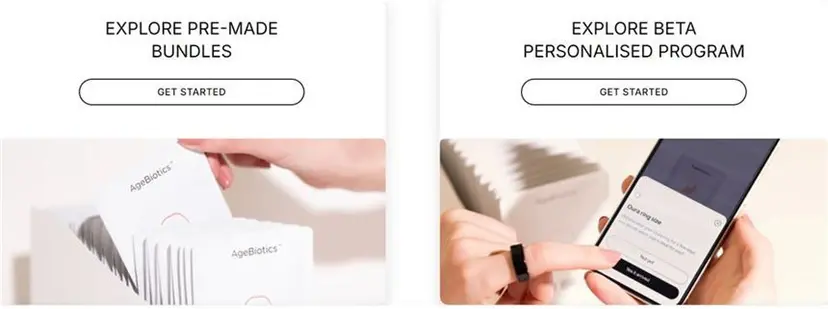
Another interesting example is Ani Biome from Croatia. This company provides supplement plans that optimize the gut microbiome to reduce inflammation and strengthen immunity. When users regularly scan and send photos of their tongues using a smartphone camera, a computer vision model analyzes the white coating, swelling, and teeth marks on the tongue to assess gut health status. Based on this information, it provides a personalized analysis of the user’s physiological and emotional state and recommends individually optimized supplements accordingly.
Users can purchase 30-day supplements through a simple diagnostic on the Ani Biome website or use a monthly or annual subscription service. Ani Biome is a startup that started in Zagreb, Croatia, in 2022, offering individually optimized fermented nutritional supplements based on AI algorithms.
Having received about 3.3 million euros in funding from EIT Climate-KIC, one of Europe's largest funds, and angel investors, they are supplying products to the US and the EU.
Startups like Blēo and Ani Biome clearly show how AI can contribute to improving human health and extending life expectancy. However, startups that present a blueprint for living a better life through preventive healthcare and personalized treatment are sometimes regarded as less important than those providing urgent medical technologies for infections or fractures. But even if it is not an urgent disease that requires visiting a hospital and receiving a doctor’s prescription every day, AI's help might be even more desperately needed in areas that require consistent daily management.
The cases examined above well illustrate how AI can improve human life. Technological advancement often brings both fear and anticipation simultaneously. Concerns remain that AI could replace human jobs or lead to risks such as privacy infringement and data misuse. Yet, at the same time, AI is positioning itself as a tool that allows humans to solve problems that were previously unsolvable and to pursue a better life. Like Orbem’s chick sexing technology, AI has the potential to improve ethical issues and positively change human life. It is exciting to see how AI will make our lives better in the future.
The author, Eunseo Lee, majored in law in Korea and studied theater in Berlin. She is based in Berlin, a city of art and a European startup hub, and leads 123factory, which connects the Korean and German startup ecosystems while growing alongside the city.