

[비즈한국] Amid growing calls to strengthen fire safety systems in multi-use buildings following a recent lodging facility fire in Bucheon, Gyeonggi Province, it has been confirmed that 65% of older apartment complexes in South Korea lack automatic fire suppression systems, or sprinklers. Most of these complexes were built before sprinkler installation regulations were tightened, leading some to argue that these requirements should be retroactively applied to prevent fire damage.
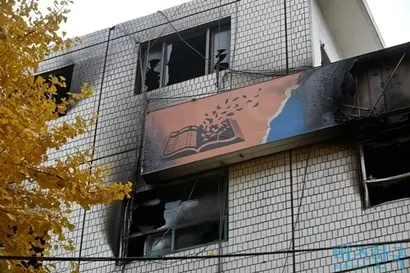
An analysis of data from the National Fire Agency’s National Fire Information System by Biz Hankook shows that there have been 3,242 fires in apartment complexes so far this year (as of the 26th), resulting in 390 casualties (39 deaths and 351 injuries). The number of fires in apartment complexes has been on the rise over the past three years: 4,869 cases in 2023 (58 deaths, 526 injuries), 4,577 in 2022 (72 deaths, 476 injuries), and 4,399 in 2021 (67 deaths, 531 injuries). Apartment complexes, where multiple households live in one building, are the most frequent sites of indoor fires as classified by the National Fire Agency.
In South Korea, sprinkler installation is mandatory for buildings six stories or higher, including apartment complexes. Under the Fire Service Act, the requirement for sprinkler installation was first established in July 1990 for "floors 16 and above in apartment complexes with 16 or more stories." This was later expanded in May 2004 to "all floors of buildings 11 stories or higher" and in June 2018 to "all floors of buildings six stories or higher." Consequently, buildings constructed before July 1990, or those built later but failing to meet the height requirements, were under no obligation to install sprinklers.
In reality, 65% of South Korea's older apartment complexes currently do not have sprinklers. According to data obtained by Representative Yang Bu-nam of the National Assembly's Public Administration and Security Committee from the National Fire Agency, out of 44,208 older apartment complexes built before 2004, only 15,388 (35%) have installed sprinklers, while the remaining 28,820 (65%) lack such equipment. The majority of these complexes without sprinklers (23,578, or 53%) were built after July 1990.
Fires in older apartment complexes without sprinklers often result in significant damage. In December of last year, a fire broke out at around 6:30 a.m. in an apartment complex in Banghak-dong, Dobong-gu, Seoul, causing two deaths and injuring 30 others. The fire took about four hours to extinguish. The apartment, completed in October 2001 with a maximum height of 23 stories, was not equipped with sprinklers, and fire doors intended to prevent the spread of fire were not closed, which exacerbated the damage.
Meanwhile, in cases where apartment fires occur, sprinklers only function as intended about 16% of the time. According to other data provided by the National Fire Agency to Representative Yang Bu-nam's office, among 23,401 fire accidents over the past five years, sprinklers functioned correctly in only 3,656 cases (16%). This fire statistics report includes cases in buildings where sprinklers are not mandatory or minor fires where sprinklers were not triggered, but it is estimated that a significant number of apartment complexes exist where sprinklers failed to operate in situations where they were needed.
Representative Yang Bu-nam pointed out, "Since sprinklers are effective in minimizing the spread of fire damage, we need to explore multi-faceted solutions to narrow the safety blind spot, such as retroactively applying sprinkler installation requirements to older housing and providing financial support."
Kim Hak-joong, Vice President of the Korean Institute of Fire Science and Engineering, added, "Sprinklers are an effective means of suppressing fires at an early stage by spraying water. However, installing sprinkler systems in older apartment complexes involves cost issues, and it could cause inconvenience to residents by lowering the ceiling height by about 60cm. Therefore, it is necessary to first verify whether existing fire compartmentalization and sprinklers are functioning properly."
Sprinklers significantly reduce fire damage. According to research by the National Fire Protection Association (NFPA) in the U.S., when a fire occurs in a building equipped with sprinklers, the civilian death rate and injury rate are 90% and 32% lower, respectively, compared to buildings without them, and the injury rate for firefighters is 35% lower. In 94% of fires in buildings with sprinklers, the fire remained confined to the object or room where it first started, whereas in buildings without them, the fire spread to surrounding areas, dropping this containment rate to 70%.