

[비즈한국] As financial authorities embark on restoring trust and innovating within the insurance industry—often dubbed the "king of complaints"—attention is turning to the current status of complaints among non-life insurance companies this year. A review of the first-half complaint figures disclosed by the General Insurance Association of Korea shows that although disclosure standards were relaxed starting in the second quarter, the number of complaints remains at a level similar to last year.

The insurance industry is the sector where the highest number of financial complaints occur. According to the Financial Services Commission, insurance complaints account for over half of all financial complaints (53% as of 2023), and the average processing time for these complaints has been increasing annually (from 30.1 days in 2019 to 62.5 days in 2023). Industry experts point out that this is largely due to the loss of consumer trust, driven by practices such as incomplete sales stemming from excessive competition among insurers. Typically, non-life insurers face more than twice as many complaints as life insurers, as disputes related to insurance payouts are more frequent.
Consequently, the General Insurance Association of Korea discloses the number of complaints received by non-life insurers every quarter. Here, "complaints" refer to cases filed with an insurer, the Financial Supervisory Service (FSS), or the Korea Consumer Agency via written means (visit, mail, fax) or electronic media (website, email). Duplicate or recurring complaints, simple consultations, and inquiries are excluded from disclosure, and among external complaints filed with the FSS or the Korea Consumer Agency, only those pertaining to "remedy for damages" are included.
Furthermore, since the association changed its complaint disclosure criteria starting in the second quarter of this year, insurance companies have been able to enjoy the "effect" of reduced complaint numbers. According to the new disclosure manual established by the General Insurance Association on June 30, complaints filed with the FSS that are "withdrawn by mutual agreement" or "voluntarily withdrawn" (e.g., voluntary withdrawal by the complainant, transfer, etc.) are no longer counted as subject to disclosure.
However, despite the new criteria, the number of complaints in the first half of this year did not differ significantly from last year. Complaints for non-life insurers in the first half of 2024, tallied under the new criteria, totaled 19,804, which is only a 3.2% decrease compared to the first half of 2023 (20,460 cases) before the disclosure standards were relaxed. According to the Korea Financial Consumer Federation, total complaints for non-life insurers in 2023 fell by 16.7% compared to 2022, making the current decrease minimal by comparison.
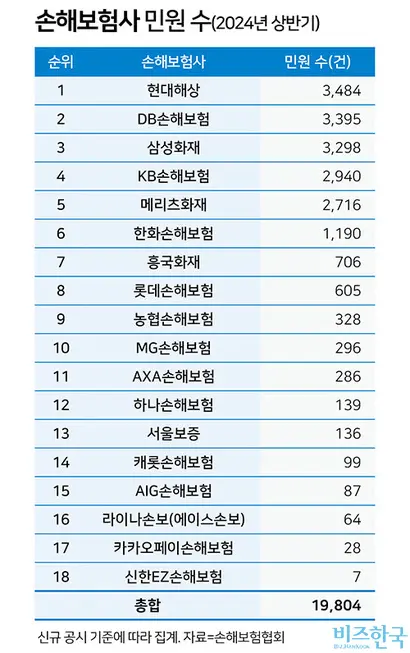
Among non-life insurers, the top three in terms of first-half complaint counts were Hyundai Marine & Fire001450 (3,484 cases), DB Insurance (3,395 cases), and Samsung Fire & Marine000810 (3,298 cases), making them the only three out of 18 companies to exceed 3,000 cases. These three companies also held the top three spots for annual complaints in 2023 (in the order of Hyundai Marine & Fire, Samsung Fire & Marine, and DB Insurance).
Ranking 4th to 8th in first-half complaints were KB Insurance (2,940 cases), Meritz Fire & Marine (2,716 cases), Hanwha General Insurance (1,190 cases), Heungkuk Fire & Marine (706 cases), and Lotte손보 (605 cases), maintaining the same order as the first half of 2023. From 9th place onwards, there were shifts in rankings, such as NongHyup Property & Casualty Insurance (328 cases) replacing MG Non-Life Insurance (372 cases the previous year). Additionally, Kakao Pay General Insurance (28 cases, 17th) was included in the disclosures this year.
The growth rate of complaints from the first quarter to the second quarter was highest for Kakao Pay General Insurance at 267% (from 6 to 22 cases). This was followed by Carrot General Insurance at 25.0% (44 to 55 cases), SGI Seoul Guarantee at 15.9% (63 to 73 cases), and Hanwha General Insurance at 9.1% (569 to 621 cases). In terms of decrease rates, Lotte General Insurance recorded -26.6% (349 to 256 cases), and NongHyup Property & Casualty Insurance recorded -26.5% (189 to 139 cases).
By applying the new disclosure criteria, the first-quarter complaint counts varied by non-life insurer, with a minimum of 0 to a maximum of 190 fewer cases. For the top three companies, the first-quarter complaint counts under the new criteria compared to the previous ones saw a reduction of 190 cases for Hyundai Marine & Fire (from 1,970 to 1,780), 34 for DB Insurance (from 1,721 to 1,687), and 151 for Samsung Fire & Marine (from 1,818 to 1,667).
Meanwhile, as insurance industry complaints have been flagged as a chronic issue, financial authorities have taken action. On May 7, the Financial Services Commission and the FSS launched the "Insurance Reform Conference," gathering stakeholders from academia, related institutions, research organizations, insurance companies, and insurance associations. The goal is to prevent stagnation in the insurance industry, restore consumer trust, and lead industry innovation.
Financial authorities have formed working teams with the industry and academia, organized by key tasks: the New Accounting System Team, Product Structure Team, Business Practices Team, Sales Channel Team, and Future Preparation Team. They have set a goal to hold monthly meetings until the end of this year to implement 10 major promotion strategies and over 60 reform tasks.
At the Insurance Reform Conference held on August 8, plans to enhance insurance industry credibility through complaint resolution were discussed. Financial authorities arranged for disputes such as simple grievances or inquiries filed with the FSS, or complaints unrelated to the policyholder, to be transferred to the Insurance Association, and for a Complaint Processing Committee to be established within the association. To this end, the authorities plan to amend the Enforcement Decree of the Insurance Business Act and the Supervision Regulations on Insurance Business, and to establish an integrated complaint processing computer system between the FSS and the association.
However, financial authorities had previously attempted to pass an amendment to the Insurance Business Act with the same content during the 21st National Assembly, but it failed. The amendment aimed to provide a legal basis in the Insurance Business Act for the Insurance Association to consult on and process general complaints, but it did not cross the legislative threshold and was discarded upon the expiration of the assembly's term.
Controversy over the fairness of the association's complaint handling also remains. The National Policy Committee, which reviewed the previous Insurance Business Act amendment, pointed out, "Considering that the Insurance Association is an organization operated by the contributions of member insurance companies, consumers may raise questions about fairness as there is a possibility that complaints could be handled in a way that favors the insurers." When a similar bill was introduced in the National Assembly in April 2021, the Korea Financial Consumer Federation protested, stating it was "like leaving a cat in charge of the fish."