

[비즈한국] On the 26th, the Rodong Sinmun revealed that North Korean leader Kim Jong-un had inspected yet another new weapon. According to the media, Kim watched demonstrations of two new drones developed by the Drone Institute of the Academy of National Defense Science, accompanied by officials such as Jo Yong-won, Ri Pyong-chol, and Pak Jong-chon.
The report explained that the drones displayed in this test are of two different types; while they differ in range and altitude, they share the characteristics of suicide drones—or loitering munitions—capable of attacking ground and maritime targets. In the published photos, all drones were mosaic-processed, obscuring their precise shapes. However, the footage showed one drone striking a target board and another striking a Cheonma-type (T-62) tank modified to resemble the South Korean military’s K2 Black Panther tank.
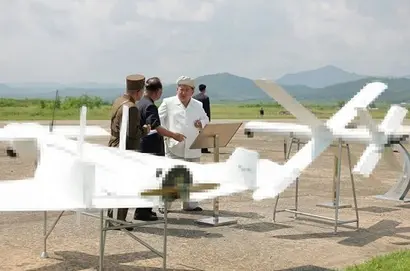
What are the actual capabilities and functions of these newly revealed North Korean drones? First, the fact that the shapes of all aerial vehicles were blurred in the photos allows for speculation regarding their origins and details. Until now, many Open Source Intelligence (OSINT) analysts have been able to conduct technical assessments through the photos, visual angles, and shooting locations of new weapons released by North Korea. Masking the surface finish, component joints, and engine shapes while showing the general forms of the suicide drones appears intended to hide their technological origins.
There are many similar-looking drones from regions like Iran, Russia, and China. However, such minor differences can reveal part sources, manufacturers, and specifications. It is highly likely that a significant portion of these drone airframes were purchased from manufacturers in countries like China rather than being developed entirely in-house. Kim Jong-un’s remark during the inspection—that "combat application tests should be conducted more intensively to quickly supply them to the People’s Army"—adds weight to this assumption. It is presumed that they rushed to reveal early-stage tests because the systems are not yet complete and parts were hastily imported or transplanted from abroad.
What about the shape and size of the drones? The first to note is the 'Harpy NG-type drone.' Some media outlets claim this drone is similar to Iran's Shahed-136, but this is factually incorrect. The biggest difference between the Shahed and the North Korean 'Harpy NG-type' is the 'wing.' The Harpy NG is an upgraded version of the Harpy drone developed by Israel's IAI, which is also operated by the South Korean military. The difference from the original version is the change in wing geometry. A secondary wing called a canard was added to the nose, and the simple triangular delta wing was changed to a double-delta wing, where the two sides of the triangle are bent once more. This increases flight stability and extends the range compared to the older Harpy or Shahed drones. North Korea did not simply copy the Shahed.
Additionally, the presence of two foldable antennas where the fuselage meets the wings is a characteristic identical to the Harpy NG. Given the circular fairings on the wings and nose, it can be inferred that North Korea's new drone possesses Suppression of Enemy Air Defenses (SEAD) capabilities like the Harpy NG. It may not just attack by aiming at the enemy with a camera, but could potentially locate active radars using radio frequency sensing.
However, in this test, the Harpy NG-type drone struck a target with a white crosshair on a black board at an angle. This suggests that in this specific test, the drone used an Electro-Optical/Infrared (EO/IR) seeker rather than radio frequency tracking.
The other type of drone unveiled is identical in shape and form to the 'HERO-400' by Israel's UVision. While some have pointed out similarities to the Lancet-3 drone from Russia's ZALA, the tail wing and main wing dimensions are different; more importantly, the shape, aspect ratio of the main wings, and the length-to-width ratio of the fuselage are very similar to the HERO-400.
The HERO-400 is an attack drone that uses an EO/IR seeker to strike armored targets. North Korea released footage of this drone performing a vertical strike on a Cheonma-ho (T-62) tank dressed up to look like a K2 tank. The top-attack method is a necessary capability when attacking targets with heavy frontal armor, such as tanks. However, a slow-moving suicide drone can execute this with manual pilot control even without sophisticated software. Unlike the Harpy NG-type mentioned earlier, which is engine-powered, this drone is highly likely to be powered by batteries and motors due to its design.
The HERO-400 drone has eight wings in total, with four main wings and four smaller tail wings arranged in an X-configuration. Four main wings provide better lift than two, and this configuration offers better flight stability at various angles compared to a conventional two-wing aircraft. However, it also has the disadvantage of increased weight. It is assumed this design was adopted for tasks like vertical attacks.
Another feature of the HERO-400 is that it is 'canister-launched.' The drone is sealed inside a cylindrical canister and launched using compressed air, allowing for operation in confined spaces. Being safely protected within the canister allows it to be carried by individuals, such as special operations forces. This is different from the Harpy NG-type, which takes off using a rocket. It suggests that the drone could be used not only for destroying tanks but also in decapitation operations, where special forces infiltrate enemy lines to attack command vehicles.
Another characteristic of the two drones is that they seem strongly aware of domestic drones developed by the Agency for Defense Development (ADD). For instance, the Harpy NG-type corresponds to the S-2 drone developed by the ADD, while the HERO-400 type corresponds to the S-4. The white fuselage with only the seeker gimbal painted black also appears to mimic the style of our ADD drones. Unveiling a long-endurance drone and a canister-type drone together, and having both drones share the same gimbal seeker, is also similar to the ADD's drone development path.
Just because North Korea mimicked Israeli drones and unveiled models with roles similar to our ADD drones does not mean they possess drone technology at the level of Israel or South Korea. Drone technology is just as dependent on communication technology as it is on flight mechanics. During this demonstration, North Korea did not show the part where the video detected by the drone is transmitted to the pilot, suggesting that their new drones may be equipped with communication systems using civilian-grade drone technology.
The antennas visible on the two drones are not military communication antennas using encrypted technology, but rather the long antennas used for common walkie-talkies. Long-range encrypted communication technology for real-time video transmission—essential for military drones—is not easily acquired.
Regardless, our military must respond to the mass production of North Korean suicide drones. While the suicide drones revealed by North Korea are much larger than ultra-small FPV drones or DJI drones, making them easier to detect, they also have longer range and greater destructive power. Rather than relying solely on drone jammers, which are currently being researched, we must also consider physical attacks, such as interception via autocannon fire.
Next-generation tanks and armored vehicles around the world are attempting to incorporate autocannons—such as 30mm chain guns or 20mm cannons—to address these threats. We should consider mounting 30mm chain guns, like those on the AH-64 Apache, or modified 20mm cannons from the LAH-1 light attack helicopter onto our next-generation tanks or armored vehicles via Remote Controlled Weapon Stations (RCWS). Furthermore, it is critical that we detect and preemptively strike such attack drones in advance.
The Agency for Defense Development is currently developing the 'FireEagle' suicide drone, utilizing technology from the Cheongeom anti-tank missile, which is well-suited for such missions. Unlike North Korean suicide drones, the FireEagle, which is operated from helicopters, can perform both reconnaissance and attack missions. Moreover, it features an Automatic Target Recognition (ATR) capability found in the Cheongeom missile, meaning it has automation functions. This means we can find and attack North Korean suicide drones first. I hope our military finds the best way to deal with the North Korean drone threat.