

[비즈한국] How many planets in our solar system have liquid lakes and seas on their surface? Just Earth? That is not the case. There is one more: Titan, the largest moon orbiting Saturn. Like Saturn itself, Titan is hidden beneath very thick clouds. For a long time, the world hidden within those clouds remained a secret.
In 2007, as the Cassini spacecraft passed by Saturn and Titan, it used radar observations to confirm the true nature of the world hidden beneath the clouds. Surprisingly, there were lakes and seas of various sizes on Titan’s surface, much like on Earth. Of course, being far from the Sun, Titan's temperatures are much lower than Earth's, averaging -179 degrees Celsius. Naturally, it is cold enough to freeze water solid. The primary components filling the lakes and seas on Titan's surface are not water, but hydrocarbons such as ethane and methane. Interestingly, because it is so cold, chunks of frozen water ice act much like rocks do on Earth.
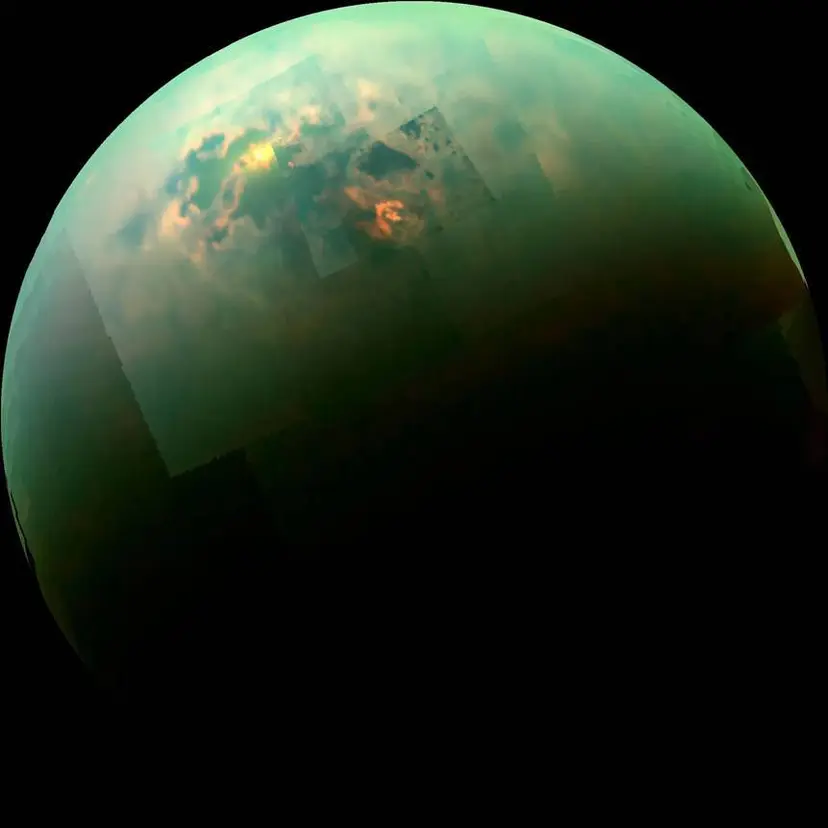
At the time, Cassini primarily mapped the area around Titan's north pole. The largest lake identified on Titan's surface covers an area of 500,000 square kilometers, which is larger than the Caspian Sea, the largest inland sea on Earth. This massive lake was named after the legendary sea monster, Kraken.
If such vast lakes and seas exist on Titan, one question naturally arises: Do waves crash in Titan's lakes and seas as they do on Earth? Does this wave action cause weathering and erosion that changes Titan’s terrain? In the not-too-distant future, could humans visiting Titan enjoy surfing on methane seas?
Until quite recently, the existence of waves in Titan’s lakes and seas was a subject of intense debate. In the photo above taken by the Cassini spacecraft, a very bright spot can be seen on one part of Titan’s surface. This was a moment captured when sunlight reflected off the surface of a liquid lake! The lake that reflected the sunlight at the time was Jingpo Lacus, a small lake attached to the western edge of the massive Kraken Mare. It was named after Lake Jingpo in China. Based on such observations, astronomers previously assumed that the surfaces of Titan’s lakes were as smooth as mirrors, speculating that, unlike Earth’s lakes, they would not have large, rolling waves.
To date, Cassini is the only exploration mission to have observed Saturn and Titan in close detail. Furthermore, the Cassini spacecraft ended its mission on September 15, 2017, by diving into Saturn’s thick clouds. The images of Titan captured by Cassini are all the high-resolution data humanity has acquired thus far. Moreover, it is difficult to determine whether waves truly exist in those surface lakes based solely on blurry images from the spacecraft's camera.
So, how can we confirm if waves are crashing in Titan’s lakes? In this study, astronomers focused on a different area: not the surface of the lakes themselves, but their edges—the shorelines.
On Earth, coastlines and lakeshores undergo weathering and erosion as waves gradually wear down the terrain and change its shape. If large waves are being continuously generated in Titan's lakes, the action of those waves could also change the shape of Titan's shorelines.
Astronomers assumed three models to recreate the shapes of the shorelines of Kraken Mare and Ligeia Mare, which had been identified by the Cassini mission. The first was a model where no weathering or erosion occurs. The second was a model where erosion occurs uniformly at a constant rate across the entire shoreline, as water seeps into Titan’s icy surface. The third was a model where the shoreline is worn away irregularly through physical erosion caused by crashing waves. They compared which of these three models best reproduced the actual shape of Titan’s shorelines.
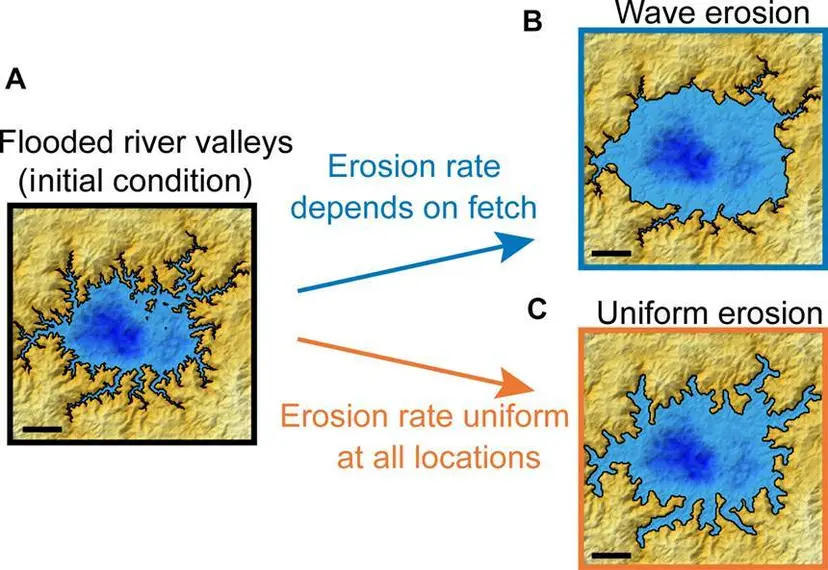
In particular, comparing the results of the latter two models—which differed in how the shorelines were eroded—reveals an interesting difference. Assuming uniform erosion occurs across the entire shoreline—which initially had a jagged, winding shape—nearly all areas are worn down smoothly and uniformly regardless of location. Only the promontories (headlands) that jut into the lake tend to retain their form without being significantly eroded.
In the model where waves are assumed to be directly eroding the shoreline, a clear difference emerges. Areas where the land is exposed as it stretches into the lake experience a high influx of liquid pushed by waves, causing those shorelines to be worn down much more noticeably and smoothly.
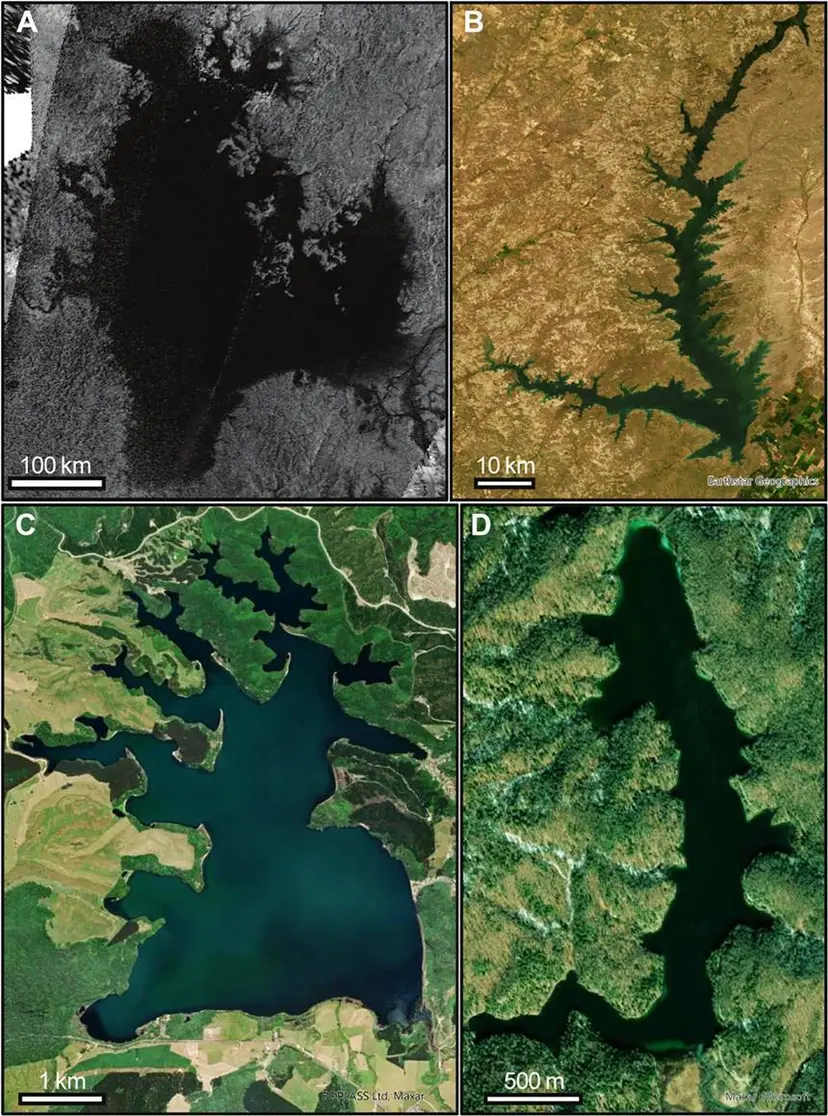
On the other hand, in areas like narrow river channels where the lake penetrates deep into the land, the influx of liquid pushed by waves is not as significant. As a result, the shorelines in these areas do not erode smoothly and retain their original shape for a long time. Consequently, while the wide shorelines change smoothly, the narrow, winding river-like boundaries that stretch in various directions retain their original sharp and complex edges. This makes Titan’s lakes look somewhat like a "Flying Spaghetti Monster," with thin strands branching out in all directions.
Interestingly, when compared to the shapes of various lakes actually identified on Titan's surface, the model assuming the presence of waves best reproduces the observed results. Through this analysis of Titan’s shorelines, astronomers have provided indirect evidence that large waves are likely crashing in Titan’s lakes.
This discovery suggests that even if the primary component filling the lakes is not liquid water but rather methane, wind blows on Titan just as it does on Earth, creating waves that ripple across the lake surfaces. In other words, we can now more clearly answer the age-old question of whether similar phenomena to those on Earth's oceans and lakes occur on other celestial bodies if they possess liquid-filled seas and lakes.
The existence of waves is a crucial basis for estimating the ecology of Titan’s lakes. Physically, waves can play a role in better mixing materials from the lake surface with those in the deeper layers. As utilized in this analysis, they cause erosion that changes the terrain of shorelines and coasts, which can create geological opportunities for diverse ecosystems to thrive in varied environments. Furthermore, this process can assist in chemical actions where chemical components that had settled and accumulated on Titan’s continents are broken down by waves and dissolved into the lakes and seas. In essence, waves are a process that stirs the surrounding ecological cocktail into something more diverse and beautiful.
If we were to sit on the shore of a lake on Titan, we would be able to see the waves of the lake rippling beneath the thick, low-hanging clouds of methane. We would also be able to see the rocks and ice on the cliffs of the shoreline being gradually worn away as they collide with those waves. Titan, once thought to be merely one of the small moons orbiting Saturn, is a stage for a geological history as beautiful and complex as Earth’s.
The Cassini mission went beyond simply passing by Titan; it also deployed a lander to drop into Titan’s clouds. The Huygens probe, separated from Cassini, became the first in human history to land on the surface of a moon—not even a planet—outside of Earth. Having safely passed through the thick clouds, the Huygens lander unveiled the true appearance of Titan’s hidden surface.
The surface of Titan, viewed directly through the Huygens landing, was startling. The methane filling Titan’s atmosphere and lakes became the basis for higher expectations regarding the possibility of extraterrestrial life. While excessively high methane levels can be toxic to Earth-based life, methane is also a major byproduct left behind by the biological activities of Earth's organisms. Perhaps the existence of the methane that fills Titan is the trace of the "exhalations" of extraterrestrial life potentially hiding there.
Astronomers hope that Titan, like the icy moons Europa and Enceladus orbiting Jupiter and Saturn, hides a more massive ocean filled with liquid water beneath its frozen icy surface. Based on analyses of Titan’s density, there is a possibility that a massive subsurface ocean exists, potentially accounting for 40-60% of Titan’s entire volume. If this speculation is true, the total amount of liquid ocean contained within tiny Titan could be six times greater than the total amount of ocean water on Earth’s surface. From an astrobiological perspective, Titan is a coveted destination that must be visited.
With the mission of Cassini, the only probe to orbit Saturn, coming to an end, there is currently nothing near Saturn. The history of Saturn exploration has hit a temporary pause. Astronomers are preparing new missions to examine Saturn and Titan more deeply. The Huygens lander that Cassini carried simply ended its journey by deploying a parachute and falling slowly through Titan's clouds. Since it had no wheels or similar mechanisms, it was technically more of a crash than a landing. It remained where it landed, allowing only the immediate, narrow area to be observed.
However, the next-generation Titan mission, the Dragonfly mission, planned for launch around 2030, is quite special. It is a mission to fly a drone equipped with propellers to explore various parts of Titan, examining its lakes and skies directly. Through the previous Perseverance mission to Mars, astronomers have already succeeded in flying a drone on a celestial body other than Earth! Building on this experience, they now dream of a drone that flies through Titan’s sky like a dragonfly, true to its name.
Come to think of it, flying on Titan is in some respects easier than on Mars. Mars has a very thin atmosphere, with only 1/100th of the atmospheric pressure of Earth, making it difficult to obtain sufficient lift even by spinning propellers. In contrast, Titan is covered by a very thick atmosphere. Therefore, it is easier to achieve lift and fly there than on Mars. If the Dragonfly mission succeeds in the near future, we will truly be able to confirm the sight of the rippling waves on Titan’s lakes.
Reference
https://www.science.org/doi/10.1126/sciadv.adn4192
Who is the author, Woong-bae Ji? He loves cats and the universe. After watching 'Galaxy Express 999' as a child, he developed a dream of sharing the beauty of the universe. Currently, he researches galaxy evolution through galactic interactions at the Center for Galaxy Evolution Research and the Cosmology Laboratory at Yonsei University. He is also active in various science communication activities, including lectures and writing. He has authored books such as 'Astronomy While Flirting', 'Thinking About the Universe All Day', and 'Stars, the Science of Light'.