

[비즈한국] The name 'Bangbae-dong' is known to have originated from the geographical characteristics of the area. 'Bangbae (方背)' combines the characters for 'square (方)' and 'back (背)', derived from a terrain that appears enclosed on all sides—essentially being surrounded by mountains. Because the Bangbae-dong area was situated beneath mountain foothills since the Joseon Dynasty, the name was given to describe a landscape surrounded by mountains, as if turning one’s back on the world.
As Bangbae-dong remained largely undeveloped for a long time, maintaining its natural terrain and agricultural character, it is understood that residents adopted place names based on these geographical features. Even today, there are many green spaces around Bangbae-dong, such as Seoripul Park, which helps maintain some of these original geographical characteristics.
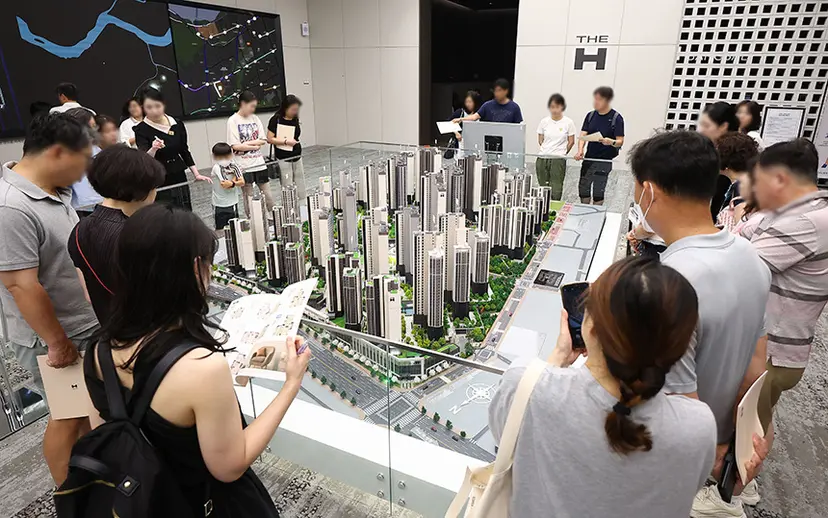
During the Joseon Dynasty, the Bangbae-dong area was an agricultural region south of the Han River, primarily belonging to Sindon-myeon, Siheung-gun, Gyeonggi-do. Much like the current Gangnam area of Seoul in general, the Bangbae-dong area was centered around farming at the time. Even during the Japanese colonial period, Bangbae-dong remained an agricultural area without any significant development. Even after liberation in 1945, Bangbae-dong maintained its rural landscape without major changes.
With the administrative reorganization in 1962, Bangbae-dong was incorporated from Siheung-gun, Gyeonggi-do, into Yeongdeungpo-gu, Seoul. Development gradually began thereafter, but it remained an area where agriculture and residential life coexisted.
Bangbae-dong today is closely linked to Seoul's administrative reorganization and the development of Gangnam. As part of the city's reorganization, Bangbae-dong was placed under the newly established Gwanak-gu, and it was during this period that the development of Gangnam gained momentum, bringing winds of change to Bangbae-dong as well. In the mid-1970s, development in Bangbae-dong began relatively early compared to other neighborhoods in the Gangnam area. The basic residential framework of Bangbae-dong was formed between 1972 and 1985 through the Isu (South Seoul) Land Readjustment Project and the Isu Additional District Land Readjustment Project.
In 1988, when Seocho-gu was separated from Gangnam-gu in Seoul, Bangbae-dong became part of Seocho-gu. Subsequently, it developed into one of the central residential areas of the district. During this period, large-scale apartment complexes began to emerge, and high-end residential areas were established. These changes were part of the broader Gangnam development.
By the 1990s, Bangbae-dong had established itself as one of the representative residential areas of Gangnam, gaining attention for its quiet and pleasant living environment. In particular, the area around Bangbae Bon-dong developed into an affluent residential district. Before the school district realignment in 1998, Bangbae-dong belonged to School District 9, but was later included in School District 8, further intensifying the fervor for education.
In the 2000s, Bangbae-dong maintained its popularity as a Gangnam residential area, and the reconstruction of detached housing proceeded actively. New apartment complexes such as Lotte Castle Arte and Bangbae Art Xi emerged, modernizing the living environment. Even today, reconstruction and redevelopment continue in Bangbae-dong, leading to improvements in the residential environment and an increase in luxury housing.
Bangbae-dong boasts excellent accessibility to the Gyeongbu Expressway and major arterial roads in Seoul, and is a transportation hub served by subway lines 2, 4, and 7. Additionally, the commercial districts near Isu Intersection and Naebang Station contribute to high residential convenience.
Bangbae-dong remains one of Seoul's key residential areas, maintaining a high level of preference alongside a quiet and comfortable living environment. A mix of traditional housing and modern apartment complexes, Bangbae-dong is known as an affluent village in Seoul and continues to evolve through ongoing reconstruction and redevelopment.
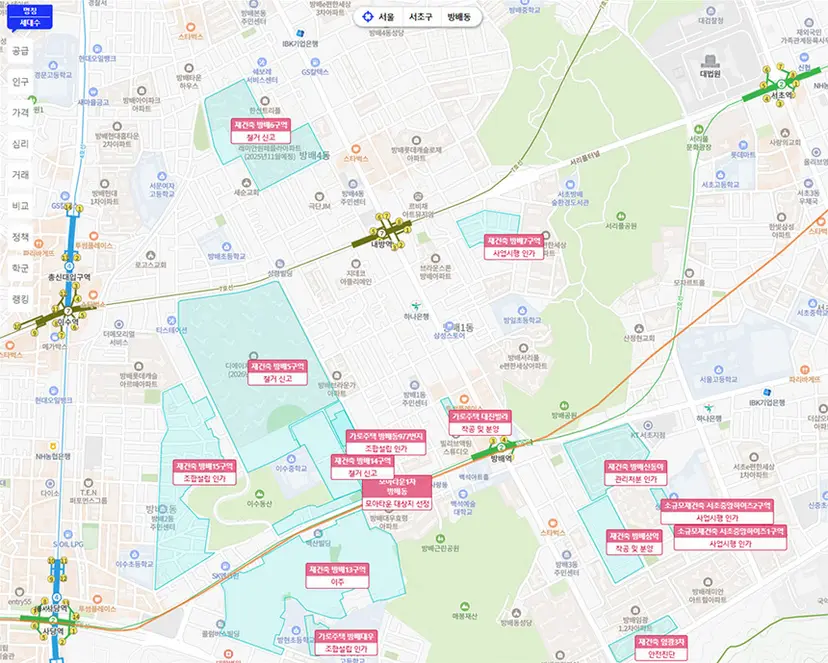
Numerous reconstruction and redevelopment projects are currently underway in Bangbae-dong. Large-scale reconstruction projects are actively progressing in Bangbae Zone 5, Zone 6, and Zone 13, and these projects are transforming Bangbae-dong into an even more upscale residential area. In particular, the arrival of high-end brand apartments such as 'THE H Bangbae' is expected to significantly improve the residential environment of the neighborhood.
Since the opening of the Seoripul Tunnel, Bangbae-dong's transportation accessibility has greatly improved. This has made it more convenient for the neighborhood to be part of the Gangnam living sphere, enhancing its value as a residential area. If transport infrastructure improvements continue, it is highly likely that residential preference for Bangbae-dong will increase further.
The business facility development plan is also noteworthy. The plan for an office town on the former site of the Defense Security Command in Seocho-gu, also known as the Seoripul Park MDM (developer) plan, is set to create a new hub for the Gangnam area of Seoul. The site is approximately 96,797 square meters, larger than the Global Business Center (GBC) in Samseong-dong, Gangnam-gu.
According to the main development contents, the plan is to create a high-tech business complex. The southern part of the site aims to attract high-tech research facilities and companies related to the 4th Industrial Revolution, such as blockchain, big data, and bio-tech, with the goal of developing it into a high-tech industrial cluster representing the Gangnam area of Seoul. A large art museum and other cultural/complex facilities will be built on the northern site, alongside public land. This reflects a plan to develop it not just as a workspace, but as a complex space where culture and nature harmonize.
This office town will be a 'forest-adjacent' office complex, surrounded by Seoripul Park, which acts as the lungs of Gangnam, where nature and work spaces blend together. It aims for a workspace where high-tech and nature coexist, modeled after places like Apple Park in Silicon Valley, USA.
A total of 2.3 trillion won is being invested in the project, and this development is considered a key project leading the growth of Seocho-gu, which is expected to significantly strengthen the urban competitiveness of the Seocho-dong and Bangbae-dong areas.
In summary, the real estate value of Bangbae-dong is set to rise significantly within the next few years. This will be driven by the progress of reconstruction projects, improvements in transport infrastructure, the large-scale high-end office town, and its transformation into a luxury residential area. In particular, it is highly likely that Bangbae-dong will establish itself as the new richest neighborhood in the Gangnam area within the next 10 years.
Kim Hak-ryul, head of the Smart Tube Real Estate Research Institute, known by his pen name 'Pasyong', previously served as a team leader at the Real Estate Research Division of Gallup Korea. He manages and hosts the Naver blog 'Pasyong's World Tour' and the YouTube channel 'Stu TV'. He is the author of books including 'Absolute Principles of Seoul Real Estate (2023)', 'The Future of Incheon Real Estate (2022)', 'Kim Hak-ryul's Absolute Principles of Real Estate Investment (2022)', 'Future Map of South Korean Real Estate (2021)', 'Only Places That Will Rise, Rise From Now On (2020)', and 'South Korean Real Estate User Manual (2020)'.