

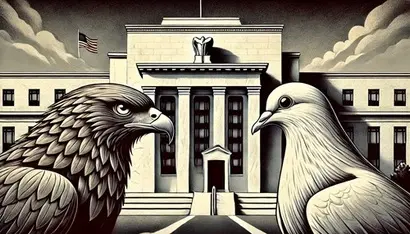
[비즈한국] Jerome Powell, Chair of the U.S. Federal Reserve, announced at the annual economic policy symposium in Jackson Hole, Wyoming, on the 23rd (local time) that "the time has come for policy to adjust." Consequently, an interest rate cut at the Federal Open Market Committee (FOMC) meeting scheduled for the 17th–18th of next month is now considered a foregone conclusion.
Chair Powell also left the door open for a "big cut" (a 0.50 percentage point rate cut). He stated, "The direction is clear, and the timing and pace of rate cuts will depend on incoming data, the evolving outlook, and the balance of risks." As investors felt that the uncertainty surrounding the Fed had been resolved for the time being, New York stock indices, as well as international oil prices, gold prices, and Bitcoin, all rose simultaneously.
As a result, investors' attention is shifting to the next set of variables. Recent factors expected to influence investments include Nvidia's earnings report on the 28th and the U.S. presidential debate scheduled for the 10th of next month. Kim Young-hwan, a researcher at NH Investment & Securities, stated, "These variables will determine how quickly tech stocks regain their leadership and when trading for beneficiaries of the new U.S. administration's policies will begin."
In particular, the U.S. presidential election in November is a critical variable in gauging investment direction. This is because beneficiary sectors and companies may differ depending on the policies of Vice President Kamala Harris and former President Donald Trump. As Vice President Harris is challenging to become the first Black female president in U.S. history, the televised debate between the two candidates on the 10th of next month is drawing the attention of not only investors but the entire world.
Before her formal entry into the race, Vice President Harris had been viewed as a "number two with no track record or presence." However, the atmosphere shifted a month after President Joe Biden suddenly announced his withdrawal from the presidential race. Within the Democratic Party, there was a dominant view that Harris was not a competitive "counterpart" to Trump, with even Michelle Obama, wife of former President Barack Obama, being mentioned despite her lack of political ambition. Yet, in just one month, Harris turned a "close-race disadvantage" into a "close-race advantage." Additionally, the addition of vice-presidential candidate Tim Walz, who projects an image of an ordinary, humble "guy next door," is credited with increasing the ticket's competitiveness.
Experts predict high sensitivity to both parties' economic policies leading up to the election. Choi Bo-won, a researcher at Korea Investment & Securities, noted, "Historically, the S&P 500 index has shown sluggish returns before an election when a Democratic candidate is elected, while the index has rebounded after the election regardless of who wins." However, this year has seen unique circumstances, including an assassination attempt, the replacement of the Democratic candidate, and significant fluctuations in approval ratings. Choi remarked, "Following the FOMC and Bank of Japan (BOJ) meetings, vigilance regarding macro indicators has increased," adding, "Policy sensitivity that will affect the economy going forward is expected to be greater than in the past."
Nevertheless, some advise that the current pre-election uncertainty is actually a buying opportunity. According to Shinhan Securities, during the September–October period of the last 10 U.S. presidential elections, the average return (excluding extremes) was -2.1%, with a 50% probability of a rise. Kim Sung-hwan, a researcher at Shinhan Securities, said, "Generally, September and October are seasonally weak for stock prices, and the period ahead of the election is no exception. It seems the uncertainty of not knowing who will become president stimulates this negative seasonality." He further analyzed, "Regardless of which party takes power, the stock market has trended upward starting in November." This rally, known as a "honeymoon rally," typically lasts until May of the following year, with an average return of 10.7% and an 80% probability of rising during that interval. In other words, the period of peak uncertainty just before the election is actually a prime buying opportunity.
Researcher Kim Sung-hwan pointed out, "While the debate over Trump versus Harris is a major topic, statistically, who wins does not hold much significance for investment strategy." He explained, "Of the last 10 presidential terms, the one with the highest profit growth was the Biden administration. This is not because Biden implemented more pro-growth policies than Trump, but because the profits of Big Tech companies were strong." There is always investor concern about who will win and what policies they will implement before the election ends, but once it concludes, the market typically returns to its baseline. Therefore, from an investment strategy perspective, the analysis suggests it is more rational to focus on the fact that the election will eventually end rather than worrying about the winner.