

[비즈한국] In response to the recent surge in real estate prices in Seoul and the surrounding metropolitan area, the government has decided to significantly simplify the procedures for redevelopment and reconstruction projects to increase the supply of apartments in downtown Seoul. Additionally, they plan to create new housing sites by partially lifting development restrictions (greenbelts) in areas adjacent to Seoul and the capital region. Through these measures, the government aims to supply a total of over 420,000 housing units in Seoul and the metropolitan area by 2029. However, despite these efforts, home prices in downtown Seoul are rising rapidly, and with mortgage loans surpassing 800 trillion won for the first time in history, doubts are being raised about whether these measures will be enough to curb the market frenzy.
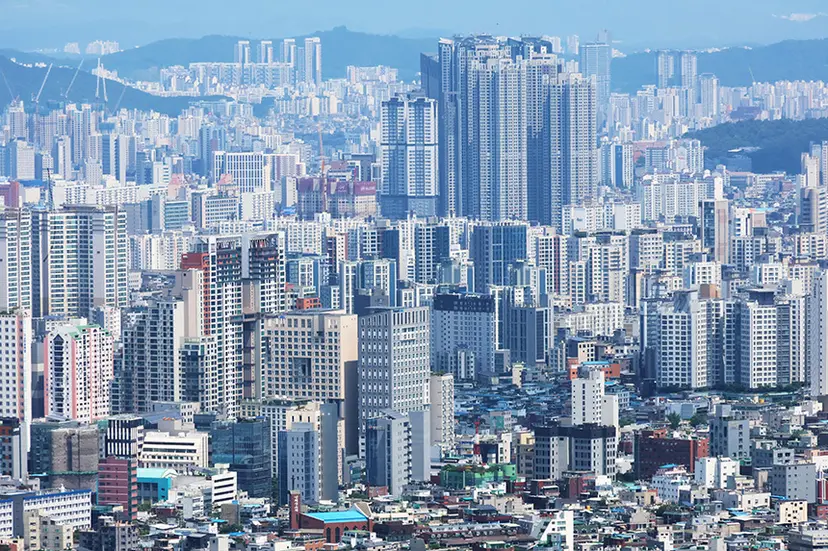
On August 8, the government held a meeting of ministers related to real estate at the Government Complex Seoul and announced the "Plan to Expand Housing Supply for National Housing Stability." The core of the August 8th measures includes lifting greenbelts in areas near Seoul to supply 80,000 new housing units, providing over 110,000 non-apartment units, such as villas, through new construction purchase rentals, and increasing the number of public-purchase rentals for non-apartments from 120,000 to 160,000. These measures mark the fourth set of real estate policies under the Yoon Suk-yeol administration, following those announced on August 16, 2022, September 26, 2023, and January 10 of this year.
While the government has introduced these high-intensity measures to stabilize real estate prices, questions remain about their effectiveness. This is because recent property prices in Seoul are rising rapidly, centered around the city center and areas near the Han River. Furthermore, contrary to the government’s plan for newly built purchase rentals, the market is seeing prices for older villas rise faster than new ones due to a series of jeonse fraud cases. In essence, the government’s measures and market preferences are completely out of sync.
Although the government plans to lift greenbelts in areas near Seoul, price increases in the capital are occurring across both northern and southern districts, primarily in the city center and along the Han River. According to the Korea Real Estate Board, Seoul’s apartment price growth rate in July reached 1.19%, the highest monthly increase recorded. After bottoming out and returning to an upward trend in April with a 0.13% increase, Seoul’s apartment prices have risen for four consecutive months, including May (0.20%), June (0.56%), and July. Notably, the upward momentum is accelerating.
By region, in the north of the Han River, Yongsan-gu recorded a 1.54% increase in July, while Mapo-gu (1.65%) and Seodaemun-gu (1.36%) also showed growth exceeding the Seoul average. In the south, Songpa-gu (2.40%), Seocho-gu (2.14%), and Gangnam-gu (1.44%) posted high growth rates. Most of these high-growth areas are located in the city center or the Han River belt, far from greenbelt zones. This is because these areas are highly preferred for residential living due to their excellent transportation convenience.
Furthermore, while the government has decided to expand new-construction purchase rentals for non-apartments like villas, the market favors older villas over new ones. Looking at the trend in sales prices for row houses and multiplex housing by building age, prices for villas under 10 years old in Seoul rose by 0.14% in July, whereas villas between 10 and 20 years old rose by 0.19%. In the Gyeonggi region, prices for villas under 10 years old fell by 0.08%, while those aged 10 to 20 years rose by 0.05%. Unlike apartments, there is a preference for established villas over new ones. This is because jeonse scams have been concentrated on newly built villas, leading buyers to seek older villas where existing residents reside, which are perceived as relatively safer for transactions.
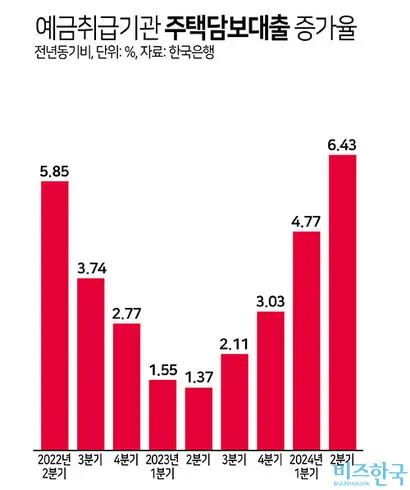
As government measures clash with market conditions, mortgage loans from deposit-taking institutions surged in the second quarter of this year, fueled by rising real estate prices, and surpassed the 800 trillion won mark for the first time. According to the Bank of Korea, mortgage loans from deposit-taking institutions in the second quarter stood at 802.3621 trillion won, a 6.43% increase compared to the same period last year (753.9068 trillion won). The growth rate of mortgage loans from these institutions began to decline after hitting 9.14% in the third quarter of 2021, dropping to 1.37% by the second quarter of 2023. Since then, it has returned to an upward trajectory, with the pace of growth steadily increasing: 2.11% in the third quarter of 2023, 3.03% in the fourth quarter, and 4.77% in the first quarter of this year.