

[비즈한국] As the Russia-Ukraine war drags on, 'cluster munitions' are garnering attention. With the stockpiles of standard ammunition like 155mm shells steadily depleting, interest is shifting toward the efficiency of cluster munitions, which offer significantly greater destructive and lethal power per round. The issue is that cluster munitions are considered inhumane weapons capable of causing massive civilian casualties, leading the United Nations (UN) to completely ban their 'use, possession, and manufacture.'
With environmental, social, and governance (ESG) criteria recently emerging as a critical factor in corporate management, overseas defense firms that once produced cluster munitions have halted their production lines. However, because South Korea remains in a state of armistice with North Korea, it has not signed the UN Convention on Cluster Munitions and continues to produce high-quality cluster munitions. As Eastern European nations near Russia, feeling the threat of war, and Middle Eastern nations facing persistent instability explore the possibility of importing these munitions, attention is turning to whether they will sign export contracts with South Korea.
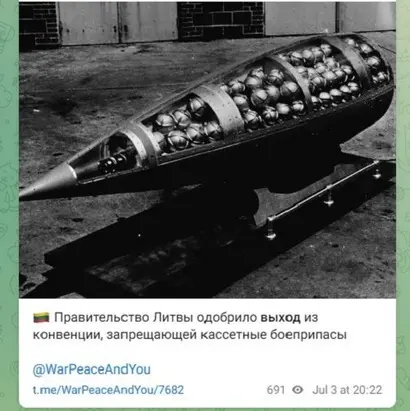
Lithuania, one of the three Baltic states bordering Russia, withdrew from the Convention on Cluster Munitions last month. According to local media, Laurynas Kasčiūnas, the Lithuanian Minister of National Defence, led the withdrawal. Minister Kasčiūnas explained that the withdrawal was due to Russia's invasion of Ukraine and its failure to follow the rules (regarding cluster munitions), while also proposing a joint purchase of cluster munitions to Russia's neighboring countries, including Poland, Latvia, Estonia, and Finland.
The Convention on Cluster Munitions (CCM) is a UN international treaty that strictly prohibits the use, possession, and manufacture of cluster munitions. As of April 26, 2019, 119 countries have joined as member states, with 105 countries having ratified it. 14 countries have signed but not yet ratified the treaty.
Cluster munitions are mass-destruction weapons consisting of hundreds of small submunitions packed inside a single bomb. Because the explosion is dispersed rather than hitting only a specific target, they were favored by many countries in the past for their power to destroy not only armored vehicles but also bunkers. During the 2006 Lebanon War, the Israeli military's use of cluster munitions resulted in many civilian casualties, drawing international condemnation.
Ultimately, in 2010, 38 countries gathered at the UN to officially announce the 'Convention on Cluster Munitions' (CCM), which went into effect in August of the same year. Currently, while over 120 countries worldwide have stated they ban their use, countries currently at war—such as Ukraine and Russia—as well as the United States, Israel, and South Korea have not signed the treaty. However, mindful of international public opinion, the U.S. halted production in 2010 and pivoted toward developing new, alternative types of ammunition.
However, as the Russia-Ukraine war has become protracted, the use of cluster munitions is on the rise again. CNN released footage on the 17th (local time) that appears to show Russian forces being struck by cluster munitions while retreating from the village of Urozhaine in the Donetsk region.
Once Russia began using cluster munitions in this war, Ukraine requested the provision of such weapons from the U.S. Though initially refused, U.S. President Joe Biden eventually approved the support, taking into account Ukraine's counteroffensive operations. American ATACMS missiles equipped with cluster munitions have effectively neutralized Russian air defense networks and air bases. Military experts explain that with ammunition stocks among Ukraine's allies running low, cluster munitions are the only means to supplement Ukraine's firepower. Can Kasapoglu, director of the defense research program at the EDAM think tank in Turkey, emphasized that "cluster munitions have played a significant role in the battlefield situation."
As a result, cluster munitions are back in the global spotlight, and demand is following. In particular, unstable regions in Eastern Europe near Russia and the Middle East are actively expressing interest in these weapons. Currently, export deals are possible between countries that have not signed the Convention on Cluster Munitions.
In particular, inquiries are reportedly flooding into South Korean defense firms such as Korea Defense Industry and Poongsan103140, which produce high-quality cluster munitions with low dud rates. A defense industry official stated, "We are receiving many export inquiries from Middle Eastern and Eastern European countries. While there are restrictions on exports due to the CCM, domestic firms are advancing their guidance technologies to ensure they do not become an inhumane lethal technology—that is, to avoid threats to civilians. We possess sophisticated technology that keeps the dud rate under 1%. I also understand that U.S. firms like Lockheed Martin are developing cluster munitions that do not violate the convention through various technologies."