

[비즈한국] Gwacheon started as an administrative and planned city built to share the governmental functions concentrated in Seoul. It was promoted from Gwacheon-myeon, Siheung-gun, to a city in 1986. It borders Seocho-gu and Gwanak-gu to the north, Seongnam to the east, Uiwang to the south, and Anyang to the west. It consists of seven neighborhoods: Galhyeon-dong, Gwacheon-dong, Munwon-dong, Byeoryang-dong, Burim-dong, Wonmun-dong, and Jungang-dong. Most areas, excluding Jungang-dong, Byeoryang-dong, Burim-dong, Wonmun-dong, and Gwacheon-dong, are restricted development zones.
According to the 2023 Gyeonggi-do Social Survey report, Gwacheon ranked first as the region with the highest percentage of residents who expressed a desire to continue living in their current city or county 10 years from now.
Gwacheon was planned in the late 1970s, and large-scale apartment complexes moved in between 1981 and 1984. These were 12 Jugong apartment complexes, ranging from Complex 1 in Jungang-dong to Complex 12 in Wonmun-dong. The first phase of reconstruction included Raemian Schur (Complex 3) and Raemian Eco Palace (Complex 11). The second phase of reconstruction began with Raemian Central Suite, and urban renewal projects are still ongoing today.
The first phase reconstruction complexes, Complex 3 (Raemian Schur) and Complex 11 (Raemian Eco Palace), have already entered the established stage. The second phase reconstruction complexes—Complex 1 (Gwacheon Prugio Summit), Complex 2 (Gwacheon Weaver Field), Complex 6 (Gwacheon Xi), Complex 7-1 (Gwacheon Central Park Prugio Summit), Complex 7-2 (Raemian Gwacheon Central Suite), and Complex 12 (Gwacheon Centreville Asterium)—completed reconstruction in 2021. The third phase reconstruction projects, including Complex 4 (Prestige Xi), Complex 5 (Summit Maestro), Complex 8·9 (The H Le Bliss), and Complex 10 (Raemian One Majesty), are currently underway.
Developments are currently proceeding in the Knowledge Information Town and Juam District. Gwacheon is a highly popular residential area with zero unsold housing units. This is why expectations for the 3rd new town, the Gwacheon District, are so high.
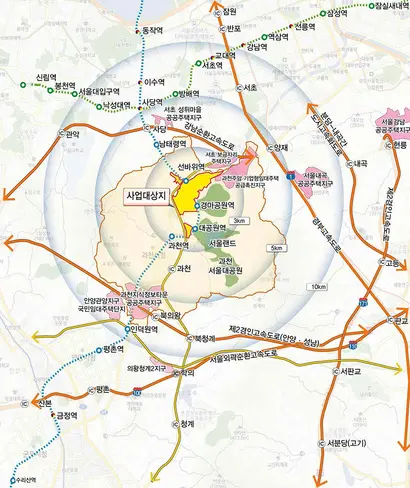
Recently, the Ministry of Land, Infrastructure and Transport approved the district plan for the Gwacheon Public Housing District (hereinafter "Gwacheon District"), which will be built on a total area of 1.69 million square meters between the old city center of Gwacheon and Seocho-gu, Seoul.
The Gwacheon District is a transportation hub. Through Line 4 (Seonbawi Station, etc.), one can reach Gangnam Station in under 20 minutes. It also boasts excellent road infrastructure, being adjacent to major arterial roads such as the Gwacheon-Bongdam Urban Expressway and the Gyeongbu Expressway (Yangjae IC). Located next to the project site are the Seoul Grand Park, the National Museum of Modern and Contemporary Art, and the National Science Museum, while the surrounding area features outstanding natural environments, with Gwanaksan, Cheonggyesan, and Umyeonsan mountains, as well as the Yangjaecheon and Makgyecheon streams.
The government plans to supply approximately 10,000 housing units in this location, with 6,500 of them built as public housing for low-income households without homes.
The Ministry of Land, Infrastructure and Transport states it will swiftly implement the land development procedures starting in 2025 and begin construction on the housing sites without delay as soon as conditions are met. Alongside land development, the government plans to promote major infrastructure projects in parallel, such as the undergrounding of the Gwacheon-Umyeonsan Expressway, aiming to secure housing construction conditions early and begin housing construction in 2028. The plan is to begin pre-sales in 2029 to supply a total of approximately 10,000 housing units. The supply breakdown includes 4,400 public units (including "New:Home" selective types), 2,900 private units, and 2,100 public rental units, along with 500 private rental units.
The district will be developed as an eco-friendly ecological city where Gwacheon residents can enjoy rest and leisure, with a "Culture Park" (the central park within the district) featuring sports facilities, water play areas, and carbon-offsetting forests, as well as waterfront parks and open spaces along the Yangjaecheon stream (totaling 438,000 square meters, about twice the size of Yeouido Park).
Educational facilities will include one kindergarten, two elementary schools, and one middle and one high school each. The plan is to create a "zero-hazard" city by prohibiting any elements that could affect safety or the educational environment within the district plan. Two complex community facilities will be installed for education, activities, rest, and meetings to create a venue for communication and exchange among residents.
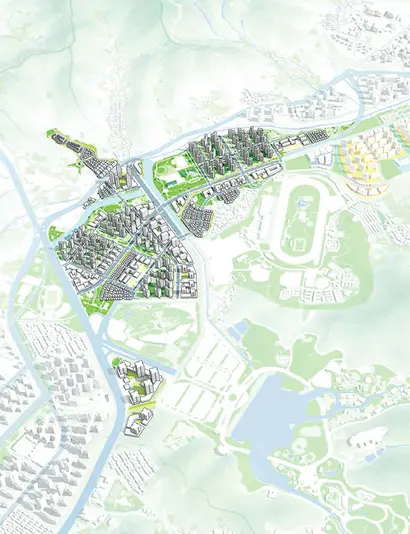
A total of 280,000 square meters of self-sufficient land will also be provided in the Gwacheon District, centered around the Line 4 station area (Seonbawi Station to Seoul Grand Park Station), to support the city's future growth. To foster high-tech industries, the self-sufficient land between Seonbawi Station and Seoul Grand Park Station is designated as a transit-oriented complex development zone, planned to house future high-tech industries like AI and semiconductors, forming a high-tech industrial self-sufficiency belt linking the "Yangjae R&D Innovation District – Gwacheon District – Gwacheon Knowledge Information Town."
The self-sufficient land next to Seoul Grand Park Station is designated as a special planning zone. Through urban planning support, such as including medical facilities as permitted uses, a bio-medical industrial cluster will be fostered. If the private sector proposes creative development plans reflecting the specific nature of the medical/bio industry, the government will review and incorporate them into the district unit plan.
Considering the proximity to cultural facilities like Seoul Grand Park and the National Museum of Modern and Contemporary Art near Seoul Grand Park Station, a central complex site will be arranged to house diverse commercial functions such as performances, exhibitions, and shopping.
Through the Gwacheon District metropolitan transport improvement measures, additional metropolitan transport networks will be expanded on top of the existing excellent network (Subway Line 4, nearby Gyeongbu Expressway, etc.). The Wirye-Gwacheon Line, which connects Gwacheon to Gangnam and Wirye, is planned to have a stop within the district following a feasibility study, and the GTX-C Government Complex Gwacheon Station will also be newly built by 2028.
By 2030, metropolitan transfer facilities will be installed centering on the railway lines stopping within the district to strengthen transfer connections with metropolitan and city buses and PM (Personal Mobility). The metropolitan road network will also be expanded, including the undergrounding of the Gwacheon-Umyeonsan Urban Expressway (Sangabeol Underpass to Seonam IC), the construction of a new road connecting Gwacheon-daero to Heolleung-ro, and the construction of the Isu-Gwacheon complex tunnel.
Because the Gwacheon District will supply housing at prices lower than the surrounding market rates, real housing demanders such as the youth and newlyweds should definitely target this area. It will be the last opportunity to see a large-scale supply of "lottery-like" apartments in the best location in the capital region.
Kim Hak-ryeol, the head of the Smart Tube Real Estate Research Institute, well-known by his pen name "Pashong," previously served as the team leader of the Real Estate Research Division at Gallup Korea. He operates the Naver blog "Pashong's World Exploration" and the YouTube channel "Stew TV." He is the author of books including "Absolute Principles of Seoul Real Estate (2023)," "The Future of Incheon Real Estate (2022)," "Kim Hak-ryeol's Absolute Principles of Real Estate Investment (2022)," "Future Map of South Korean Real Estate (2021)," "From Now On, Only Rising Areas Will Rise (2020)," and "South Korean Real Estate User Manual (2020)."