

[비즈한국] The album cover art for the debut album 'Unknown Pleasures' by the British rock band Joy Division is quite impressive. It features a unique design of stacked, jagged, oscillating curves. This is actually a reproduction of the observed radio spectrum data emitted from PSR B1919+21, the first neutron star (pulsar) ever discovered. The band included it as a message to show that their musical world is as mysterious as a pulsar.

In 1967, astronomer Jocelyn Bell Burnell detected a very strange celestial object through the Mullard Radio Astronomy Observatory. Radio pulses were consistently arriving from a specific location at an impossibly short interval. The pulses lasted about 0.04 seconds and occurred once every 1.337 seconds. It was so regular that, at first, she could hardly believe it was a natural phenomenon. Half-jokingly, she wondered if it might be a signal artificially sent by aliens, and thus nicknamed the signal 'LGM' for 'Little Green Man'.
Unfortunately, the source of these radio pulses was not aliens. However, it was just as astounding: a neutron star, left behind when a massive star collapsed into a small, high-density core. When a giant star collapses into a tiny volume, it becomes a rapidly rotating neutron star. Neutron stars form strong magnetic fields, and the axis of the magnetic field can be slightly tilted relative to the rotation axis. The neutron star spews out intense energy along its magnetic field. Because the actual rotation axis and magnetic axis are slightly tilted, the direction of the energy jet emitted by the neutron star rotates little by little at a constant period—much like a rotating lighthouse. It is called a 'pulsar' because it emits radio waves in pulse signals that blink at a constant period.
Usually, because pulsars are rapidly rotating neutron stars, the period of the pulse signal is also incredibly short. It takes less than a second for a neutron star to rotate; it is often in the millisecond range. The fastest-rotating pulsar discovered to date is PSR J1748−2446, found in 2004. This pulsar rotates an astonishing 43,000 times per minute. In terms of revolutions per minute (RPM), that is 43,000 RPM. Currently, the supercar with the highest RPM is the Gordon Murray Automotive T.50, which boasts 12,100 RPM. A massive neutron star is spinning nearly 3 to 4 times faster than a supercar! Thus, in the world of ordinary pulsars, extreme speed and short periods are the norm.
However, astronomers recently discovered a pulsar that rotates at an incredibly slow, long period. Its period is so long and slow that it is questionable whether it can even be considered a typical pulsar. Surprisingly, the rotation period of this strange pulsar is not 1 second, nor even 1 minute, but 53 minutes! It rotates very slowly, taking almost an hour to complete one cycle. What is the identity of this record-breaking slow pulsar?
The discovery of this exceptionally slow pulsar was purely accidental. Astronomers had originally planned to monitor rapidly changing astronomical objects, such as gamma-ray bursts, which change in brightness at high speeds in the night sky. Because these are sudden phenomena that brighten and vanish in a split second, it is easy to miss them if you are looking in the wrong place. Therefore, it is necessary to scan a wide area of the sky at once to capture these transient events.
Astronomers utilized the ASKAP radio telescope array spread across the vast desert of Western Australia. It consists of 36 huge, dish-shaped antennas, each 12 meters in size, all looking at the same direction in the sky as if they were a single, massive antenna. They look like a group of meerkats standing together in the desert, staring in the same direction. This telescope can survey a total area of 30 square degrees—a massive section of the sky that could be covered by 150 full moons. Through this, astronomers monitored the sky over a six-hour period on October 15, 2022, to see if any phenomena with rapid changes in brightness or position were occurring.
However, an unexpected, strange phenomenon was captured. From a star named ASKAP J1935+2148, located 16,000 light-years away, gamma-ray pulses 10 to 50 seconds in length were arriving repeatedly every 3,225 seconds. A pulse repeating at 3,225-second intervals means it is repeating very slowly, once every 53 minutes! Looking at the spectrum of this mysterious star, it clearly resembles a typical pulsar. The only difference is the fact that its period is a very slow 53 minutes, not a few milliseconds or seconds.
Through this observation, astronomers determined that ASKAP J1935+2148 contains a mix of three slightly different pulse forms. First, they identified pulse signals emitted at the highest intensity with a duration of 10–15 seconds, totaling 15 occurrences. Next, there were pulse signals about 26 times weaker in intensity. These weak signals were emitted for a short duration of about 370 milliseconds and were detected twice during the entire observation period. Finally, there were states where no distinct pulse signals were emitted. It shows a very complex pattern where pulse signals with different durations and intensities are emitted at approximately 53-minute intervals.

So, what exactly is the identity of this record-breaking 'slowpoke' pulsar? As explained earlier, it cannot be explained by the known model of a collapsed neutron star rotating rapidly. The slowest-rotating neutron star pulsar discovered to date has a period of only about 76 seconds—spinning once in just over a minute. Compared to that, the rotation period of this newly discovered slow pulsar is 53 minutes (not 53 seconds!). To explain pulse signals emitted at such an incredibly slow period, we might need to consider a different type of pulsar. It is possible that a white dwarf is acting as the pulsar.
To put it simply, a white dwarf can be seen as a less extreme case compared to a neutron star. When a relatively lighter star finishes all its nuclear fusion and reaches the moment of its death, it sheds its outer layers, leaving behind a high-density core at the center. Because it can no longer perform nuclear fusion, it cannot create new energy; it only slowly cools down from the heat remaining after the explosion. This hot, small, dense remnant is called a white dwarf. A neutron star is an even more extreme, high-density remnant left behind when a much heavier star collapses.
In fact, astronomers confirmed in 2016 that radio pulses emitted at regular intervals could be observed not only from neutron stars but also from white dwarfs. AR Scorpii, a star located 380 light-years away in the constellation Scorpius, is a binary system where a red dwarf and a white dwarf orbit each other. Astronomers captured radio pulse signals emitted at constant intervals of about 1.97 minutes from this system. Of course, the period is still short compared to the 53-minute period of the newly discovered slow pulsar, but it is considered very slow compared to conventional neutron star pulsars known to rotate on a millisecond scale.
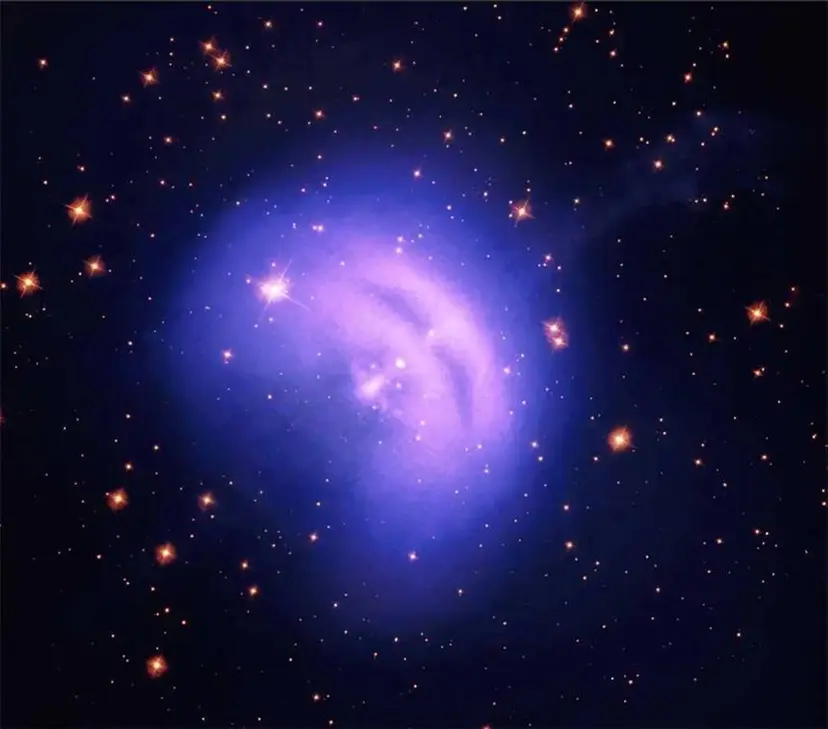
Therefore, we can consider the possibility that this slow pulsar is also a white dwarf pulsar that emits pulses at regular intervals while accompanied by a companion star. To verify this, astronomers observed the sky around ASKAP J1935+2148 using the infrared instrument HAWK-I on the VLT telescope in Chile. However, no particular nearby celestial object emitting infrared radiation was found. The possibility that it is a white dwarf pulsar in a binary system with a companion star seems low.
One can estimate the approximate size of a star through its rotation period, and that analysis result is also quite baffling. After assuming a wide range of factors, such as the star's magnetic field strength and the curvature of the star's surface, and applying the very slow rotation period confirmed in this observation, if this star were a white dwarf pulsar, the calculated size would far exceed 0.14 times the solar radius (a typical size for white dwarfs), resulting in an absolutely impossible figure. Therefore, it is also difficult to simply view this as a white dwarf pulsar.
Another possibility is that it is a magnetar, a pulsar with an extremely powerful magnetic field. Usually, magnetars emit complex pulse signals with different periods in their surroundings due to their powerful magnetic fields. The anomalous and complex radio spectrum of ASKAP J1935+2148 observed this time could be understood in this way. However, this hypothesis also has a fatal limitation. Ultimately, a magnetar is still just a neutron star pulsar with a very strong magnetic field. It does not resolve the fundamental question of how a high-density neutron star collapsed into such a small size can rotate slowly at a period of over 50 minutes while emitting pulse signals.
So, what exactly is the identity of this newly discovered slow pulsar? Does it belong to one of the two types we know—the neutron star pulsar or the white dwarf pulsar—that we have recently begun to discover? Perhaps we might need an entirely different third category.
References
https://www.nature.com/articles/s41550-024-02277-w
https://www.nature.com/articles/s41550-022-01688-x
https://www.nature.com/articles/nature18620
About the author, Woong-bae Ji: Loves cats and the universe. After watching 'Galaxy Express 999' as a child, he dreamt of sharing the beauty of the universe. Currently, he researches galaxy evolution through interactions at the Yonsei University Galaxy Evolution Research Center and the Near-Field Cosmology Laboratory, while engaging in various science communication activities such as lectures and writing. He has authored books such as 'The Observatory for Lovers', 'Thinking About the Universe All Day', and 'Stars, the Science of Light'.