

[비즈한국] The loan comparison fintech platform Finda has been operating a commercial area analysis service through 'Openup,' which it acquired two years ago. The service aims to help prospective small business owners reduce the risk of failure by providing local and industry-specific commercial data. While similar services exist through the Small Enterprise and Market Service (SEMAS) or the Seoul Metropolitan Government, Openup’s unique selling point is its ability to provide estimated sales for individual business locations. These estimated sales figures are high-interest data not only for prospective entrepreneurs but also for existing business owners who must analyze both their trade areas and competitors when setting prices, planning events, or running delivery app advertisements. However, there is a blind spot. Openup's sales information service operates on a model where data is published by default, and only made private if an individual business owner raises an objection. This has caused friction, as store owners who do not wish to have their information public must periodically express their refusal to the company to keep the data removed.
Two Years Since Acquiring Openup, Finda Says It Sees "Synergy in Small Business-Linked Projects"
For prospective small business owners investing significant capital, finding the most suitable location for their shop is considered the primary task. It involves comprehensively examining various conditions, from commercial area types (office vs. residential) to foot traffic, rent, number of competing stores, and survival rates of new businesses. Since there is a demand for accurate information, credit rating agencies, various startups, and public institutions like the Small Enterprise and Market Service have jumped into the commercial information service sector. The Seoul Metropolitan Government and the Small Enterprise and Market Service each provide commercial analysis services, while NICE Information Service’s ‘NICE Biz Map’ and ‘Commercial Note’ by Cashnote (a subsidiary of Korea Credit Data) are prime examples. KT030200 also operated a service called ‘Jalnagage,’ but it was terminated in June, four years after its launch, due to low adoption and usage rates.
Finda’s acquisition of Openup—a startup buying another startup—drew significant market attention. In July 2022, Finda acquired a 100% stake in Openup and converted the commercial analysis service, which had previously been provided as a paid service to large corporations and institutions, into a free service accessible to everyone. The goal was to lower the barrier to entry for regional sales analysis data that was previously difficult for small business owners to access and to resolve information asymmetry. The decision was based on the judgment that it could create synergy with self-employed loan brokerage for Finda, which specializes in loan comparison services.
There are similarities in the goals of Finda, which started to resolve information asymmetry that favors financial companies in the loan market, and Openup, which aims to resolve the opacity of information regarding a shop's trade area. Finda believes synergy with Openup is already manifesting. A Finda official said, "When seeking a loan at the startup stage, business owners are not evaluated on their business site; instead, personal credit ratings are applied. Finda possesses numerous predictive models regarding how much revenue can be generated when operating a specific type of business at a specific location. This can be used as supplementary data when applying for loans at financial institutions." They added, "We are supporting prospective entrepreneurs and early-stage small business owners who face problems like high interest rates and limit restrictions, helping them make rational decisions."
"Estimated" Sales Feel Uncomfortable... Even if Privatized, Request Must Be Renewed Every 90 Days
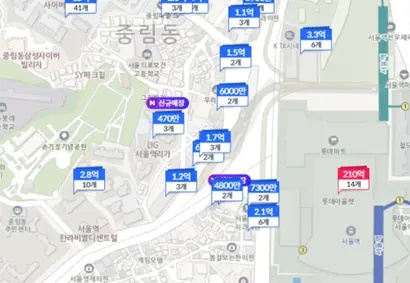
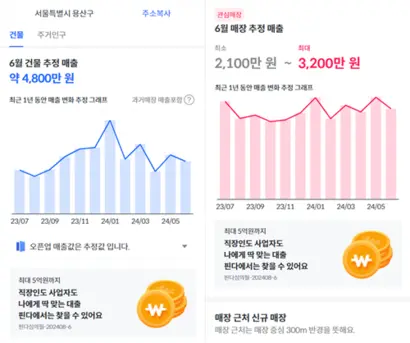
However, pushback is emerging among existing small business owners. Because sales are an extremely sensitive issue for the self-employed, they are reluctant to have their store's information made public. Openup allows users to check estimated sales for individual stores on a map interface. Previous month's sales are displayed as a range from minimum to maximum, and a graph showing estimated sales trends over the past year is also provided.
Since the service transitioned to a free model, it has been provided without any separate consent process for the stores involved. A person named Mr. A, who has been running a franchise restaurant in Geumcheon-gu, Seoul, for 11 years, said, "I recently learned of the existence of the Openup service through my children. Sales are a sensitive area for self-employed people—to the point where they don't even share rent prices with neighboring merchants, let alone sales figures with other branches. Learning that they have been operating this service without even a simple notification, let alone seeking consent, I plan to apply to have my store's information hidden."
Legally, sales information is not considered personal information requiring consent for disclosure. According to Finda, the disclosed sales information is an estimate calculated conservatively, accounting for omitted cash sales and other factors. Openup partners with a major credit card company, uses payment data per store as a core sample, and combines it with population and foot traffic data from sources such as KT, the Ministry of Land, Infrastructure and Transport, the National Tax Service, Statistics Korea, and the Ministry of the Interior and Safety to calculate estimated revenue. In that process, an AI learning model is used to calibrate the figures to be as close to the actual amounts as possible.

There is also strong criticism regarding the opt-out procedure. To hide store information, including sales, owners must submit documents proving their identity, such as a business registration certificate, and request that the information be made private. Furthermore, this request must be renewed every 90 days. On online communities for small business owners, there is an ongoing debate about the legality of publicizing sales and the accuracy of the estimates. Some owners are asking if it is possible to "delete" their store entirely rather than just making it private. Mr. A questioned, "They say I have to renew my request every three months even after I've already expressed that I want it to be private; isn't the cart being put before the horse?" Concerns are also being raised that if actual sales exceed the estimated maximum—or are more than double—it could lead to misuse as incorrect evidence when calculating premiums (gwonligum) in the future.
A Finda official explained, "It seems there are cases where people don't realize that sales data is not legal personal information. Businesses requesting privacy account for only about 1% of the total store data on Openup." They added, "However, we have prepared a simple application process that takes about one minute for those who are uncomfortable with information exposure. Requiring business owners to verify their identity with documentation is a safety mechanism introduced because there have been cases where unauthorized individuals attempted to hide information for other businesses."