

[비즈한국] Recently, a growing number of obstetrics and gynecology (OB/GYN) clinics have been closing their doors or halting delivery services. Starting with Munhwa Women's Hospital in Gwangju last September, local stalwarts like Gwak Women's Hospital in Seongnam and Yein Women's Hospital in Changwon, Gyeongsangnam-do, have made similar decisions, leaving local communities in a state of shock. While the government implemented measures to improve delivery fees last year, critics argue that these have had little effect.

Number of Clinics Capable of Delivery Has More Than Halved in a Decade
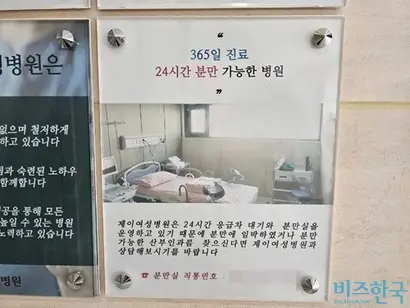
As of the 1st of this month, J Women’s Hospital, which had been responsible for deliveries for expectant mothers in the northwestern part of Seoul, discontinued its delivery services. Opened in 2015, the hospital provided '24/7' delivery care through its delivery room and postpartum care center. However, facing difficulties due to a decrease in the number of mothers, it has now closed its delivery room, as well as its internal medicine and pediatrics departments. During a visit on the 12th, a notice posted next to the first-floor elevator read: "We continue to operate OB/GYN outpatient clinics and provide care for early and mid-term pregnancies, excluding childbirth."
Last September, Munhwa Women's Hospital, the largest OB/GYN clinic in Gwangju, shut down. Founded in 2006, the hospital announced the news on its website, stating, "We are closing due to a continuous decline in deliveries." Gwak Women's Hospital in Seongnam, which once ranked first in the nation for the number of deliveries, and Yein Women's Hospital in Changwon, Gyeongsangnam-do, also decided to close this year. All of these hospitals cited financial difficulties.
An official from J Women’s Hospital stated, "We had been considering discontinuing delivery services for two years. While it is difficult to provide specific numbers, the significant drop in the number of expectant mothers led to management hardships." The official added, "While we could theoretically resume services if the situation improves, the decision was made after much deliberation by the director, and there are currently no plans to restart delivery services." The hospital had previously tried to overcome the decline by hosting events for childbirth and reviews of their services last year.
The number of hospitals capable of handling deliveries continues to shrink. According to the Ministry of Health and Welfare, as of the end of last year, there were 463 OB/GYN clinics performing deliveries nationwide, a decrease of 243 (34.4%) from 706 in 2013. The decline is even more pronounced for primary care clinics, which dropped from 409 in 2013 to 195 by the end of last year. Out of 250 cities, counties, and districts nationwide, 72 regions lack an OB/GYN or a delivery room. Specifically, 22 regions have no OB/GYN (6 in Gyeongbuk, 5 in Gangwon, 4 in Jeonbuk, 3 in Jeonnam, 2 in Gyeongnam, 1 in Chungbuk, and 1 in Daegu), and 50 regions have no delivery room at all.
New Fees Introduced, but OB/GYN Association Claims "Field Voices Were Ignored"
OB/GYN doctors have consistently demanded the normalization of delivery fees. In response, the Ministry of Health and Welfare announced the 'Improvement Plan for Delivery Fees Following Essential Medical Support Measures' in October last year. Specific contents included: 550,000 KRW compensation per delivery for medical institutions in all areas except for major cities (regional fee), 550,000 KRW compensation per delivery for institutions with resident OB/GYN specialists and a delivery room (safety policy fee), and an increase of up to 200% in additional fees for high-risk deliveries involving older mothers or complications. This plan, funded by 260 billion KRW in annual health insurance, has been in effect since last December.
However, since the number of clinics discontinuing services has not decreased even after the introduction of these measures, critics argue the government failed to reflect the reality of the field. Following the initial government announcement, the Korean Association of Obstetricians and Gynecologists released a statement: "After the government announced the 'Improvement Plan for OB/GYN Delivery Policy Fees' in February, we participated in opinion surveys, meetings, and forums for nine months to emphasize the difficulties faced by delivery institutions and the risk of infrastructure collapse, yet our demands were not reflected at all. It seems the government ignored the voices from the field and provided only enough support to barely keep us alive."
The burden of unavoidable delivery accidents also complicates the situation. According to an 'Analysis of Obstetric Medical Litigation' published last year by Professor Seong Won-jun of Chilgok Kyungpook National University Hospital, the average claim amount for damages related to delivery accidents over the past 10 years was 538 million KRW, ranging from a minimum of 23 million KRW to a maximum of 5.19 billion KRW. The actual average payout reached 229 million KRW, a 3.3-fold increase compared to the average of 70 million KRW between 2005 and 2010. Most recently, in July of last year, a court ruling ordering an OB/GYN doctor to pay 1.2 billion KRW for a case involving a newborn with cerebral palsy sparked further controversy.
First-Half Resident Application Rate at 67.4%, Falling Short Again
As a result, it is difficult to produce new OB/GYN specialists. According to the first-half 2024 recruitment results for first-year residents announced by the Ministry of Health and Welfare last December, OB/GYN departments saw only 122 applicants out of 181 spots (an application rate of 67.4%), marking another shortfall. This is a 4.5 percentage point decrease from the 71.9% rate the previous year. In terms of absolute numbers, applicants dropped from 133 to 122. Breaking it down by region, the capital area had an application rate of 79%, while non-capital regions saw less than half, at 45.2%.
The government recently stated that it discussed increasing the state compensation limit for no-fault delivery accidents—currently around 30 million KRW—to reflect actual civil compensation levels during a meeting of the Special Committee on Healthcare Reform. This was also included in the essential medical policy package announced in February. Current compensation limits are set at 15 million KRW for fetal death, 20 million KRW for newborn death, and 30 million KRW for maternal death or neonatal cerebral palsy. In Japan, compensation can reach up to 300 million KRW.
Oh Sang-yoon, Secretary-General of the Korean Association of Obstetricians and Gynecologists, said in a phone call with Biz Hankook, "The Medical Dispute Mediation Act includes the concept of 'unavoidable medical accidents.' I believe this recognizes that a doctor can fulfill all their duties and yet still face a bad outcome. The government should start by discussing who is responsible for such unavoidable accidents and improve the legal environment for OB/GYN specialists. Regarding Japan, which the government is expected to use as a reference, they achieved a social consensus 12 years ago to set the compensation at 300 million KRW. The government must recognize that a social consensus with both the concerned parties and the public is essential."