

[비즈한국] On the 1st, a fire broke out in an electric vehicle (EV) parked in an apartment underground parking lot in Cheongna-dong, Seo-gu, Incheon, leaving behind massive damage. About 140 nearby vehicles were scorched, and a power outage occurred, causing a commotion that led to the evacuation of about 120 residents. Fortunately, there were no casualties, but the fire was not fully extinguished until eight hours later due to the difficulty of initial suppression. With recent EV fires occurring one after another, there is growing criticism that specialized fire suppression facilities are needed in spaces where EV charging stations are installed.
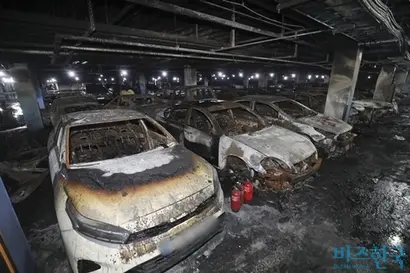
EV fires are on the rise, but extinguishing them is not easy
EV fires have been on an upward trend recently. According to data confirmed by Representative Song Eon-seok of the People Power Party from the National Fire Agency, there were a total of 161 EV fires in South Korea over the five years from 2017 to 2023. The number, which was just one in 2017, increased rapidly to 3 in 2018, 7 in 2019, 11 in 2020, 24 in 2021, 43 in 2022, and 72 in 2023. EV fires that occurred while parked or charging, like this recent accident, have more than tripled over the last three years, from 10 cases in 2021 to 18 in 2022 and 34 in 2023.
EV fires are difficult to suppress. This is because the battery, identified as the cause of the fire, is attached to the bottom of the vehicle body. When "thermal runaway"—where a chemical reaction inside the battery is abnormally activated—occurs, the internal temperature can soar to 1,000 degrees Celsius, causing the combustion to spread. Since the battery, the source of the fire, is encased within the vehicle body, extinguishing it is no simple task. During the suppression process, there is also a high risk of secondary accidents due to potential battery explosions, toxic gases, or exposure to high-voltage currents. According to a Tesla report from the United States, compared to internal combustion engine vehicles, EV fire suppression takes eight times longer, requires 2.5 times the manpower, and uses 100 times the amount of water.
Park Jae-sung, a professor of Fire and Disaster Protection Engineering at Soongsil Cyber University, explained, "Because EVs are not typical combustible materials, the fire spreads rapidly and is difficult to suppress once it starts. The battery, located at the bottom, can only effectively be extinguished when it is essentially completely submerged in water."
Large-capacity sprinklers and water tanks needed
In South Korea, the installation of EV charging facilities is mandatory in the majority of apartment complexes and multi-use facilities. Under the Eco-Friendly Motor Vehicles Act, apartment complexes with 100 or more units or public facilities with 50 or more parking spaces must install EV charging stations for at least 5% of their total parking capacity (2% for facilities with construction permits issued before January 2022). Furthermore, under the Housing Construction Standards Rules, apartment complexes with 30 or more units are now required to install portable charging outlets for at least 7% (previously 4%) of total parking spaces.
Conversely, there are currently no specific fire safety regulations for EV charging facilities. According to the current Fire Safety Facilities Act, indoor parking lots with an area of 200 square meters or more must be equipped with water spray extinguishing systems or equivalent sprinklers. However, there are no separate fire facility regulations specifically for EV charging areas. An official from the National Fire Agency explained, "There is currently no legislation that specifically mandates fire facilities for suppressing EV fires. General sprinklers are being installed in indoor parking lots of buildings, including apartment complexes."
However, there are calls for specialized fire facilities for EV charging stations due to the unique nature of these fires. Professor Park Jae-sung stated, "Because an EV fire spreads rapidly once it starts, there is a need to reinforce fire-extinguishing equipment in spaces where EV chargers are installed, more so than in other areas. We can secure fire-extinguishing capabilities by increasing the sprinkler spray density or enlarging the capacity of water tanks." Gong Ha-sung, a professor of Fire and Disaster Protection Engineering at Woosuk University, added, "Measures such as installing high-capacity sprinklers to enhance suppression capabilities or setting up fire partitions to prevent the fire from spreading to nearby vehicles could be feasible."
Following the recent EV fire accident, the National Assembly is also showing signs of legislative amendments. On the 1st, Representative Song Eon-seok of the People Power Party proposed an amendment to the Parking Lot Act that would require the installation of fire-extinguishing water supply facilities, such as water tanks, at EV charging areas. On the 9th, Representative Park Yong-gap of the Democratic Party of Korea also proposed an amendment to the Fire Safety Facilities Act, which would require the provision (installation) of water spray devices, specialized EV fire extinguishers, and fire blankets at charging stations, and mandate additional fire-extinguishing water tanks or fire shutters for indoor charging facilities.
Representative Song Eon-seok stated, "As we saw in the tragic EV fire at the Cheongna apartment in Incheon, an EV fire in an indoor parking lot can lead to massive loss of life and property," adding, "I will do my best to ensure the passage of these amendments so that a system can be built to secure public safety alongside the expansion of EV charging infrastructure."