

[비즈한국] On the 30th of last month, President Yoon Suk Yeol met with Andrew Ng, a professor at Stanford University and one of the world's four leading AI scholars, to request his participation in the newly established National AI Committee's global advisory group, receiving a positive response. Since taking office, President Yoon has defined high-tech industries as future growth engines and pledged to expand government support for them. Recently, he has been focusing on AI, which is sparking a global frenzy. The decision to establish the National AI Committee, chaired by the President himself, and the invitation of Professor Ng as an advisor are prime examples of this.

Although President Yoon is personally taking the lead in fostering the AI industry, only about 1 in 20 companies in South Korea actually adopt and utilize AI. This risks leaving Korean companies behind in the global AI trend. Experts point out that because true economic success depends on the synergy between AI development and corporate adoption, support must be provided not only for research and development (R&D) in the AI sector but also to increase corporate utilization.
After the cabinet meeting on the morning of July 30, where the establishment of the National AI Committee was approved, President Yoon met at the presidential office with Professor Ng, a pioneer in big learning methodology and a world-renowned AI scholar. During their meeting, they exchanged views on the outlook for economic and social development through AI, and on fostering startups through AI talent.
President Yoon has previously met with other AI luminaries, such as Geoffrey Hinton of the University of Toronto and Yann LeCun of New York University, as well as Sam Altman, CEO of OpenAI and the "father of ChatGPT," to discuss strategies for Korea's AI advancement. The President's focus on AI stems from his belief that falling behind in the global AI race would deal a significant blow to the Korean economy.
In its AI report this year, PwC, one of the "Big Four" global accounting firms, projected that AI would boost global GDP by 14% by 2030, which translates to $15.7 trillion (approximately 2 quadrillion 150.7 trillion won). The utilization of AI is expected to boost efficiency and productivity across the entire economy, while also driving job growth through increased investment. Furthermore, increased productivity leads to higher profits and, consequently, higher wages, which in turn fuels further demand.
Indeed, the use of AI technology has been shown to affect corporate productivity. According to the National Assembly Budget Office, companies that utilized AI across all industries exhibited 5.07% higher productivity than those that did not. This effect was particularly pronounced in the service sector, where AI-utilizing companies showed 5.63% higher productivity. Given that Korea's service sector labor productivity is low compared to other countries, AI adoption could help improve its competitiveness.
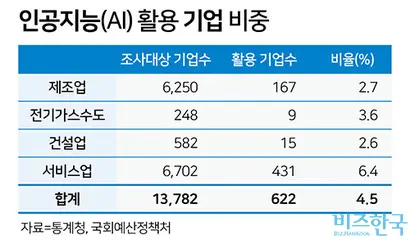
While the government is accelerating support for AI development with these factors in mind, Korean companies are not making much use of AI. According to Statistics Korea’s survey on business activities, only a very small number of companies are utilizing AI. Out of 13,782 companies surveyed, only 622, or 4.5%, were using AI. There is a risk that Korea alone might be alienated from the immense economic net benefits generated by AI. While the service sector showed 6.4% adoption (431 out of 6,702 companies), the utilization rate was even lower in manufacturing (2.7%) and construction (2.6%).
This trend was confirmed by a survey conducted by the Software Policy and Research Institute of Korea. Among 982 companies that had introduced AI technology, 76.9% (756 companies) had done so for three years or less. Only 10.1% (99 companies) had been using it for six years or more. Because adoption is so recent, only 12.5% (123 out of 982) of the companies surveyed were utilizing AI technology at a company-wide level. The remaining companies were either in the initial stage of introducing AI or were using it only in limited departments.