

[비즈한국] As the government and the telecommunications industry continue a long tug-of-war over plans to lower household communication costs, the shifting online rate plan strategies of the three major mobile carriers are drawing attention. SK Telecom017670 has secured the title of "the industry's first 20,000-won range 5G rate plan," while KT030200 and LG Uplus032640 have launched branding initiatives with 'Yogo' and 'nerget,' respectively. LG Uplus has recently reorganized nerget, which began as an event-based service, into a formal product and is making strategic moves, such as applying the industry’s lowest price of "20,000 won for 6GB."
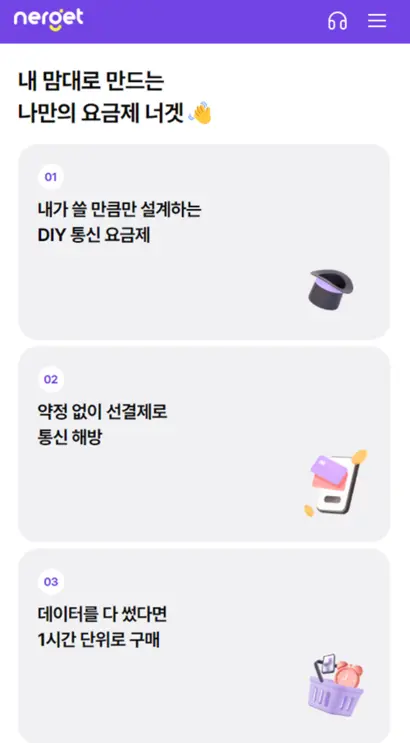
"20,000-won range 5G" with 1,000-won interval plans for granular choice
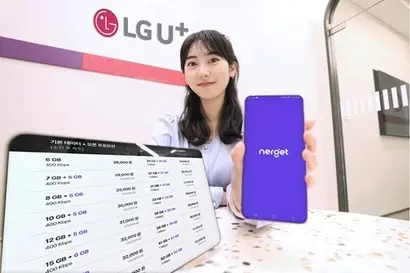
Through its platform nerget, LG Uplus offers the cheapest 5G rate plan among the three major carriers at 26,000 won for 6 gigabytes (GB). This is 1,000 won cheaper than SK Telecom’s ‘Direct 5G 27,’ which was previously the lowest price for the same data capacity. KT currently operates the ‘Yogo 30’ plan, which provides 5GB of 5G data for 30,000 won.
This follows LG Uplus's decision to adopt nerget as a regular rate plan last June, which involved a comprehensive overhaul of its system. LG Uplus reorganized its previous price structure, which ranged from 1GB to 24GB and unlimited across 16 options, to now offer 18 choices ranging from 6GB to 50GB and unlimited plans. The 1GB, 3GB, and 5GB plans, which were in the low 30,000-won range, have been discontinued, and data allowances for each plan have been expanded.
nerget is a mobile-app-only telecommunications service based on a prepaid, rather than postpaid, model. It is a no-contract product that allows free changes and cancellations. The primary target audience is the MZ generation. The concept is to minimize the waste of "unused, discarded" data by combining a no-contract model with prepayments. nerget focuses on increasing efficiency by lowering the minimum data threshold and base price, while allowing users to purchase additional data only when needed. It is more cost-effective compared to LG Uplus’s lightweight products like ‘5G Slim+ (9GB for 47,000 won)’ or ‘5G Mini (5GB for 37,000 won).’ Unused data can even be refunded. In effect, this creates a new choice for customers who use less data than the levels offered by existing online-only 5G plans, which previously required paying for at least 8GB.
Will it capture budget phone demand and pressure the runner-up, KT?
nerget, which centers on the segmentation of rate plans, was born amidst the government’s push to lower household communication costs. When the Ministry of Science and ICT repeatedly demanded lower communication fees last July, such as through its "Telecommunications Market Competition Promotion Plan," LG Uplus was the first to introduce a new form of pricing policy via the nerget promotional rate plan. Prior to this, in February of last year, the three major carriers released a series of intermediate rate plans after President Yoon Suk-yeol ordered measures to alleviate the burden of communication costs during the Emergency Economic Council meeting.
At the time, Park Yun-kyu, the 2nd Vice Minister of Science and ICT, praised the initiative, saying, "It is such an innovative method that one might think, 'This is what the number three operator should be doing.' It seems to be the first truly suitable rate plan, as our policy goal is to have constant competition among the three carriers." However, the disappearance of the low-capacity 1GB, 3GB, and 5GB plans following the formal reorganization is a point of regret. While the new plans offer more basic data for a similar price compared to pre-reorganization levels, they eliminated choices for those who prefer to maintain service at a lower price point. An LG Uplus official explained, "We are providing 6 times more data for 26,000 won, which is cheaper than the previous 30,000-won 1GB plan. The intention is to provide more data at a lower price."
nerget stands at the forefront of the "digitalization of telecommunications" strategy pursued by LG Uplus. Yeo Myung-hee, CFO and CRO of LG Uplus, emphasized during the second-quarter earnings conference call on the 7th, "We expect the proportion of non-face-to-face sign-ups via online channels to continue to increase, centered around nerget, a new form of digital rate plan. We plan to strengthen factors that drive online channel sign-ups by building an integrated app and app ecosystem that can improve the digital customer experience." Some view the success of the prepaid-based nerget as a potential indicator of the viability of expanded prepaid rate plans, as it could serve as a foundation for designing plans that align with actual usage.
Whether this low-to-mid-range segmentation strategy will pressure the traditional number two operator, KT, is also of note. As of May this year, LG Uplus had approximately 7.34 million wireless subscribers, closely trailing KT (10.05 million) with a gap of 2.71 million lines. The move is expected to attract existing budget phone (MVNO) users who want to cut communication costs and potentially pressure KT, while also revitalizing competition in the telecommunications market, much like how LG Uplus launched the lowest rate plan, 1,000 won cheaper than SK Telecom's.
However, nerget operates as a "sub-brand" service separate from LG Uplus’s regular products, and it does not link with services like call forwarding or fintech services that confirm communication bill payments. There is also a possibility that upcoming features, such as an iPhone call recording app scheduled for introduction in the fourth quarter, may not be applied to nerget. An LG Uplus official explained, "nerget is a unique rate plan structure based on a prepaid method and is a completely different product from LG Uplus’s regular offerings. There are differences in membership benefits and the like."
Seo Yong-gu, a professor of business administration at Sookmyung Women's University, pointed out, "With the baby boomer generation reaching retirement age, the size of the retiree population is growing, and there is a high possibility that a low-cost market will become active in the telecommunications sector during economic downturns. We can expect competition to capture rational consumers as a 'lightweight' approach, which includes only essential functions, becomes full-scale in telecommunications products that previously relied heavily on value-added services."