

[비즈한국] As the healthcare vacuum caused by the collective resignation of resident doctors persists, the nursing community is also voicing its struggles. Nurses, who have long suffered from heavy workloads, have seen their duties increase significantly since the residents walked out and are now facing forced unpaid leave. Job postings for new nurses, which typically appear a year in advance, have also vanished. We spoke with a practicing nurse about the experiences of nurses over the past year.
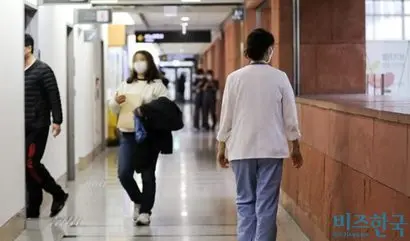
Nursing-to-Population Ratio Far Lower Than OECD Average
“The problem of nurse overwork has existed for a long time, as resident doctors have always flocked to popular specialties,” explains Nurse A. A added, “There has always been a shortage of medical staff in the field. In unpopular specialties, because there were no residents, nurses were already being tasked with more physician-related duties than in other departments. Since we can’t simply reassign specialized nurses from unpopular departments just because residents left the popular ones, general nurses have been deployed instead, leading to a massive increase in overall workload.”
Nurse A points to the nurse-to-patient ratio. A stated, “In Korea, one nurse takes care of about 12 patients; this ratio itself is already two to three times higher than in other countries. It was a situation where we couldn't even take our vacation days comfortably.” In fact, according to Statistics Korea, the number of nurses per 1,000 people in South Korea is among the lowest in the Organization for Economic Cooperation and Development (OECD). According to the ‘Korea SDG Implementation Report 2024’ published by Statistics Korea, as of 2021, the number of nurses per 1,000 people in Korea was 4.6, lower than the average for OECD member countries (8.4) for which relevant statistics are available.
The forced unpaid leave that began in late February is also a problem. A said, “Most of the hospitals where residents were stationed are large hospitals. Since these hospitals are no longer accepting new patients, the number of surgeries has decreased. Also, as patients in wards for mild cases are discharged after treatment and no new patients are admitted, the overall bed turnover rate has dropped. Hospitals have been forcing nurses to take unpaid leave or use their annual leave, especially in departments where the workload has decreased.” According to the Korean Confederation of Trade Unions’ Medical Solidarity Headquarters, 29 wards were merged or closed in 10 large hospitals across the country immediately following the collective resignation of residents, affecting around 400 nurses.
“Even Passed Nurses Have Been Waiting for Assignment for 7 Months; Graduating Seniors Considering Other Fields”
Nurse A expressed concern for junior nurses who have been waiting for their assignments for seven months. A noted, “The national nursing examination is held in January, and after the results are announced in February, nurses are typically assigned to hospitals in order from late February. But all of this has stopped. It’s been nearly a year,” adding, “Because of this, current fourth-year students are also anxious. Large hospitals should have started recruiting nurses by now, but since there are no job postings, students are saying they are looking into other roles in the health sector instead.” Currently, the only hospitals proceeding with recruitment are Chung-Ang University Hospital and Kangwon National University Hospital.
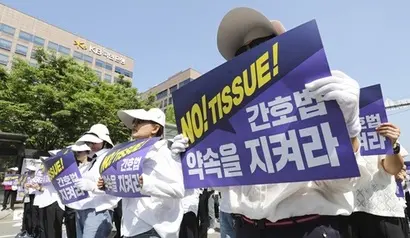
What is the biggest difficulty for nurses? Nurse A identified the ambiguity of nursing duties and the lack of a compensation system as the greatest challenges. A lamented, “Currently, nursing tasks are bundled only under the vague term ‘medical assistance,’ and they are not clearly defined even in the enforcement rules of the Medical Service Act. Because we rely on interpretations by the Ministry of Health and Welfare, the interpretation changes depending on the official in charge. Since duties aren't clearly divided to begin with, and interpretations vary, we are constantly being pushed into a situation where we oscillate between what is legal and illegal.”
A also pointed out the inadequacy of the compensation system. A argued, “The medical fee system in our country is built around doctors. The only thing nurses have is the ‘Nursing Management Fee,’ which is a variable fee based on how many nurses are used, representing 25% of the hospitalization fee. Even though doctors already have fee schedules set for every single medical act, 40% of the hospitalization fee goes to them as ‘Medical Management Fees.’ For a long time, the system has been centered on doctors, while nurses have been pushed into excessive work without any defined scope of practice or compensation.”
Recently, the ruling and opposition parties agreed to handle livelihood legislation, including the Nursing Act, during the extraordinary session of the National Assembly. Following a meeting with Bae Joon-young, the floor spokesperson for the People Power Party, Park Sung-joon, the floor spokesperson for the Democratic Party of Korea, said on the 8th, “The People Power Party is actively pursuing the ‘Goo Hara Act’ and the Nursing Act. We can sufficiently reach a bipartisan agreement on those,” adding, “The Special Act on Jeonse Fraud still has some points of contention that need adjustment.” As the Nursing Act, which defines the status and rights of nurses and includes the scope of work for Physician Assistant (PA) nurses, appears likely to pass within August, conflict between the Korean Medical Association and resident doctors has recently flared up again over this issue.