

[비즈한국] There is a saying, "The value of 'together'." It appeared in a corporate image advertisement about ten years ago. It is a wonderful slogan that carries the meaning that the power of togetherness can change the world. Being together signifies empathy or communication, and this power can create a new paradigm. Art, too, holds value when it resonates with people. Empathy stems from the spirit of the times and a universal artistic language. The 'Korean Art Support Project' also aims to showcase the thoughts of various people through an accessible artistic language. As we reach Season 10, we support artists who strive to practice Confucius's idea that "good art must be easy to understand."
What is the Korean aesthetic? When faced with this question, many people think of words like antique, rustic, subtle, and plain. This judgment arises from the belief that the Korean aesthetic originates from naturalness.
Of course, this is an undeniable fact that forms one pillar of our aesthetic. However, I believe there is an issue with confining the entirety of the Korean aesthetic solely to these values.
Why have we come to view the Korean aesthetic only through these categories? It was the Japanese folk craft researcher and art critic Muneyoshi Yanagi (1889-1961) who identified these aesthetics in traditional Korean art (to be precise, the art of the Joseon Dynasty). He had such affection for our traditional art that he actively opposed the demolition of Gwanghwamun when it was discussed for the construction of the Japanese Government-General building during the colonial era.
He took a particular interest in white porcelain and folk paintings (minhwa), which were representative art forms of the Joseon Dynasty. He recognized the plainness and antique beauty in the unadorned aesthetic of white porcelain, and the rustic beauty in folk paintings, compiling his findings into books such as 'Joseon and Its Art' and 'Thinking of Joseon.'
Strictly speaking, this aesthetic is limited to the Joseon Dynasty. It was the result of values created by Neo-Confucianism, which guided Joseon for 500 years by suppressing expression and elevating ideology.
The aesthetic organized by Yanagi continues to lead our art even in the 21st century. Currently, the art that holds prestige and value in the Korean art scene is abstract art referred to as 'Dansaekhwa' (monochrome painting). It is a form of extreme abstraction that fills the entire canvas with basic elements of painting such as dots, lines, planes, and colors, following the minimalism that emerged around the United States in the 1960s.
The aesthetic of minimalism aligns well with the Japanese sensibility. Therefore, it was popular in Japan and was transplanted into our art world by a group of young painters who led Korean contemporary art in the 1970s. The origin of 'Dansaekhwa' also comes from 'Monochromism,' created by Yves Klein, who led minimalism in Europe.
The theoretical background of Dansaekhwa essentially comes from the plainness, rustic tones, and simplicity of brushwork seen in Joseon Dynasty white porcelain. In other words, it became a form of painting that fit perfectly into the logic of "modernizing the Korean aesthetic."
A phenomenon that shatters this trend is recently appearing in popular culture, which is receiving global attention. It shows the true nature of the Korean aesthetic through brilliant colors, movements, and singing styles that erupt with emotion. This is the 'Aesthetic of Dynamism.'
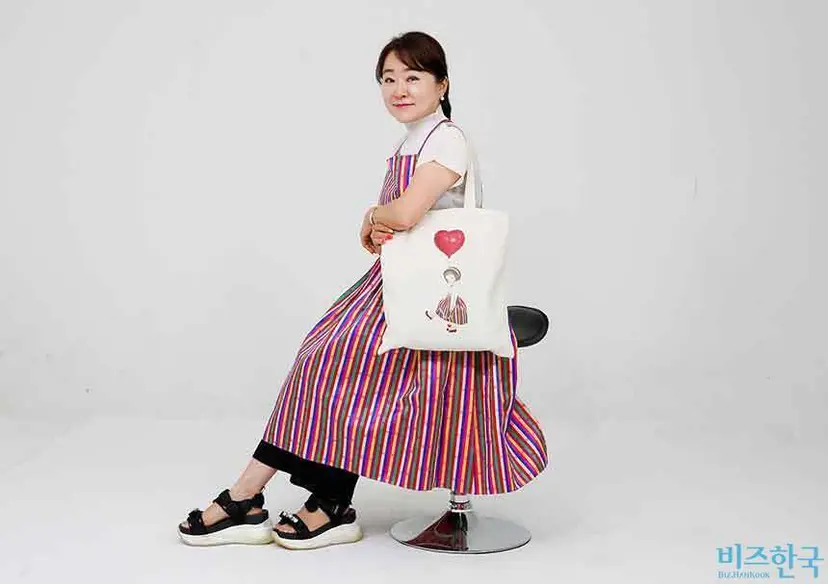
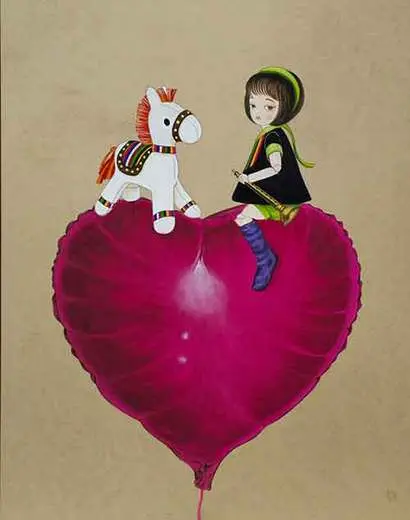
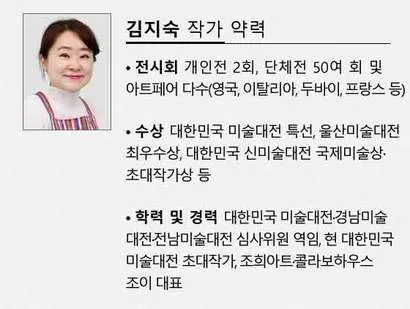
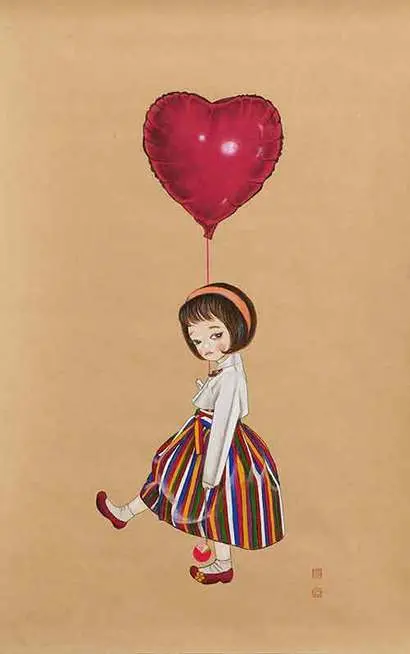
Kim Ji-sook's painting focuses on the expressiveness of the Korean aesthetic. It is a painting of the Korean aesthetic of dynamism. She portrays the sentiment of childhood in a fairy-tale manner using the diverse colors of saekdong. Through paintings featuring a girl in saekdong clothes, she expresses the various childhood memories she once held. She captures the diversity of childhood through the colorful tones of saekdong and is asserting a Korean aesthetic through the expressive power created by the clash of primary colors.