

[비즈한국] Apartment prices are rising, particularly in preferred areas of Seoul such as the three Gangnam districts and Yongsan. While preferred areas in the metropolitan region are also showing an upward trend, provincial areas continue to decline, reflecting a growing divergence within and between regions. Apartment transaction volumes in Seoul and the metropolitan area have been increasing since the start of the year. Conversely, transaction volumes for non-apartment properties and provincial apartments have continued to decline and remain low. Consequently, the market expects Seoul housing prices to continue rising for the time being.

In addition, apartment building permits have been declining since last year, and the non-apartment sector, in particular, has shrunk rapidly since 2022, dropping to 26% of its long-term average.
Apartment construction starts also plummeted to 64% of the long-term average last year and are currently constrained at 88% of that average. Like building permits, non-apartment construction starts have also fallen to 26% of the long-term average.
On the other hand, apartment completions have been increasing since 2023. While the performance in the first half of 2024 was at 140% of the long-term average, there is a high concern for a future decline due to the recent contraction in construction starts. For non-apartments, completions are also expected to fall to 40% of the long-term average due to the decline in permits and construction starts.
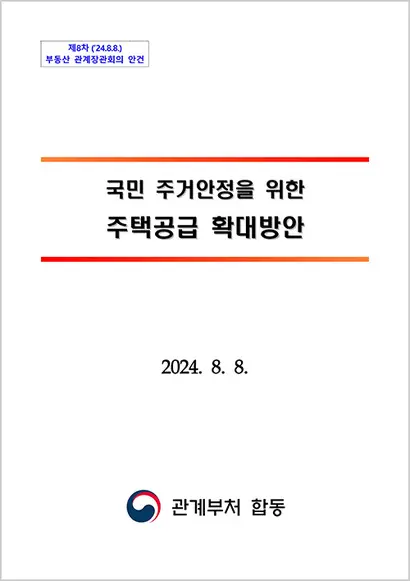
On August 8, 2024, the "8th Real Estate Ministerial Meeting" was held at the Government Complex Seoul. The meeting discussed the "Plan to Expand Housing Supply for People's Housing Stability." Presided over by the Deputy Prime Minister, it was attended by ministers and vice-ministers from the Ministry of Land, Infrastructure and Transport (MOLIT), the Ministry of the Interior and Safety, the Office for Government Policy Coordination, and the Financial Services Commission, as well as the Mayor of Seoul and the Governor of the Financial Supervisory Service.
On this day, Choi Sang-mok, Deputy Prime Minister and Minister of Economy and Finance, stated that the key to stabilizing the real estate market lies in providing sufficient housing to meet demand and managing liquidity at an appropriate level. He announced plans to drastically increase housing supply and preemptively manage housing demand. Deputy Prime Minister Choi stated that through this housing supply expansion plan, a total of over 427,000 housing units and new sites will be provided in Seoul and the metropolitan area over the next six years.
First, the plan intends to supply an additional 210,000 units in highly preferred locations centered in Seoul and the metropolitan area. Specifically, it plans to lift Green Belt restrictions in and around Seoul to provide 80,000 units of new housing sites, while temporarily designating all Seoul Green Belt areas as land transaction permit zones until the new sites are announced to thoroughly manage speculative demand. For metropolitan public housing sites, such as the 3rd generation new towns adjacent to Seoul, it was decided to add more than 20,000 units through improved land use efficiency. Furthermore, it was emphasized that more than 110,000 non-apartment units, such as villas, would be supplied quickly through new construction purchase leases, and in the case of Seoul, these would be supplied without limit until the non-apartment market normalizes. Including both new and existing properties, the plan aims to expand the public purchase of non-apartment housing from the original target of 120,000 to at least 160,000 units.
The government stated that it would supply 217,000 units for which supply plans have already been finalized to prospective homebuyers as early as possible. It proposed enacting a special act to promote reconstruction and redevelopment to move up timelines by about three years, aiming for the early commencement of 176,000 units in urban areas like Seoul over the next six years. It also intends to encourage the early supply of 41,000 units by having the Korea Land and Housing Corporation (LH) purchase unsold units if construction begins in metropolitan public sites by 2025.
On the demand side, the government intends to strengthen the management of market liquidity and household loans while blocking speculative demand. It plans to gradually solidify and expand Debt Service Ratio (DSR) regulations, such as implementing the second stage of the "stress DSR" starting September 1, 2024, and to strengthen the monitoring and analysis of the growth rate and risk factors of household loans in general. To this end, it announced that additional macroprudential regulatory measures would be prepared.
On the same day, Park Sang-woo, Minister of Land, Infrastructure and Transport, stated that they had re-examined policies to vitalize housing supply from scratch and prepared practical measures that allow the public to feel confident in a stable supply. To this end, the government has decided to clearly shift the paradigm of reconstruction and redevelopment from regulation to support and to dramatically increase the speed of implementation. It added that it would provide omnidirectional public support to normalize the non-apartment market, which has served as a housing ladder, and to ensure the rapid supply of housing in 3rd generation new towns and metropolitan public sites.
Oh Se-hoon, Mayor of Seoul, stated that he would join the effort to expand housing supply by lifting development restrictions to provide housing for future generations, while maintaining the basic principle of "preserving the natural environment and securing space for leisure and rest for future generations." He also added that he would provide unconventional incentives for maintenance projects and improve systems in parallel with the expansion of new construction purchase leases to increase the supply of non-apartments.
To summarize the August 8 housing supply expansion plan in one phrase, even if all prerequisites for the policy were resolved, it would likely take more than 10 years for it to become visible. Long-term direction is always good, but feasibility will ultimately be the most important issue.
The Seoul Metropolitan Government says it will lift the Green Belt. From the public's perspective, it is seen as an easier way to supply housing than pushing forward with maintenance projects. Both the Moon Jae-in and Yoon Suk-yeol administrations have ended up using the "new town" card.
As I mentioned in my "Real Estate Insight" column six years ago during the announcement of the 3rd generation new towns, there are many places where even the 2nd generation new towns have yet to be supplied. If Green Belt areas are added again this time, the 3rd generation new towns will also be pushed back in the development sequence.
Wouldn't it be better to resolve the sites currently being pursued sequentially first? Instead of developing new sites, wouldn't it be more effective to lay out a tighter wide-area transportation network in existing developed sites? I hope we stop these meaningless, number-filling supply plans.
Of course, urban supply measures such as easing requirements for reconstruction and redevelopment were included in this alternative. If things go as planned, the associations will be happy—provided they are actually allowed to proceed. But can they? Really?
The reason I have no choice but to have a negative outlook on maintenance projects is because they require legal amendments or new legislation. This will likely be the biggest problem. There are a total of 49 supply measures proposed in the August 8 plan. Just looking at the items that require legal issues to be resolved first, there are the abolition of the Reconstruction Excess Profit Recovery Act, raising the ceiling for reconstruction floor area ratio incentives, easing union establishment consent and simplifying procedures, introducing short-term registered rental for non-apartments, and reducing acquisition tax on unsold units after completion. Most of the main points require legal amendment or enactment. This means the agreement or resolution of the National Assembly is necessary.
The key to lifting regulations is held by the Democratic Party, which is the absolute majority party, and most of these laws were created by the Democratic Party during the previous administration. Let's put ourselves in their shoes. Would the Democratic Party pass deregulation bills?
I have done more than 10 media interviews asking if the August 8 housing supply expansion plan would affect the real estate market. My answer from Smart Tube has been the same each time: If it were implemented immediately as per the August 8 plan, it could have a positive impact on the market, but it is too difficult to implement.
If this plan was announced while knowing it could not be implemented immediately, it will ultimately lead to the same results as the previous administration. Because the same reasons will lead to the same results.
Kim Hak-ryeol, also known by his pen name "Pashong," the head of the Smart Tube Real Estate Research Institute, previously served as the team leader of the Real Estate Research Division at Gallup Korea. He manages and hosts the Naver blog "Pashong’s World Exploration" and the YouTube channel "StewTV." He is the author of books including "Absolute Principles of Seoul Real Estate (2023)," "The Future of Incheon Real Estate (2022)," "Kim Hak-ryeol's Absolute Principles of Real Estate Investment (2022)," "Future Map of South Korean Real Estate (2021)," "From Now On, Only Places That Rise Will Rise (2020)," and "South Korean Real Estate User Manual (2020)."