

[비즈한국] In July 1994, astronomers observing Jupiter witnessed a startling spectacle. Fragments of Comet Shoemaker-Levy 9, which had broken into 21 pieces due to Jupiter's immense gravity after an approach in 1992, plunged into the planet's surface. Dark bruises were left across the Jovian cloud tops. Researchers even captured the moment a brilliant shockwave spread across the surface as the fragments impacted. Because the impacts occurred at the terminator—the boundary between the sunlit day side and the shadowed night side—the shockwaves were captured with even greater clarity.
However, what can be seen on Jupiter’s night side—the side facing away from the Sun—might not be limited to the mere traces of cometary impact shockwaves. Recently, astronomers have begun discussing the possibility of finding traces of dark matter, the long-standing mystery of modern cosmology, on Jupiter's night side!
Jupiter and the other gas giants in the outer solar system contain vast amounts of hydrogen. Hydrogen is the most abundant element, accounting for 75% of the universe's total mass. Usually found in interstellar space between stars, hydrogen exists in the form of molecules—two hydrogen atoms bonded together. This form is sufficiently stable even in the extremely cold environment of interstellar space.
However, if there is a celestial body emitting intense energy—like a black hole ejecting jets or a bright star spewing powerful ultraviolet radiation—a different form of hydrogen can exist: the trihydrogen cation (H3+). A typical hydrogen atom consists of one proton at the center and one electron orbiting it. A stable hydrogen molecule consists of two such atoms, totaling two protons and two electrons.
But when an intense light source nearby provides high energy, an electron can be stripped from a hydrogen molecule, creating a dihydrogen cation (H2+). This cation can then react with another ordinary hydrogen atom in the vicinity, eventually forming a trihydrogen cation—a triangular-shaped ion made of three hydrogen atoms with only one electron lost. This unique hydrogen ion was discovered by accident in 1911 by physicist J. J. Thomson while conducting plasma experiments.
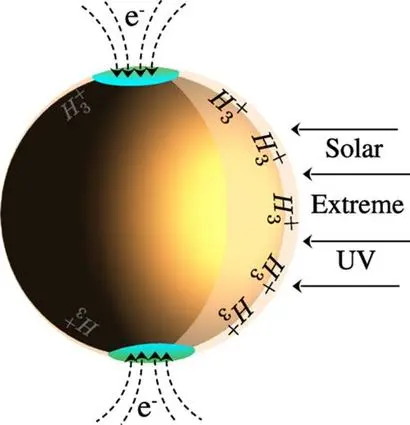
Trihydrogen cations also exist on Jupiter. They are created when high-energy solar wind particles from the Sun bombard the cloud tops. These ions are easily detected, especially on the sunlit day side of Jupiter facing the Sun. Furthermore, Jupiter has a powerful magnetic field. High-energy particles are concentrated at the north and south poles along magnetic field lines, creating bright auroras just as they do on Earth, which in turn generate more trihydrogen cations around the polar regions. Conversely, one would expect almost no trihydrogen cations on the dark night side, where there is no intense energy source to stimulate the hydrogen atoms in the clouds.
But that might not necessarily be the case! The energy source stimulating the hydrogen in Jupiter's clouds does not have to be solar wind or cosmic rays from the Sun. What if, for example, it were unknown particles constituting dark matter?
Originally, dark matter was a concept introduced to explain the excessively fast movement of stars within galaxies. It is presumed to be an unknown substance that neither absorbs nor emits light, does not interact with light in any way, and possesses only mass. It serves to fill the gravitational gap needed to explain the structure of the universe. The true nature of dark matter remains unknown. It is not even certain whether dark matter consists of small particles like other fundamental particles.
If dark matter is composed of particles, there is a glimmer of hope. Dark matter particles could potentially have corresponding antimatter or antiparticles. If a dark matter particle and its antiparticle collide, they can undergo an annihilation process, where their total mass is entirely converted into energy and they vanish. Although the dark matter particles themselves neither absorb nor emit light, the annihilation of dark matter particles and antiparticles can leave behind sufficiently intense energy in the surrounding space. In fact, some astronomers have attempted to find traces of high-energy gamma rays or X-rays that might be emitted by such annihilations. Of course, this observation has yet to yield definitive evidence.
Dark matter is usually discussed at the scale of galaxies or galaxy clusters to explain the motion of stars and galaxies. Therefore, it is commonly thought that dark matter exists only in galactic space. However, this is not necessarily true. Our solar system is part of our galaxy. If dark matter is spread throughout the galaxy, it surely permeates the space within our solar system as well. And there is a possibility that dark matter annihilations occurring throughout the solar system leave traces of high-energy signatures.
In this study, physicists focused on the possibility that dark matter annihilations could occur in the atmospheres of gas giants like Jupiter. If so, the intense energy released during the annihilation would stimulate the hydrogen atoms in Jupiter's clouds, forming highly unstable trihydrogen cations through the process described earlier. If more trihydrogen cations are detected in Jupiter's clouds than expected, it could serve as indirect evidence that dark matter particle annihilation is taking place within the planet.
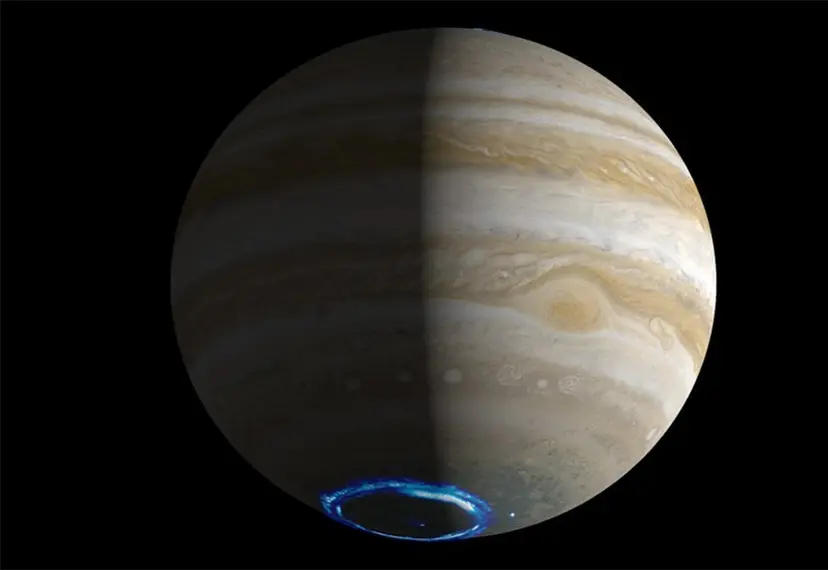
Of course, as explained earlier, there is more than one way to create trihydrogen cations on Jupiter. Hydrogen atoms in the clouds can be ionized by solar wind particles, and they are also formed when auroras are created along Jupiter's strong magnetic field. Therefore, it is necessary to distinguish between trihydrogen cations formed by these standard methods and those produced purely by energy released from dark matter annihilation.
To this end, the study focuses on the dark night side of Jupiter, away from sunlight—especially the night regions at low latitudes near the equator, far from the polar regions. If high levels of trihydrogen cations are detected even in the dark clouds of the night side, it would mean that hydrogen atoms are being ionized by another unknown energy source, not sunlight!
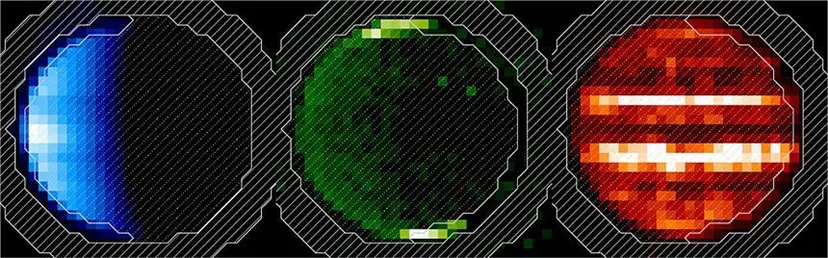
Do trihydrogen cations really exist on Jupiter's night side? In fact, this observation was attempted long ago. As the Cassini probe headed toward Saturn, it performed a flyby of Jupiter in December 2000. Cassini swept rapidly across the dark night side of Jupiter. During this process, sensors on Cassini checked for the existence of trihydrogen cations in the Jovian clouds.
Fortunately, trihydrogen cations leave traces in the 3–5 micrometer infrared spectral range, which we can observe routinely. Thus, identifying their existence and abundance is not very difficult. Unfortunately, however, the Cassini probe found no traces on the night side of Jupiter at the time. In other words, Cassini's exploration results indicated that no trihydrogen cations were detected on the night side.
Does this mean the idea proposed in this study—to use Jupiter itself as a massive dark matter detector—is a complete failure? Or rather, why propose such an idea now, when it was already confirmed by the Cassini mission more than 20 years ago that no trihydrogen cations were detected in Jupiter's clouds?
Interestingly, the fact that no trihydrogen cations were detected during the Cassini mission could actually be a clue that helps clarify the properties of dark matter particles, which remain unknown!
The failure of Cassini to detect any signal might not have been because there were zero trihydrogen cations, but because the amount was too small. It is possible that the intensity of light emitted by trihydrogen cations in Jupiter's clouds was too weak to reach the detection threshold of Cassini's instruments. We know quite accurately the detection limit of Cassini's equipment. Therefore, by applying this limit in reverse, we can constrain the maximum possible level of trihydrogen cation signals in Jupiter's clouds at the time. In other words, the range of energy levels that dark matter particles could be emitting is constrained—specifically, the maximum level of energy that dark matter particles annihilating within Jupiter could be generating!
The total energy potentially left behind in Jupiter by dark matter particle annihilation is determined by two main factors. First, the mass of each individual dark matter particle. As shown by Einstein’s famous formula E=mc^2, which demonstrates the principle of mass-energy equivalence, the total mass of the two dark matter particles that vanish during annihilation is converted entirely into energy. Therefore, the estimated energy range allows us to constrain the mass range of the dark matter particles.
The second factor is how frequently dark matter particles collide. How often each particle collides and the probability of their paths overlapping is determined by their cross-section. If the cross-section of each particle is large, the likelihood of collision is higher; if it is small, they are less likely to collide and will pass each other by. Ultimately, the total amount of energy that dark matter particles can release within Jupiter can be seen as a function determined by these two factors: particle mass and cross-section.
Because no trihydrogen cation signal was detected in the previous Cassini observations, we can assume that the amount of energy possibly generated by dark matter particles in Jupiter is below the detection limit of Cassini's instruments. While staying within this detection limit, we can propose a range for the physical quantities of dark matter particles by varying the hypothetical mass and cross-section!
This is a remarkable development because it allows us to constrain the search range for candidate dark matter particles. Instead of blindly searching for candidates in every mass and cross-section range, we can focus on specific ranges. This could provide an excellent guide for physicists who have been struggling for decades in laboratories to identify the true nature of dark matter!
Moreover, this study offers an even more intriguing guide. Does it have to be planets within our solar system? Naturally, dark matter could permeate gas-type exoplanets orbiting other stars. If dark matter annihilations similar to those in Jupiter occur there as well, we should be able to detect higher levels of trihydrogen cations on the dark night sides of exoplanets facing away from their host stars. Dark matter particles are expected to be more densely packed toward the center of our galaxy, where gravity is stronger. Therefore, it would be advantageous to observe exoplanets located near the galactic center where dark matter density is high. This analysis even presents predictions on the levels of trihydrogen cation signals that could be detected in the atmospheres of massive gas-type exoplanets (about 10 times the mass of Jupiter) if they were located 300 or 3,000 light-years from the center of our galaxy!
If the claims of this study are correct, we can now utilize massive gas planets like Jupiter and Saturn as giant dark matter detectors. We simply need to look for traces of energy released during the annihilation of dark matter particles hidden within the thick clouds. However, there is a significant limitation. To filter out only the traces caused by dark matter, we must look at the dark night side of gas planets facing away from the Sun. Yet, when observed from Earth, we only ever see the bright day side of Jupiter, Saturn, and other gas planets that reflect sunlight. Therefore, no matter how much we observe with ground-based telescopes or even the Hubble and James Webb Space Telescopes orbiting Earth, we cannot see the "back side" of gas planets.
Ultimately, to use Jupiter and Saturn as giant dark matter detectors, we need to send new probes to fly past and directly examine their dark night sides. The Cassini probe is an old, obsolete craft that visited Jupiter more than 20 years ago. We are now in an era where we can send new probes equipped with more advanced detectors capable of sensing even more subtle levels of energy.
Of course, it still takes years of waiting to travel from Earth to Jupiter and Saturn. But from an astronomical perspective, the fact that we can turn the nearby planets of our solar system—which can be reached within years—into a massive laboratory to solve the universe's greatest mystery, dark matter, is truly a stroke of luck. These gas giants at the edge of the solar system, which we once thought would only serve to help us understand planetary origins and evolution, may soon become the stage for a new era of solving the deepest mysteries of cosmology.
Video of Jupiter's polar aurora
https://www.youtube.com/watch?v=dplSgv6qlMk
https://esahubble.org/videos/heic1613a/
Video of Jupiter's magnetic field
https://svs.gsfc.nasa.gov/4142
Video of the Fermi Space Telescope's observation results, which searched for traces of gamma-ray light presumed to be emitted by the annihilation of dark matter particles in the center of our galaxy
https://svs.gsfc.nasa.gov/11513/
Visualization of dark matter particles densely packed, colliding, and orbiting rapidly around the black hole at the center of our galaxy
https://svs.gsfc.nasa.gov/4183/
Animation showing the process of dark matter candidate particles (WIMPs, weakly interacting massive particles) releasing energy as they collide and annihilate
https://svs.gsfc.nasa.gov/10955/
References
https://journals.aps.org/prl/abstract/10.1103/PhysRevLett.132.261002
https://agupubs.onlinelibrary.wiley.com/doi/10.1002/2015JA021097
About the author, Woong-bae Ji: He loves cats and the universe. After watching 'Galaxy Express 999' as a child, he dreamed of sharing the beauty of the universe. He is currently researching galaxy evolution through galactic interactions at the Center for Galaxy Evolution Research and the Near-Cosmology Laboratory at Yonsei University, while actively engaging in scientific communication through lectures and writing. He is the author of books such as 'The Astronomical Observatory of Sum,' 'Thinking About the Universe All Day,' and 'Stars, The Science of Light.'