

[비즈한국] As the aftershocks of the payment settlement crisis at Qoo10 subsidiaries TMON and Wemakeprice (the "TMAP crisis") continue, the government is busy preparing countermeasures, including providing support to affected businesses. The Democratic Party of Korea has formed a party-level task force (TF) regarding the TMAP crisis and has begun pushing for the enactment of an Online Platform Act to prevent a recurrence of such incidents.
While the government and political circles are focused on creating countermeasures, concerns are being raised that this incident could be a prelude to a wider crisis for the entire online shopping industry, given the worsening profitability of domestic online malls and the aggressive growth of Chinese shopping platforms like AliExpress and Temu.
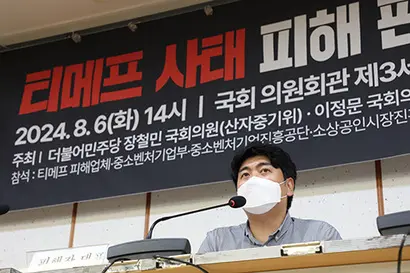
The government and the People Power Party held a consultative meeting on the 6th regarding the TMAP crisis and decided to provide liquidity to companies that suffered from payment delays. Accordingly, the authorities decided to support affected businesses with 200 billion won in emergency management stabilization funds and 300 billion won in guarantees through the Korea Credit Guarantee Fund and the Korea Technology Finance Corporation.
Kim Sang-hoon, Chairman of the Policy Committee of the People Power Party, stated after the meeting, "The party requested the government to expedite the execution of funds so that affected companies can receive support as soon as possible, and the government has agreed to proactively accept this." Following the agreement, the Financial Services Commission began accepting pre-applications for the liquidity support program on the 9th. However, critics point out that this is essentially a case of "paying off debt with more debt," and will only help companies maintain the status quo rather than providing a fundamental solution to the settlement crisis.
The opposition party is also accelerating its moves. On the 6th, the Democratic Party of Korea held a meeting of its TMAP Crisis TF, deciding to push for legal countermeasures and the holding of hearings regarding the failure to prevent the crisis. Cheon Jun-ho, head of the Democratic Party's TMAP Crisis TF, stated after the meeting, "We need fundamental measures to prevent a recurrence, and we believe an Online Platform Act is necessary," signaling his intent to push for legislation.
However, looking at the recent state of the online shopping industry, some point out that the TMAP crisis could be just the initial stage of a larger industry-wide crisis. This is because excessive competition among domestic market players is causing the profitability of online shopping malls to steadily decline. As seen in the TMAP crisis, once growth hits a ceiling despite large-scale investment, companies enter a cutthroat competition for market share, which in turn squeezes profitability further.
According to the Bank of Korea, the net profit margin (net profit relative to sales) of the telecommunications sales industry, which includes online shopping malls, has consistently recorded negative figures since 2015, with the exception of 2017. The interest coverage ratio (operating profit relative to interest expense) turned negative in 2021. The interest coverage ratio for the telecommunications sales industry was 165.3% in 2020, but plummeted to -287.6% in 2021 and -108.96% in 2022. An interest coverage ratio of 100% means that a company's earnings for the year are equal to the interest it must pay. Therefore, falling below 100% means the company is not earning enough to cover its interest payments, and the fact that this figure is negative highlights the alarming situation facing the online shopping industry.
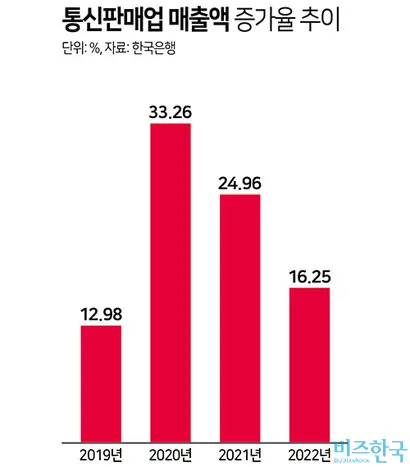
Productivity, along with profitability, is also poor. The value-added rate (value-added amount relative to sales) for the telecommunications sales industry was 30.23% in 2010, but it has steadily declined to 23.97% in 2022. Growth prospects are also worsening; the sales growth rate for the telecommunications sales industry was 33.26% in 2020, but it has been falling, recording 24.96% in 2021 and 16.25% in 2022.
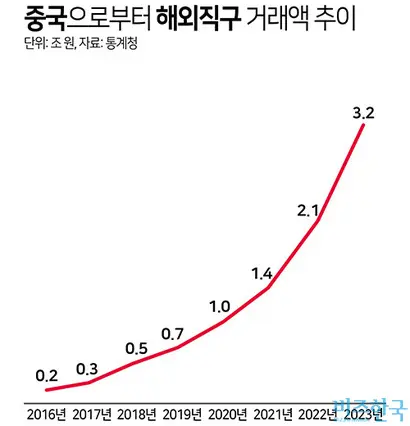
In this situation, the rapid surge in overseas direct purchases, particularly from China, is also dealing a blow to the domestic online shopping industry. South Korea's overseas direct purchases reached 6.7 trillion won last year, an increase of 26.9% compared to the previous year. China accounts for 48.7%, nearly half of all these direct purchases. Direct purchases from China were around 200 billion won in 2016, but they reached 1 trillion won in 2020, followed by a sharp rise to 2.1 trillion won in 2022 and 3.2 trillion won in 2023. Analysts suggest this is heavily influenced by the aggressive growth of Chinese online malls like AliExpress and Temu, which have been implementing low-price marketing strategies and free returns.