

[비즈한국] For South Korean defense companies eyeing the US market, 2025 is shaping up to be a critical year. This is due to both the US presidential election and the full-scale implementation of the US Department of Defense’s Cybersecurity Maturity Model Certification (CMMC). LIG Nex1079550’s 2.75-inch guided rocket, "Poniard," which recently cleared the final stages of the US Foreign Comparative Testing (FCT) and is nearing export, is also expected to navigate hurdles such as "Trump risk" and CMMC compliance.
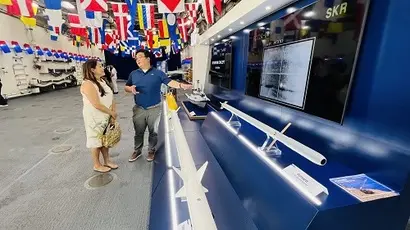
Poniard Proves Performance by Hitting All FCT Test Targets
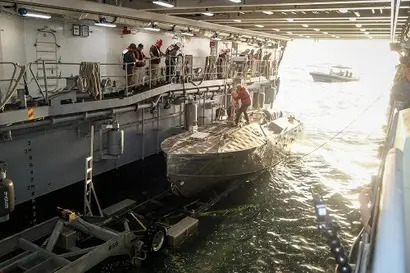
LIG Nex1’s 2.75-inch guided rocket, Poniard, successfully passed its final FCT evaluation after hitting all six targets during test launches in the waters off Hawaii. The FCT is a program designed by the US Department of Defense to evaluate superior technologies possessed by allied defense firms worldwide for potential integration into US development and acquisition projects. This live-fire exercise was conducted during the Rim of the Pacific (RIMPAC) exercise, based on an unmanned-based future operational concept scenario established by the US and South Korean navies. It marks the first instance for either nation where unmanned concepts were applied across the entire process, including unmanned target acquisition, aerial drone detection, satellite communications, and guided rocket launches from unmanned surface vessels (USVs).
Deployed by the South Korean Marine Corps in 2016, Poniard was developed as a vehicle-mounted weapon system designed to strike North Korean air-cushioned landing craft. To facilitate exports, LIG Nex1 independently developed a launcher for the 2.75-inch guided rocket capable of being mounted on small unmanned surface vessels.
LIG Nex1 integrated the Poniard—originally operated as a ground-based system by the military—into a launch system compatible with US firm Textron’s USVs, and verified its maritime operational capability. An LIG Nex1 representative who oversaw the on-site testing explained, “Because the FCT is a process of testing new weapon systems that the US does not currently possess, the US Navy’s performance requirements were extremely high. The fact that our military is actually operating Poniard on the front lines was a decisive factor in enhancing our credibility.”
Following the successful completion of these test launches, LIG Nex1 plans to focus on securing an export contract with the US and then aggressively expand into the global market. To this end, the company began requirement-generation activities with the US Navy last October and is proceeding with commercialization efforts in line with the unmanned operational concepts currently under review by the US Navy. However, steps such as formal US Navy requirement generation, budget acquisition, and contract verification remain before an actual contract can be signed.
RDP-A Signing Uncertain… CMMC Certification Mandatory Starting 2025
Experts emphasize that to export Poniard to the US, risk factors such as a potential Trump re-election and CMMC requirements must be addressed.
The US has officially entered the presidential election race. If former President Trump wins re-election, a return to "Buy American" policies—which prioritize domestic procurement—is expected. Some worry that if the US government focuses intensely on restoring a domestic-centered defense supply chain, South Korean defense firms may face difficulties entering the US market.
Furthermore, the US-Korea Reciprocal Defense Procurement Agreement (RDP-A), a "Defense FTA" currently being pursued with President Joe Biden, could be derailed. There is also speculation that it could be renegotiated in a way more favorable to the US. This essentially acts as a warning light for domestic defense companies that were aiming for US exports through an RDP-A deal.
The CMMC, which is set to be implemented as early as 2025, remains an urgent challenge for domestic defense firms. This is particularly critical if Poniard intends to pursue direct exports to the US.
The CMMC is a system by which the US Department of Defense evaluates and certifies the cybersecurity capabilities of defense contractors. All organizations that handle Controlled Unclassified Information (CUI) will be required to obtain CMMC certification in the future, and contract opportunities and scopes will vary depending on the level of certification. It is a mandatory requirement not only for US defense companies looking to do business with the Pentagon but also for global supply chain partners. Defense firms considering entering the US market must obtain this certification.
CMMC is divided into three levels. Level 1 (Basic) requires meeting 17 security requirements, Level 2 (Advanced) 110, and Level 3 (Expert) 134. It is understood that currently, no South Korean defense firm has obtained Level 2 certification.
In the future, it appears that South Korean defense companies will need to proactively obtain CMMC certification to export weapons like Poniard not only to the US but also to other US allies. Ryu Yeon-seung, a professor of Defense Security at Myongji University, explained, “Domestic defense majors will likely need to obtain Level 2 certification. We must also prepare a ‘Korean-style CMMC’ and work toward a mutual recognition agreement with the US. Only then will we be able to smoothly export weapons to the US and its allies in the future.”