

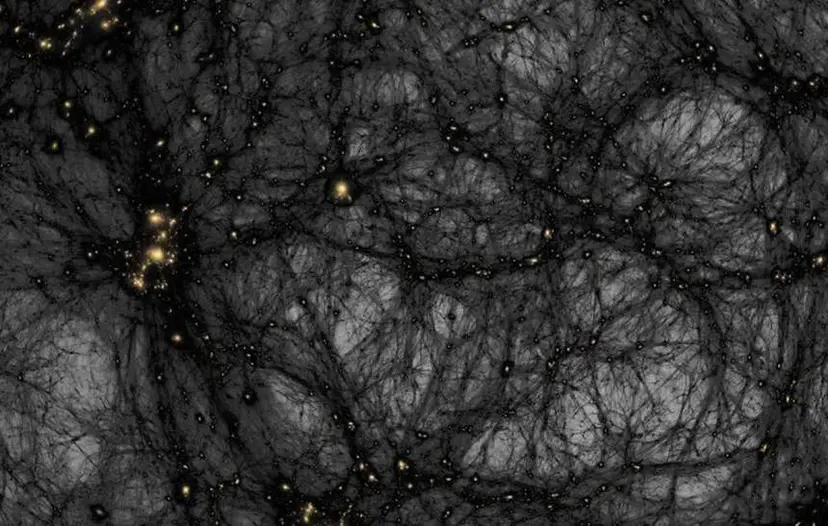
[비즈한국] Dark matter is known to account for nearly 80% of the universe's mass. It is far more abundant than the atoms that make up our bodies, planets, and stars. In fact, it is no exaggeration to say that the universe is not a world of brightly shining stars, but a world of dark matter. Yet, frustratingly, no one knows the true nature of this dominant substance in the universe.
Dark matter does not emit light. Therefore, no matter how much we look at the universe through telescopes, it is useless. Its presence cannot be confirmed through classical observations that detect light. It only reveals itself through the gravity exerted by its mass. Thus, the existence of this phantom known as dark matter can only be inferred through the gravitational traces it leaves behind.
When considering the nature of dark matter—that it does not shine but exerts strong gravity—another entity comes to mind: the black hole, an object whose gravity is so strong that not even light can escape, effectively puncturing the fabric of space-time. Many have long speculated that the mystery of dark matter, which emerged to explain the missing gravity in the universe, might actually be large and small black holes hiding in the darkness of space.
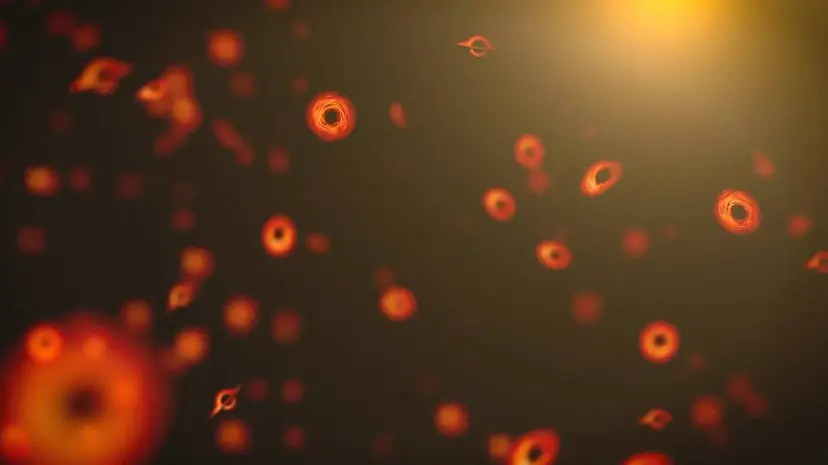
There are two types of black holes familiar to us: stellar-mass black holes, left behind when heavy stars several dozen times the mass of the Sun collapse at the end of their evolution, and supermassive black holes, which reside at the centers of galaxies and have masses millions to billions of times that of the Sun.
However, there is a possibility that more unique black holes are hidden in the universe: primordial black holes, which were born at the very beginning of cosmic history, immediately after the Big Bang. Primordial black holes can be much lighter than the Sun—some could be the mass of the Earth, or even as light as a single asteroid. Even if individual masses are very light, if a vast number of primordial black holes were floating around in space, filling the halo surrounding our galaxy, could they explain our galaxy's otherwise inexplicable excess mass? Could it be that the phantom known as dark matter, which fills our galactic halo more heavily than it appears, is actually the shadow of these primordial black holes?
Recently, an answer to this grand question has emerged. To find it, researchers utilized vast observation results spanning 20 years. What is the answer found after such a long wait? Sadly, there are no primordial black holes in the halo surrounding our galaxy. The dream of astronomers who hoped that dark matter was composed of primordial black holes has been shattered.
Primordial black holes are also famous for being a concept proposed by physicist Stephen Hawking. Unlike the black holes we are familiar with, which are created by the collapse of massive stars, primordial black holes are born in a completely different way. Immediately after the Big Bang, the universe was not perfectly uniform from the very beginning. Some regions had slightly higher or lower densities than their surroundings. Matter began to gather around regions with slightly higher density. These high-density regions became even denser, while low-density regions were emptied as matter was drawn away. Through this process, the large-scale structure of the universe, where galaxies are intertwined like a web, was completed.
These minute density differences in the beginning became the seeds for galaxies. Meanwhile, regions with higher density could have had matter gather rapidly in small areas, quickly kneading them into tiny mini-black holes. Not the general black holes left behind by dying stars after hundreds of millions of years of evolution, but imaginative entities that might have popped out at the very dawn of the universe, just after the Big Bang—this is how primordial black holes were likely born.
Some of these primordial black holes may have merged with each other early on, growing in size and eventually becoming the supermassive black holes at the centers of galaxies. However, an overwhelming number of primordial black holes might still be floating in space. What if countless primordial black holes were floating in the halo space around our galaxy? Could the gravitational effects of primordial black holes have been mistaken for the effects of dark matter? To confirm whether dark matter is truly composed of primordial black hole fragments floating in the halo, we must count how many such rogue black holes exist within our galactic halo.
The problem is that black holes are dark entities that do not emit light directly. If so, how can we detect their existence?
Black holes bend the surrounding space-time with their powerful gravity. As a result, the light from a distant background universe passing behind the black hole is bent in slightly different directions before reaching Earth, a phenomenon known as gravitational lensing. When we on Earth, a distant background celestial object, and another object with heavy gravity distorting space-time are nearly in a straight line, a gravitational lensing effect occurs where the light from the background object is distorted most severely.
You can think of gravitational lensing using a wine glass. Imagine placing a wine glass over a photo of the distant background universe observed by the James Webb Space Telescope. The base of a wine glass is not perfectly flat; the glass gets slightly thicker toward the center. Therefore, the photo seen through the bottom of the glass appears distorted. If you slowly move the wine glass over the photo, the celestial objects in the photo underneath will appear to slowly bend. Gravitational lensing in the actual universe is similar to this. When an object acting as a lens passes in front of the background universe as viewed from Earth, we see the light from beyond as a distorted, virtual image.
In particular, if the lens object is smaller and lighter, we can observe a more special phenomenon. Light from a background star that was bent in various directions around the lens object converges again toward Earth. Then, when viewed from Earth, the background star appears much brighter than it actually is. This phenomenon is called microlensing. Therefore, by constantly monitoring the background stars beyond our galactic halo and checking how often microlensing occurs—where stars briefly appear amplified in brightness—we can determine how many primordial black holes are floating in the halo and how heavy each of them is.
However, there is a catch. Microlensing happens purely by chance. It cannot be predicted. An object acting as a lens must accidentally pass almost directly in front of a background star. Furthermore, if you take your eyes off it and look elsewhere, the opportunity for observation is lost! Also, one must monitor consistently for a very long time to avoid missing these primordial black holes.
If an object with a mass not as heavy as the Sun acts as a lens, the phenomenon where the background star appears bright lasts about a week. If a lens object much heavier, about 100 times the mass of the Sun, bends the background star's light, the star will very slowly brighten over several years before returning to its original brightness. Therefore, to rigorously verify the existence of such heavy primordial black holes, one must watch the night sky constantly for years without interruption, capturing whether the amplification phenomenon occurs as background stars briefly brighten and dim!
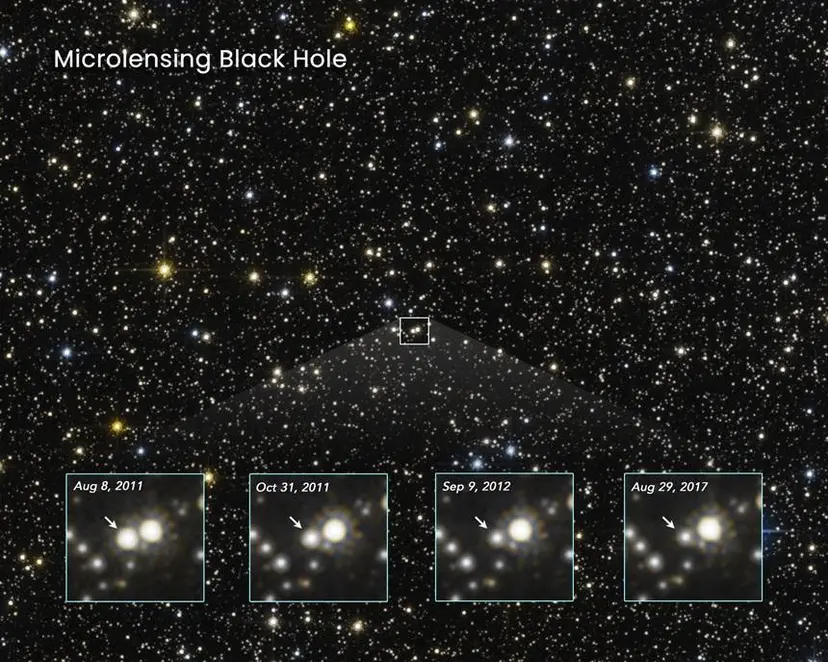
To this end, astronomers have been conducting a massive observation project called OGLE (Optical Gravitational Lensing Experiment), which tirelessly waits for and monitors microlensing phenomena occurring within our galaxy. In this analysis, they examined results from observing the sky toward the Large Magellanic Cloud, one of the satellite galaxies orbiting our galaxy, specifically to capture microlensing by primordial black holes that might be floating in our galactic halo.
If a primordial black hole happened to pass through the halo space between the Large Magellanic Cloud and Earth, a microlensing phenomenon could occur, making the starlight in the Large Magellanic Cloud appear brighter for a short time. To catch as many microlensing events as possible, including those by relatively heavy objects that last for years, astronomers analyzed vast observation data accumulated over 20 years, from 2001 to 2020. During that time, OGLE consistently monitored the brightness changes of nearly 80 million stars shining in the Large Magellanic Cloud.
If dark matter, which makes up most of the mass of our galactic halo, were entirely composed of primordial black holes, microlensing events should have been observed very frequently over the 20-year period. For example, if all the primordial black holes in our halo had a mass about 10 times that of the Sun, 258 microlensing events should have been observed in the sky toward the Large Magellanic Cloud during the entire observation period. Assuming the rogue primordial black holes in the halo were 100 times the mass of the Sun, we should have seen 99, or at least 27 events if they were 1,000 times the mass of the Sun. So, what were the results of the massive observation conducted over 20 years?
The result is devastating. Over 20 years, the OGLE survey captured only 12 microlensing events in the sky toward the Large Magellanic Cloud. Furthermore, when calculating the mass of the lens objects based on how bright the background stars appeared, all 12 events were simple microlensing caused by stars within our galaxy whose existence was already known. In other words, not a single microlensing event caused by a primordial black hole floating in the halo was confirmed. The primordial black holes in the halo predicted by Stephen Hawking were not found.
Even if you add up all the high-density objects that caused microlensing confirmed over the past 20 years, they do not fill the total mass of our galactic halo. Even if you gather all objects with masses between 1.8 × 10⁻⁴ and 6.3 times the mass of the Sun, they account for only 1% of the dark matter mass needed to fill our halo. Even including a wider range, gathering objects with masses between 1.3 × 10⁻⁵ and 860 times the Sun's mass only barely fills 10% of the total dark matter in our halo. In effect, primordial black holes cannot meet the target for dark matter in our galaxy at all. The primordial black hole, once considered one of the most promising candidates for the identity of dark matter, has now disappeared from the list of candidates.
If this observation had revealed that most of the dark matter mass was filled with primordial black holes, the mystery of dark matter might have been solved more easily. While the persistent mystery of the black hole itself would remain, a more peaceful conclusion would have been possible—that dark matter was not a mysterious substance, but just fragments of black holes that were hard to find because they were light in mass. However, this observation shows that we cannot even expect such a peaceful conclusion, pointing toward a conclusion that will most baffle physicists: that dark matter may be an entirely new substance made of mysterious particles that we have not yet grasped.
Reference
https://www.nature.com/articles/s41586-024-07704-6
Who is the author, Ji Woong-bae? He loves cats and the universe. After watching 'Galaxy Express 999' as a child, he dreamed of sharing the beauty of the universe. Currently, he researches evolution through galaxy interactions at the Galaxy Evolution Research Center and the Near-Field Cosmology Laboratory at Yonsei University. He also engages in various science communication activities, including lectures and writing. He is the author of books such as 'The Thumb-Tapping Observatory,' 'Thinking About the Universe All Day,' and 'Stars, The Science of Light.'