

[비즈한국] A "clinic opening license" linked to clinical training and a "license renewal system" that periodically verifies a doctor's fitness to practice are being actively pursued. The government announced that its 3rd medical reform plan, which includes these measures, will be released next year following discussions by the Special Committee on Medical Reform. With attention focused on whether the "lifetime license," which has long characterized medical licenses in Korea, will undergo changes, we examined the situation in the UK, which has already implemented both the clinic opening license and the license renewal system.

Clinical practice only possible after 2 years of training… Personal 'Medical Register' is fully open to the public
In the UK, there is a concept called a "license to practice." Unlike in Korea, where one can practice medicine without a separate license after passing the national medical licensing examination, one must undergo clinical training after obtaining a degree to be issued a license to practice. After obtaining a degree, a doctor must temporarily register for a license to practice and then complete full registration after finishing the first year of clinical training. The General Medical Council (GMC), the body responsible for license registration, was established in 1858. The GMC states that the purpose of license management is "to protect the public by ensuring that doctors' behavior, professional performance, and health meet specific requirements."
To be issued a license to practice, one must prove they possess the necessary knowledge, skills, and experience for medical practice. This is a recently revised requirement; previously, the focus was on the applicant's education and qualifications. The GMC provides the specific details required for each subject, and it typically takes about 3 to 6 months to be issued a license to practice. The portfolio submitted by the applicant can be viewed in the "Medical Register" on the GMC website. The register is open to all patients, and anyone can look up a doctor's information by searching their name or registration number.
Specifically, the Medical Register includes items such as: whether they hold a license to practice, general practitioner or specialist qualifications, revalidation year, designated body and responsible officer for revalidation, graduation school and year, dates of temporary and full registration, whether they are receiving additional medical training, and gender. This contrasts with Korea, where one can only identify the number of specialists by department per medical institution through the Health Insurance Review & Assessment Service. Furthermore, as the items indicate, doctors must periodically have their license to practice revalidated to continue their medical activities.
Revalidation every 5 years… 76% pass rate
The GMC describes this renewal as "a procedure for doctors to demonstrate that they are keeping their skills and knowledge up to date." Reasons given for the need for renewal include: supporting doctors in reflecting on their practice regularly, providing patients with confidence that doctors have the latest information, improving medical standards, and identifying areas for improvement in the organizations where doctors work. License renewal occurs every 5 years, and the GMC can revoke a doctor's license if they do not undergo revalidation.
While obtaining a license focuses on whether one has the "qualifications," renewal focuses on whether the medical professional is "capable of continuous practice." Consequently, "professional development" is an evaluation item, and it includes feedback from those who received medical services and evaluations from peers. A notable point is the "health statement" section. Doctors must complete a statement including any health conditions they wish to discuss with an evaluator. The GMC publishes "Good Medical Practice" every year to provide guidelines for managing health.
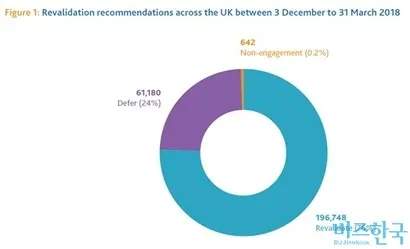
What are the renewal rates? The GMC prepared and released a report covering the statistics of the first 5 years after introducing the revalidation procedure. From December 2, 2012, to March 31, 2018, out of a total of 258,570 cases recommended for revalidation, 76% (196,748 cases) passed. 24% (61,180 cases) were deferred, and 0.2% (642 cases) were non-engaged. Looking at the age distribution, the non-engagement rate was 2.2% for doctors aged 70 and older, which was higher than other age groups.
Revalidation "deferrals" are mainly possible when information is unstable or in reasonable situations requiring additional time (maternity leave, sick leave, career breaks, or interruption of practice, waiting for information transfer). The deferral period can be chosen from 120 to 365 days. Other reasons for voluntarily relinquishing a license were recorded as: retirement (62%), overseas or planning to go overseas (24%), and quitting the medical profession or planning to quit (6%). In statistics by region of degree, those who received degrees in the UK had the highest number and rate of revalidation, followed by foreign universities and then European Economic Area universities. Conversely, the deferral rate was highest among European Economic Area universities.
Meanwhile, the government announced "advancing license management" as a detailed plan of the Essential Medical Policy Package last February. It included the phased introduction of a clinic opening license linked to clinical training and the establishment of a system for verifying fitness to practice. Subsequently, the Ministry of Health and Welfare announced the 1st to 3rd medical reform plans on the 31st of last month. The 3rd medical reform plan, which covers the clinic opening license and license renewal system, is scheduled for next year. If the clinic opening license is introduced, it may become difficult to open a clinic without completing resident training. As a result, there are perspectives within and outside the medical community that this is a tactic to pressure residents to return to work.