

[비즈한국] The president of the housing reconstruction association for Sinbanpo 15th (Raemian One Pentas) in Seocho-gu, Seoul, who sparked controversy after deciding to pay himself a 5.8 billion won incentive, has recently expressed his intention to decline the payment, according to a Bizhankook investigation. The complex had planned to award 1% of the development profits generated from the reconstruction project to the association president, but the scale of the incentive drew sharp criticism from both inside and outside the association.
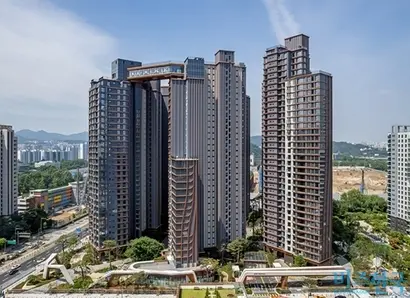
According to the urban renewal industry, a certain Mr. Kim, the president of the Sinbanpo 15th Reconstruction Association, informed members on the 4th that he would not accept the 5.8 billion won incentive that the association had resolved to pay him. It is reported that Mr. Kim promised to submit a memorandum to the association on the 5th formally refusing the incentive. Mr. Kim told members, "To normalize association operations, protect its interests, and ensure peace of mind for the members, I intend to put the incentive issue to rest," adding, "I will not accept any part of the incentive approved at the general meeting."
Previously, on the 19th of last month, the Sinbanpo 15th Reconstruction Association passed a motion at a general meeting of members to pay Mr. Kim a 5.8 billion won incentive. This amount was calculated as 1% of the association's estimated project profit (approximately 578 billion won). Mr. Kim is credited with having generated development profits despite difficult project conditions since taking office in 2017—a time when internal conflict was rampant—by navigating challenges such as the waiver of reconstruction charges, the replacement of the construction company, and the push for post-construction sales.
However, after the decision to pay the incentive was made, critical public opinion emerged both inside and outside the association, arguing that the amount was excessive compared to the president's actual contributions. In fact, Mr. Kim's incentive is higher than the bonuses received last year by the CEOs of Korea's two largest construction firms: Oh Se-chul, CEO of Samsung C&T (1.2 billion won), and Yoon Young-joon, CEO of Hyundai E&C000720 (600 million won). Following the meeting's resolution, some members raised objections, citing the payment as unjust, and initiated accounting audits and lawsuits; the controversy also drew criticism from the public after the news was reported.
This is not the first time a high-value incentive for an association president has sparked controversy. Early this year, the redevelopment association for the area around Bisan Elementary School in Anyang, Gyeonggi-do (Pyeongchon El Proud), pushed to pay its president a 5 billion won incentive (3 million won per household member), but canceled the plan following a Bizhankook report and the subsequent backlash. Previously, in September 2020, the Sinbanpo 1st (Acro River Park) reconstruction association in Seocho-gu, Seoul, decided to award 20% of additional profits to its president as an incentive; however, following a lawsuit, the Supreme Court ruled that only 7% was valid.
There are no legal regulations governing incentive payments for urban renewal project executives. In 2015, the Seoul Metropolitan Government amended its "Standard Administrative Regulations for Urban Renewal Associations," which established a principle that associations should not pay separate performance incentives to executives beyond their salaries and bonuses. However, as this is merely a notice based on an ordinance, there are no actual sanctions for violations. In effect, the prohibition on incentive payments to association executives is merely a recommendation.
Meanwhile, the Sinbanpo 15th association is also embroiled in a damage compensation dispute with its former contractor, Daewoo E&C047040. The complex selected Daewoo E&C as its contractor in 2017 but replaced them with Samsung C&T in 2019 following conflicts over construction cost increases. Daewoo E&C filed a lawsuit to confirm its status as the contractor, claiming the association terminated the contract unfairly, and secured a final victory in the Supreme Court in 2022. Just before completion this past June, Daewoo E&C provisionally seized the project site, claiming a 20.8 billion won damage claim resulting from the contract termination.
President Kim explained, "On the 2nd, the association urgently borrowed funds from Samsung C&T to deposit the full amount of Daewoo E&C's provisional seizure claim with the court and filed an application to cancel the execution of the seizure. Once a security deposit (release deposit) is made and an application to cancel execution is filed, the seizure must be lifted. Once the cancellation decision is issued, the provisional seizure will be resolved."