

[비즈한국] As the government moves to completely abolish the pre-feasibility study (pre-ta) for research and development (R&D) projects, critics are pointing out that the administration is wavering not only on its R&D policy but also on its commitment to fiscal soundness. The government had previously slashed this year's R&D budget by nearly 3 trillion won compared to the previous year, citing a need to rectify the "science cartel" in the name of fiscal health.
However, after facing persistent criticism that the move was out of sync with global trends of supporting cutting-edge technology, the government decided to increase the R&D budget again next year. Now, they have announced a policy to completely abolish the pre-feasibility study for R&D altogether. Concerns are being raised that this could undo the budget-saving effects achieved since the Yoon Suk-yeol administration took office and tightened pre-feasibility requirements in the name of fiscal soundness.
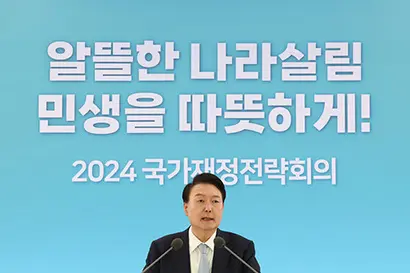
During the ‘2024 National Fiscal Strategy Meeting’ on May 17, President Yoon Suk-yeol instructed his cabinet to “completely abolish the pre-feasibility study for R&D, which is the foundation of growth, and significantly expand investment.” With countries like the U.S. and those in Europe expanding direct government support for advanced industries such as semiconductors, batteries, and electric vehicles, there had been discussions about the need to relax or selectively exempt R&D projects from pre-feasibility studies to increase Korea's direct support. President Yoon, however, went a step further by ordering the complete abolition of the studies in the R&D sector.
Currently, government-funded projects with a total cost of 50 billion won or more (with 30 billion won in state funding) must undergo a pre-feasibility study. The government plans to pursue legislative amendments to abolish the studies for R&D and, in the interim, expand exemptions for R&D projects until the laws are changed. In line with the government's policy, the ruling party has already proposed partial amendments to the National Finance Act and the Framework Act on Science and Technology to exclude R&D from these studies. Along with the abolition, the government has also announced plans to increase next year's R&D budget to the highest level ever.
However, critics argue that these fluctuating R&D budget policies have not only confused the scientific community but could also jeopardize the fiscal soundness that the Yoon Suk-yeol administration has championed as a core principle. When drafting this year's budget, the Yoon administration allocated 21.9 trillion won to R&D, a reduction of 2.8 trillion won from the previous year's 24.7 trillion won. They justified the drastic cuts by claiming that R&D budgets were being distributed like "handouts" within the scientific community.
Yet, in less than a year, they announced that they would increase next year’s R&D budget by 2.9 trillion won—the largest increase ever—to "strengthen R&D." However, due to the government's hot-and-cold policy, the actual net increase over two years is only 100 billion won, effectively keeping it stagnant. The bigger problem is that if the pre-feasibility study is abolished for R&D, the fiscal discipline that had been improved through these studies could be undermined.
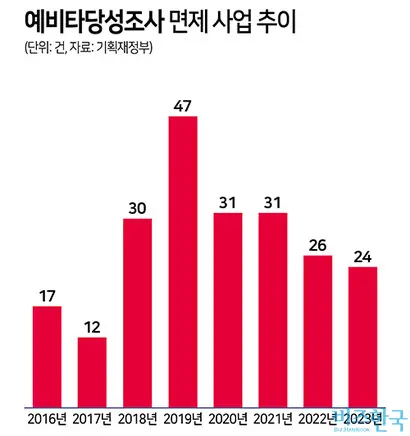
According to the Ministry of Economy and Finance, the number of projects exempted from pre-feasibility studies rose from 12 in 2017 to over 30 in 2018, and reached 47 in 2019. While there was a slight decrease in 2020 and 2021, they remained in the 30s. After the Yoon Suk-yeol administration took office and emphasized fiscal soundness, the number of exemptions began to trend downward, with 26 in 2022 and 24 in 2023.
As the number of exemptions decreased, the total project costs also declined. The total cost of projects exempted from pre-feasibility studies, which was 12.8798 trillion won in 2018, surged to 35.975 trillion won in 2019 and remained over 30 trillion won in 2020 at 30.0215 trillion won, before falling to 11.9999 trillion won last year. Under the Yoon administration, the total cost of exempted projects was cut by more than half, contributing to the goal of improving fiscal soundness.
The fiscal improvement effect of these pre-feasibility studies also applies to the R&D sector. According to the National Assembly, of the 138 R&D projects that completed a pre-feasibility study between 2018 and 2023, 71 were approved. The original total cost requested by the ministries for these 71 projects was 58 trillion won, but through the pre-feasibility process, the cost was adjusted to 32.2 trillion won. In effect, the pre-feasibility study process for R&D projects led to a budget saving of 25.8 trillion won.