

[비즈한국] Expectations for nuclear power exports are rising as Korea Hydro & Nuclear Power (KHNP) was recently selected as the preferred bidder for the Czech Republic's nuclear power plant construction project. Korea’s record of new nuclear power plant exports disappeared for six years after 2014, only to begin reappearing in 2022. Analysts suggest that as previously won nuclear projects were completed and unveiled, Korea’s nuclear technology and price competitiveness have begun to be recognized in the market.
Selected as Preferred Bidder for 24 Trillion Won Czech Nuclear Project
“Team Korea,” consisting of KHNP and private companies, was selected as the preferred bidder for the Dukovany nuclear power plant construction project in the Czech Republic on the 17th. The project involves building two large-scale 1,000-megawatt (MW) nuclear reactors (units 5 and 6) in the Dukovany region, located 200km from the Czech capital, Prague. The estimated project cost is around 24 trillion won. The Czech government is currently planning to build two additional reactors (units 3 and 4) in the Temelín region, 130km from Prague, and KHNP is also eyeing that project.
For this new Czech nuclear project, KHNP formed a consortium with KEPCO E&C052690 (design), Doosan Enerbility034020 (main equipment, construction), Daewoo E&C047040 (construction), KEPCO NF (nuclear fuel), and KEPCO KPS (commissioning, maintenance). Barring any unforeseen issues, they plan to sign the main contract next March and provide a turnkey supply for all nuclear construction tasks, including design, procurement, construction, commissioning, and nuclear fuel supply. As the lead construction contractor, Daewoo E&C will be responsible for overall construction, including main equipment installation and infrastructure development, in partnership with Doosan Enerbility.
A Daewoo E&C official stated, "As we are yet to sign the final contract, we will pull ourselves together and do our absolute best in negotiation preparations as a member of Team Korea to not only secure the Dukovany 5 and 6 contracts but also the Temelín 3 and 4 construction contracts. We will do our utmost until the end to build a perfect-quality nuclear plant so that Korea's superior technological prowess can once again be known to the world."
Overseas Nuclear Exports Resume Under Yoon Suk Yeol Administration
Overseas nuclear power exports have shown signs of resuming since the launch of the Yoon Suk Yeol administration. According to nuclear project order statistics provided by the International Contractors Association of Korea (ICAK) at the request of Bizhankook, Korean companies have won a total of 12 overseas nuclear power projects (with a cumulative order value of $22.5 billion, or 31 trillion won) up to last year. New overseas nuclear power orders, which had disappeared for six years after recording 4 projects ($500 million) in 2014, began to reappear with 1 project in 2022 ($2.5 billion) and 2 projects in 2023 ($300 million).
Abolishing the nuclear phase-out policy and restoring the nuclear industry ecosystem are key national tasks of the Yoon Suk Yeol administration. In July 2022, the government selected these as the third national task when announcing the 120 national tasks of the Yoon administration. The vision is to actively utilize nuclear power as a means for energy security and carbon neutrality, strengthen the competitiveness of the nuclear ecosystem, and leapfrog to become a nuclear powerhouse through strengthening the ROK-U.S. nuclear alliance and expanding exports. The government has set a goal to export 10 nuclear reactors by 2030 while resuming the construction of the Shin Hanul 3 and 4 reactors domestically.
President Yoon Suk Yeol said at a cabinet meeting on the 30th, "A strong bridgehead has been established to enter the global nuclear market, which is worth 1,000 trillion won. In this bidding process, we had to put a lot of effort into overcoming the decline in credibility caused by the nuclear phase-out policy. It is urgent and critical to establish an institutional foundation so that our nuclear industry can grow steadily without being affected by changes in government."
Will Nuclear Exports Continue with ‘Technological Prowess and Price Competitiveness’?
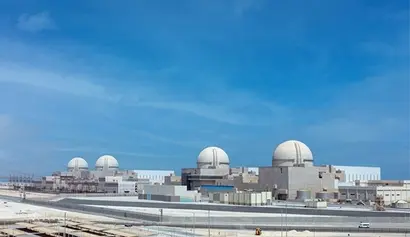
Korea’s nuclear technology is being proven through its results. The Barakah Nuclear Energy Plant in the UAE, the largest in the history of nuclear exports and the first to be built in a desert region, is a prime example. The KEPCO consortium, consisting of KEPCO, KHNP, and Hyundai E&C, won the project in December 2009 to build four large-scale nuclear reactors in Barakah, west of Abu Dhabi, the capital of the UAE. According to the industry, units 1 to 3 of the Barakah plant have begun commercial operation, and unit 4 is currently under construction.
Korea also possesses price competitiveness compared to other countries. According to the World Nuclear Association (WNA), Korea’s nuclear construction cost per kilowatt (kW) is $3,571, which is lower than that of competitors such as France ($7,931) and the U.S. ($5,833). KHNP, France’s EDF, and the U.S.’s Westinghouse participated in the Czech tender. As the Czech government expanded the order scale from the initial 1 unit to up to 4, the competition evolved into a two-way race between Korea and France, who submitted revised bids.
Currently, Korea’s nuclear power exports are centered around KHNP and KEPCO, which hold the reactor technology. It is reported that KHNP is pursuing nuclear projects in countries such as Poland, Romania, and the Netherlands, while KEPCO is active in the UAE, the UK, Turkey, and South Africa. An official from the Ministry of Trade, Industry and Energy's Nuclear Export Cooperation Division stated, "These countries are promising export targets, and we will accelerate cooperation (for nuclear exports) in the future."
A nuclear industry official predicted, "A major advantage is that KHNP or KEPCO receive integrated package orders and lead the projects while bearing the risks of multi-trillion won deals. If the Czech project is successfully completed, it is highly likely that leading Korean construction companies with excellent technical skills will enter various European nuclear markets, including neighboring countries like the Netherlands."