

[비즈한국] Anxiety is growing among vendors whose funds have been tied up due to the TMON and WeMakePrice crisis. While Qoo10 Group CEO Ku Young-bae, the parent company of TMON and WeMakePrice, stated that he would "try to secure liquidity even if it means using personal assets," the subsequent revelation that he had filed for corporate rehabilitation for TMON and WeMakePrice in court has only deepened the despair of vendors who have not received their settlements. The government has introduced a support package worth 560 billion won for small business owners to handle the situation, but critics are calling it "closing the stable door after the horse has bolted."
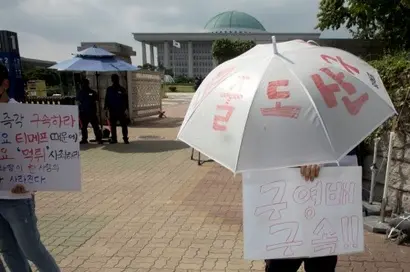
As the TMON-WeMakePrice crisis, which began with unpaid travel product settlements, leads to court receivership for both companies, concerns are mounting that it could trigger a chain reaction of bankruptcies for SMEs and small business owners. On July 29, TMON and WeMakePrice filed for corporate rehabilitation procedures with the Seoul Bankruptcy Court. In such cases, payments due to creditors are frozen and a portion of the debt is written off. Since the path to civil litigation, such as claims for damages, is also blocked, vendors are left watching the situation with no clear end in sight. Furthermore, with another Qoo10 subsidiary, Interpark Commerce, announcing on July 30 that "settlement delays have occurred due to the impact of unpaid settlements from TMON and WeMakePrice and the suspension of payment processing by PG companies," additional damage is expected.
As the situation worsened, the government and the National Assembly stepped in. On the 30th, the National Assembly's National Policy Committee held an emergency hearing, calling in Qoo10 Group CEO Ku Young-bae, WeMakePrice CEO Ryu Hwa-hyun, and TMON CEO Ryu Kwang-jin to urge them to present countermeasures. Previously, on the 29th, financial authorities launched a 560 billion won funding support plan to provide liquidity for vendors. The Korea SMEs and Startups Agency and the Korea Small Business Institute are providing 200 billion won in emergency management stabilization funds, while the Korea Credit Guarantee Fund and Industrial Bank of Korea024110 are supporting 300 billion won in low-interest loans.
However, among vendors, there is a loud consensus that this crisis was a "foreseen catastrophe." They argue that the habitual settlement delays, frequent discount events, point sales to secure cash, and pre-sales of gift certificates were all "danger signals" characteristic of platforms obsessed with rapid expansion.
Cases of vendors suffering due to a platform's financial difficulties have occurred consistently. In January 2023, an unpaid settlement crisis occurred at the live commerce platform "VOGO" (operated by VOGO Play). VOGO gained popularity with unconventional discount benefits, such as offering up to 100% of the payment amount in points depending on the product, but it could not bear the accumulated deficit and suspended services.
At the time, VOGO, like Qoo10, used vendor payments for operating expenses in a "robbing Peter to pay Paul" manner, causing significant damage to the vendors on the platform. The unpaid settlement amount for VOGO reached 33.6 billion won. VOGO attempted self-rehabilitation, such as changing its settlement system, but eventually filed for corporate rehabilitation, finishing the process and resuming services in May of this year. In the aftermath of the VOGO crisis, the review commerce platform "House App" also notified its vendors of its inability to settle payments in February of last year.
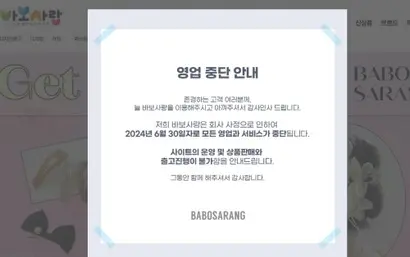
Damage has occurred this year as well. Design stationery platform "Babosarang" (operated by Webiz) suddenly announced its closure on its website on July 1. It was a "hit-and-run" closure where all employees had already resigned in advance, and payments to vendors were never settled. Even for entrusted products, vendors had to go to the logistics center themselves to retrieve their inventory. The damaged companies have filed criminal complaints and civil lawsuits against the CEO of Webiz, but since Webiz has signaled a bankruptcy filing, it is unclear whether they will recover their funds.
As such, critics point out that the lack of institutional mechanisms has amplified the aftermath of the TMON-WeMakePrice crisis. The biggest issue cited is that settlement cycles vary for every platform. Because there are no guidelines or regulations, settlements take an average of 50 to 60 days, and up to 100 days in some cases, yet small business owners and SMEs have no choice but to join because they need the sales. It is also noted that the long-term holding of vendor payments by platforms has led to the misappropriation of funds or non-payment crises.
Bang Ki-hong, chairman of the National Stationery Store Revitalization Association, emphasized, "Due to the COVID-19 pandemic, offline sales have shrunk significantly, and the online market has grown. When the share of online sales increases, vendors have no choice but to follow the platform's unfair policies, even if they know they are unfair. From the start, vendors have no authority to negotiate terms." He added, "The reason platforms can 'rob Peter to pay Paul' with settlement money is that they hold onto the funds for a long time. The Fair Trade Commission should have taken action when the warnings were first issued."
There is also an opinion that the government missed the opportunity to prevent the crisis. Ahn Jin-geol, director of the People's Livelihood Economy Research Institute, stressed, "Legal measures such as regulations on settlement cycles and insurance for vendors are necessary. I believe the government was not unaware, but simply sat on its hands. They should have regulated it through related laws, such as requiring parts of the funds to be entrusted to institutions or held in trust so that platforms cannot touch vendor payments."
Bills regarding fair trade on online platforms have been proposed several times in the National Assembly but have failed to pass. In the 21st National Assembly, 20 bills related to online platform brokerage transactions were proposed, but all were scrapped due to the expiration of the term. In the current 22nd National Assembly, five have been proposed but remain pending. The "Act on Monopoly Regulation and Fair Trade in Online Platforms," representatively proposed by Democratic Party lawmaker Park Ju-min on July 5, includes provisions to set the deadline for payment of sales proceeds within 40 days and to require platform operators to pay interest if payment is made after 40 days.
Without regulations, there is no proper way for vendors to cope when an unpaid settlement crisis occurs. Unlike consumers, there is no single agency for complaints or reports. The only option for vendors who have been cheated out of their money is to file criminal complaints with the police or initiate civil lawsuits. However, if there are no funds left on the platform or the operator goes into hiding, it is realistically difficult to recover the money.
Lawyer Yang Chang-young (Head of the People's Livelihood Hope Headquarters at People's Solidarity for Participatory Democracy) expressed concern, saying, "Even if you win in a civil court, if there is no capital, the judgment becomes meaningless because there are no assets to enforce against. While fraud charges could theoretically be established if it is confirmed that they induced continued transactions without any intention or ability to pay, you cannot judge based on just a few facts. The solution to this crisis remains far off."