

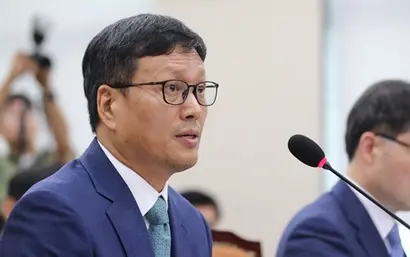
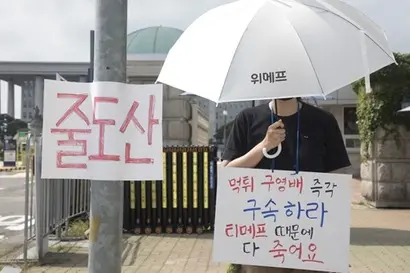
[비즈한국] As TMON and WeMakePrice, which triggered a massive settlement delay crisis, filed for corporate rehabilitation, their parent company Qoo10 CEO Ku Young-bae appeared before the National Assembly on the 30th. This comes 13 days after Qoo10 issued an official apology regarding the WeMakePrice and TMON crisis. CEO Ku bowed his head repeatedly, stating, "I will naturally accept all criticism, accountability, and punishment. I will put forward everything I have (to resolve the situation)." Although the group CEO stepped forward to express his will for damage recovery, the sellers' losses have become inevitable due to insufficient debt repayment capacity and the companies' filing for rehabilitation. Often called the "godfather of first-generation e-commerce" for writing the "Gmarket success story," CEO Ku is now facing his worst crisis.
Character
Qoo10 CEO Ku Young-bae returned to the domestic market in 2022 by acquiring TMON, WeMakePrice, and Interpark Shopping one after another. Having spent 25 years in the industry since the first generation of e-commerce, he is a founding member of Interpark and the founder of Gmarket.
Born in 1966 in Gurye, South Jeolla Province, CEO Ku graduated from Seoul National University with a degree in Mineral and Petroleum Engineering. His first job was with Schlumberger, an American petroleum exploration technology company that was far removed from the e-commerce business. As Schlumberger is a service company that manages oil well measurement and resources, employees' main duties involved exploring oil in deserts and at sea. From 1991, when he joined the company, CEO Ku spent eight years conducting oil exploration in the Middle East, India, and Oman. He also met his wife, known to be of Indian aristocratic descent, during his time working locally.
Career
His connection with the e-commerce industry began in 1999 when he met then-Interpark Chairman Lee Ki-hyung. CEO Ku is the man behind the Gmarket success story, which started with the internal Interpark venture "Goosdak." Appearing at the emergency pending issue inquiry at the National Assembly's National Policy Committee on the 30th, CEO Ku emphasized his successful experience with Gmarket and his more than 20 years of industry experience.
After joining Interpark, CEO Ku launched Goosdak in 2000 as a separate entity with a capital of 1 billion won, applying the auction model. While it did not achieve significant results at the time, it changed its name to Gmarket in 2003 and grew rapidly by introducing an open-market business model.
Two years after its launch, Gmarket surpassed 1 trillion won in gross merchandise volume (GMV), and in 2007, it reached an annual GMV of 3 trillion won, the first in the e-commerce industry, overtaking the industry leader, Auction. This was also when Gmarket was listed on the NASDAQ in the U.S. By 2008, it recorded a GMV approaching 4 trillion won. Even eBay, the world's largest e-commerce company that owned Auction, struggled in the face of Gmarket. Eventually, eBay gave up on competition and chose to acquire Gmarket. CEO Ku, who held a 5.1% stake in Gmarket (2,559,850 shares), walked away with 71.5 billion won at the time.
Capability
Leaving the Gmarket myth behind, CEO Ku stepped into the Asian market. Established in Singapore in 2010 as a joint venture with eBay, Qoo10 grew its local footprint and even earned the nickname "the Amazon of Singapore." It is evaluated that Korean products, with higher quality standards and technology than Chinese goods, contributed to Qoo10's growth. The capabilities of Qxpress, a logistics subsidiary providing fulfillment services, also helped solidify Qoo10's influence.
Based on its success in Singapore, Qoo10 expanded into Japan, Indonesia, Malaysia, China, and Hong Kong. Once the 10-year non-compete clause with eBay expired, CEO Ku started up again in the domestic market. After acquiring TMON in 2022, he went on to acquire WeMakePrice, Interpark Shopping, and AK Mall in sequence. These companies had already lost momentum to competitors like Naver, Coupang, SSG.com, and Gmarket. Immediately after the acquisitions, TMON showed signs of a performance rebound, with its transaction volume increasing by 60% compared to the same period the previous year. Qoo10 Group's goal was to form a coalition of first-generation e-commerce companies to seek new growth engines and increase synergy among group companies.
Critical
CEO Ku emerged as a major player in the global e-commerce market, extending beyond Asia by acquiring the U.S. shopping platform Wish early this year. However, his aggressive moves led to a crisis. The biggest cause identified for the TMON and WeMakePrice settlement delay is CEO Ku's "octopus-style" business expansion and the "shell game" of shuffling sales proceeds. Analysis suggests that by aggressively increasing subsidiaries for the listing of Qxpress and exploiting the long settlement cycles of the shopping platforms, a liquidity crisis occurred where sales proceeds could not be settled.
Appearing at the emergency pending issue inquiry at the National Assembly's National Policy Committee on the 30th, CEO Ku emphasized that there was no intent to commit "fraud." CEO Ku said, "This situation was not caused by fraud or intent, but due to problems that have accumulated over more than a decade," adding, "I acknowledge the criticism that I proceeded with aggressive M&A and marketing in an environment where the economic situation was deteriorating."
Regarding the criticism that his sincerity is doubtful because he proceeded with TMON and WeMakePrice's rehabilitation process on the same day he announced he would contribute his own funds to handle the situation, he replied, "For the past two weeks, I have tried to raise funds by using my shares as collateral. Most of the funds were used for promotions amidst fierce price competition." Regarding the rehabilitation process, he emphasized, "I will repay all debts through Autonomous Restructuring Support (ARS)." Concerning the $25 million (about 34 billion won) borrowed from TMON/WeMakePrice and invested in the Wish acquisition, he explained, "The loan was repaid within a month and has nothing to do with this settlement delay crisis," denying that he siphoned off seller settlement funds for M&A purposes.
Challenges
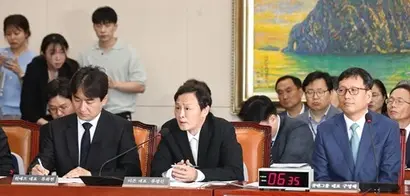
Currently, CEO Ku, Qoo10 Korea CEO Mok Ju-young, TMON CEO Ryu Kwang-jin, and WeMakePrice Co-CEO Ryu Hwa-hyun are under a travel ban. The police launched an investigation on the 29th after receiving complaints against CEO Ku and four other related individuals. The prosecution also proactively formed an investigation team ahead of the financial authorities' request for investigation. This is based on the judgment that the case is a large-scale crime affecting people's livelihoods and that small vendors are at risk of a chain of bankruptcies due to the settlement delays.
The total group funds CEO Ku stated he could mobilize amount to a maximum of 80 billion won. This is vastly insufficient to cover the estimated 1 trillion won in unpaid settlements, making self-recovery impossible. This is why critics say CEO Ku's remarks, such as "Please give me a little time" and "I need some help from the government," are hollow. Even these funds are not immediately available. Amidst growing criticism regarding the moral hazard of key executives, TMON CEO Ryu Kwang-jin and WeMakePrice CEO Ryu Hwa-hyun appeared at the inquiry and revealed that all financial management for TMON and WeMakePrice had been handled by Qoo10 Technology, under the parent company Qoo10.
The situation is spiraling downward. As the court decided to freeze the assets and claims of TMON and WeMakePrice following their rehabilitation filings, settlement payments and consumer refunds have halted, and the possibility of settlement delays at Interpark and AK Mall is also being discussed. Financial Supervisory Service Governor Lee Bok-hyun confirmed that TMON and WeMakePrice have soundness or liquidity issues exceeding 1 trillion won. Governor Lee stated, "Considering the cumulative losses of TMON and WeMakePrice through July of this year, damages exceeding 1.2 trillion to 1.3 trillion won are expected," adding, "We have requested an investigation by the prosecution because there are already strong traces of illegal activities revealed during the fund-tracking process."