

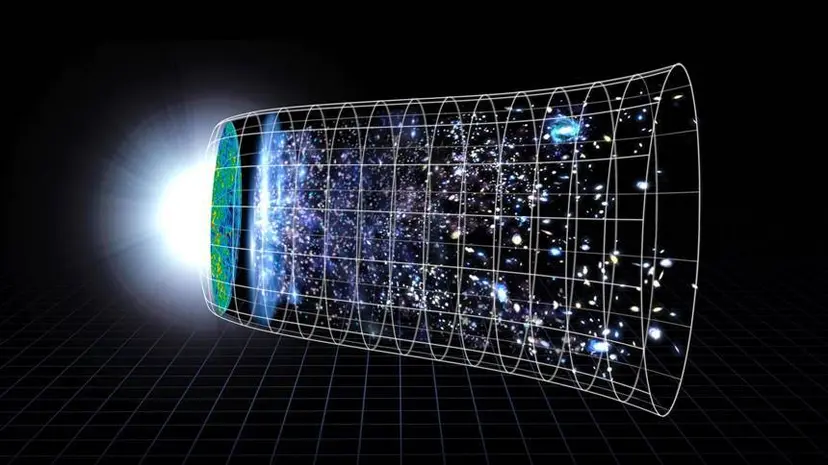
[비즈한국] The universe, which began with the Big Bang 13.8 billion years ago, has been expanding steadily. Various independent observational pieces of evidence all show that universal spacetime is expanding. At the very least, the grand fact that "the universe is expanding" is a clear reality that no astronomer in modern cosmology denies. However, when digging deeper, astronomers' opinions on the universe's expansion model differ slightly. The most important issue is the question regarding the expansion rate: "Exactly how fast is our universe expanding?"
This challenge, which has plagued astronomers for a long time, has not yet been clearly explained. However, this puzzle could be a clue that reveals unexpected new possibilities about our universe.
Traditionally, the expansion of the universe is observed through the recession of galaxies as the distance to surrounding galaxies increases. As the entire universal spacetime expands uniformly, galaxies located further away are observed to be moving away at higher speeds. This relationship, where the distance to a galaxy is proportional to the speed at which it recedes, is called the Hubble-Lemaître law. It is the most direct observational evidence for the expansion of the universe.
On the other hand, there is also a method to prove the universe's expansion using the traces of the Big Bang's heat, which remained as the universe, initially at a very high density and temperature, slowly and uniformly cooled down. This residual heat from the Big Bang is observed in the form of faint radio noise emanating from all over the universe today. This is called the Cosmic Microwave Background (CMB).
The problem is that the two representative expansion rates of the universe—from galaxy recession and the CMB—are measured slightly differently. The expansion rate estimated from the CMB is 67 km/s/Mpc. In more familiar terms, this means that a region of space 1 megaparsec (about 3 million light-years) away is receding at a speed of 244,000 km/h.
However, when measuring the expansion rate through the recession of galaxies, a slightly different value emerges. Recently, by observing bright Type Ia supernovae, astronomers have measured the distances and recession speeds of galaxies in the universe as far as over 10 billion light-years away. The expansion rate estimated this way is 73 km/s/Mpc. Similarly converted, this means a region 1 megaparsec away is receding at a speed of 264,000 km/h.
Interestingly, the expansion of the universe estimated via the recession of galaxies (through supernova observations) is measured to be about 10% faster than the expansion estimated solely through the CMB. We are clearly looking at the same universe using different methods, yet the universe appears slightly different depending on the method used. This baffling mystery of modern astronomy is called the "Hubble Tension."
Then, why does the expansion of the universe, estimated by the movement of distant surrounding galaxies, appear slightly faster than the expansion estimated by the CMB?
The movement of galaxies filling the universe actually involves a complex mix of factors. Beyond the effect of increasing distances between galaxies as universal spacetime expands, there is also the effect of adjacent galaxies pulling on each other with their respective gravity. Therefore, to determine the expansion rate of the universe from galaxy movements, one must filter out the effect of galaxies pulling each other along. This movement of galaxies being pulled by each other's gravity is called the "bulk flow" of galaxies. Such individual galactic gravitational interactions can act as a disturbance, making it difficult to grasp the pure expansion effect of spacetime using only galaxy observations.
After observing the direction and speed in which surrounding galaxies move, if one subtracts the expected effect of galaxies moving away due to the expansion of spacetime from their total movement, the effect of gravity pulling them in specific directions can be isolated. Recently, astronomers conducted observations to identify the bulk flow of galaxies moving purely due to each other's gravity across a vast region of the universe. This is the "Cosmicflows" project, which identifies the locations and movements of 180,000 galaxies within about 100 million light-years of the Milky Way to analyze only the bulk flow effect, excluding the expansion effect.
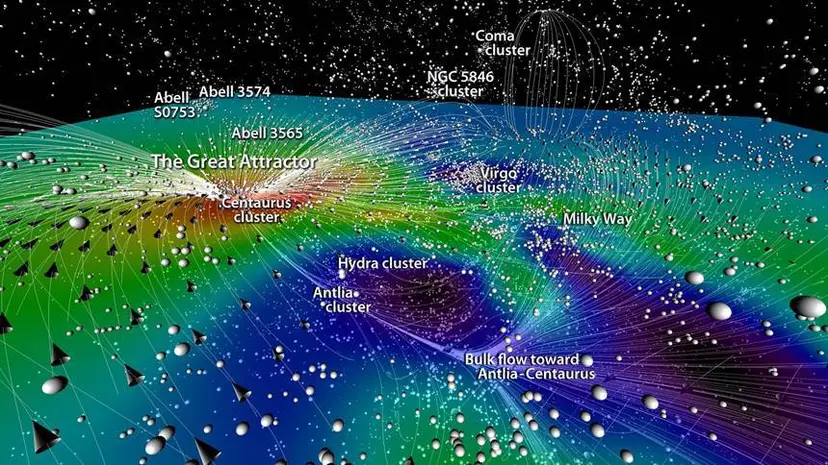
However, astronomers who analyzed the Cosmicflows data discovered an unexpected result. Most of the many galaxies within about 80 million light-years appear to have a consistent average movement, flowing more rapidly toward a specific direction near the constellation Centaurus. It is as if some massive concentration of matter beyond that direction is consistently pulling the galaxies. This harbors the possibility that galaxies might be pulled slightly faster outward, attracted by gravity from a region with higher density than our surroundings.
Based on this bulk flow of galaxies, some astronomers have long hypothesized that the Milky Way might be located near a vast, empty region—a "giant void"—where the galaxy density is relatively lower compared to its surroundings. Galaxies filling the universe are not distributed randomly. Higher density regions have stronger gravity and accumulate more matter, while lower density regions lose matter to all sides, leaving behind empty voids. Thus, galaxies form a complex, web-like cosmic large-scale structure. If our galaxy were truly near a giant "Local Void," it would explain why the surrounding galaxies appear to be moving away in all directions faster than the expansion estimated by the CMB.
Around the Local Void, there are regions where galaxies are more densely clustered. Consequently, galaxies near our Milky Way are continuously pulled toward these high-density regions in all directions. From our perspective living near the center of the Local Void, it can appear as though the surrounding galaxies are moving away in all directions more rapidly!
In fact, when this analysis applies the faster movement of surrounding galaxies confirmed by the Cosmicflows project back to the expansion rate estimated by previous supernova observations, it shows that the Hubble Tension can surprisingly disappear quite neatly. Once the bulk flow movement—where our surrounding galaxies are consistently pulled in one direction—is corrected, the expansion rate estimated by supernova observations decreases from 73 km/s/Mpc to 69 km/s/Mpc. This is a value nearly identical to the expansion rate estimated solely by the CMB!
So, is our Milky Way really situated near a giant void with a density much lower than the cosmic average? To explain the mystery of the Hubble Tension, our galaxy would need to be near a void that is about 20% less dense than the cosmic average. However, there is a problem. The existing standard model of universal evolution, the ΛCDM model, which assumes dark matter and dark energy, has difficulty producing such a massive, empty void.
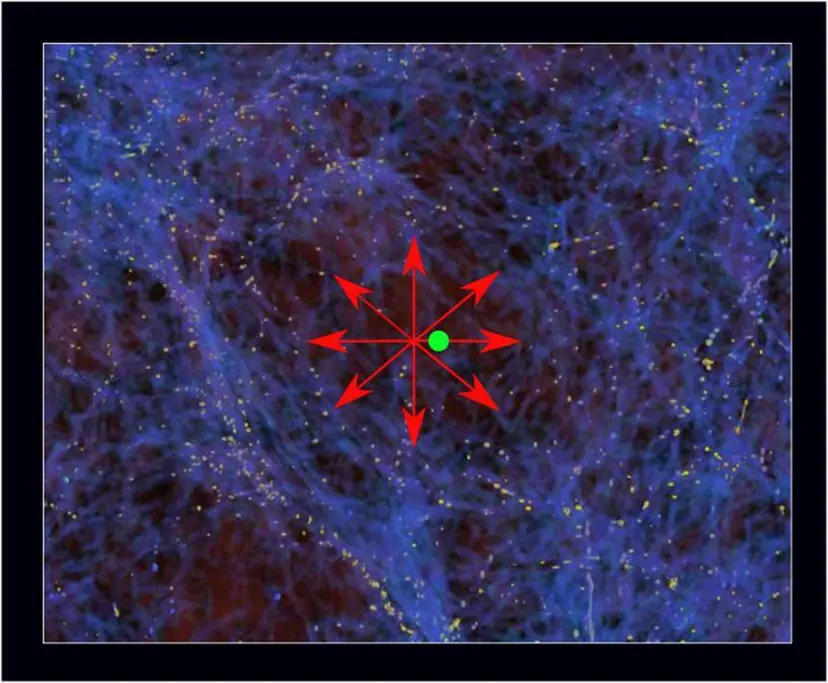
In the ΛCDM model, the density distribution of the universe should be generally uniform. Of course, regions that were initially high-density become more so, and low-density regions become even lower, forming the skeleton of the cosmic large-scale structure in a web shape, but it cannot reproduce a truly giant void on the scale of 100 million light-years in diameter. Therefore, many astronomers still harbor doubts about interpreting the Hubble Tension simply as an optical illusion occurring because we happen to be near a giant void.
However, in this recent paper, astronomers are making an even bolder proposal. They suggest that the mystery of the Hubble Tension can be explained by applying an alternative model where gravity acts in a slightly different way, rather than the existing ΛCDM model that assumes dark matter and dark energy.
Astronomers assume that an unknown substance exists in galaxies—one that does not emit light but contributes to gravity—to explain the excessively fast movement of stars in galactic outskirts. This is called "dark matter." Beyond the movement of stars, the existence of dark matter is accepted as a fact to some extent through various current observations, such as gravitational lensing. Dark matter is a mysterious concept that does not interact with light at all and asserts its existence only through gravity. However, nothing is yet known about what exactly dark matter is composed of.
Therefore, some astronomers attempt to explain the excessively fast movement of stars in galaxies in ways other than dark matter. The most representative (and arguably the most successful) attempt is the MOND hypothesis, also known as Modified Newtonian Dynamics. Simply put, MOND starts from the assumption that at astronomical scales where distances are very large and gravity is weak, the gravitational effect might actually be acting stronger than previously expected. Compared to the way described by existing general relativity, if gravity can act more strongly at long distances, stars in the outskirts of galaxies could be held by stronger gravity. If so, it explains why stars far from the galactic center can orbit at sufficiently high speeds.
Applying this MOND hypothesis to the cosmic large-scale structure yields interesting results. If gravity acts stronger than expected at long distances, regions with high density in the cosmic large-scale structure located far away could pull the galaxies around us with slightly stronger gravity. Then, even without assuming that our Milky Way is contained within a giant super-void, it can explain why the galaxies around us are observed to be pulled in all directions at quite high speeds.
According to the results of this paper, applying gravity using the MOND approach, rather than the existing method, neatly makes the Hubble Tension disappear! In other words, the discrepancy between the expansion rate estimated by the CMB and the one estimated by the movement of galaxies vanishes cleanly! Only then does our universe become a peaceful universe with a single expansion rate.
Of course, MOND still has significant limitations, as it cannot perfectly overcome other diverse and independent observations explained by existing dark matter models. However, this study is a very interesting result in that it applies MOND not just at the scale of a single galaxy but at the scale of the entire universe, and offers the possibility of solving a massive, unresolved conundrum of modern cosmology.
The MOND hypothesis is still treated as a fringe theory in the astronomy community. However, its history has not been cut off; it continues to be discussed persistently and seriously. Will MOND eventually emerge as a new mainstream in the astronomy community that neatly solves the mystery of the Hubble Tension on a cosmological scale? Like the knots in the complex, web-like cosmic large-scale structure, the secrets of the universe remain unsolved.

The cosmic large-scale structure is more than just a simple map showing the state of the universe we live in; it can be called a treasure map filled with the secrets of the universe. I would like to introduce a special project prepared for space enthusiast readers who want to feel the cosmic large-scale structure beyond the clouds every day, even in gloomy weather with overcast skies.
Does the moment the umbrella spreads wide not feel like the moment of the Big Bang, when spacetime expanded in an instant? Just as we stand every moment in the center of the observable, spherical universe with a radius of 49 billion light-years, standing in the center of a round umbrella that holds the universe seems to make me feel my own universe every moment. That is why I started a project called the 'My Own Observable Universe Umbrella,' engraved with the appearance of the cosmic large-scale structure.
By painstakingly engraving the simulation that best depicts the 13.8-billion-year formation process of the cosmic large-scale structure onto an umbrella, opening the umbrella reveals my own observable universe. I hope you become the protagonist of the universe even on rainy days when raindrops fall.
References
https://academic.oup.com/mnras/article/527/3/4388/7337338
https://academic.oup.com/mnras/article/524/2/1885/7218572
https://academic.oup.com/mnras/article/526/2/3051/7296158
https://iopscience.iop.org/article/10.1088/0004-637X/775/1/62
About the author, Woong-bae Jee: He loves cats and the universe. After watching 'Galaxy Express 999' as a child, he dreamt of sharing the beauty of the universe. Currently, he researches galaxy evolution through galactic interactions at the Galaxy Evolution Center and Near-Field Cosmology Laboratory at Yonsei University. He engages in various science communication activities, including lectures and writing. He has authored books such as 'The Observatory of Flirting,' 'Thinking About the Universe All Day,' and 'Stars, the Science of Light.'