

[비즈한국] Financial holding companies have recorded "all-time high" first-half performances, driven by record-breaking interest income across the four major groups (KB, Shinhan, Hana, and Woori Financial). Despite warnings of potential crises—sparked by the repercussions of Hong Kong H-index-linked securities (ELS) and uncertainties in internal and external environments—the firms achieved strong results that made such concerns seem unfounded. With the financial groups consistently breaking their own performance records, they are once again finding it difficult to avoid criticism over "interest-based profiteering," bringing focus back to the current state of their "coexistence finance" initiatives, which were set as a primary goal for the new year.
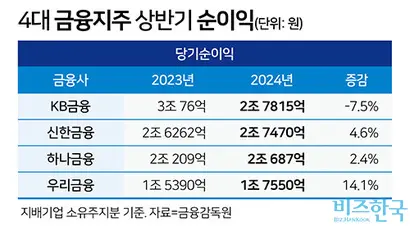
The combined interest income of the four major financial groups in the first half of 2024 surpassed 20 trillion won. Net profits also showed resilience. In the first half of this year, KB Financial105560 and Shinhan Financial engaged in a neck-and-neck race for the top spot, both seeing growth in interest income. KB Financial’s first-half net profit was 2.7815 trillion won—a 7.5% decrease compared to the same period last year—but it still secured the top spot among the four groups. The decline was attributed to the bank’s net profit, which stalled at 389.5 billion won due to compensation for Hong Kong ELS losses in the first quarter. However, the bank recorded a net profit of 1.1164 trillion won in the second quarter alone.
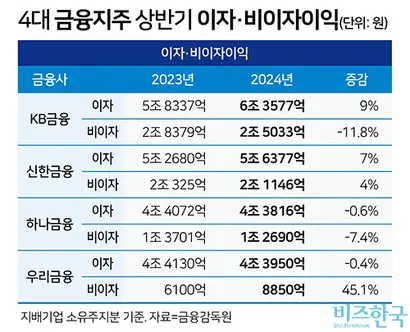
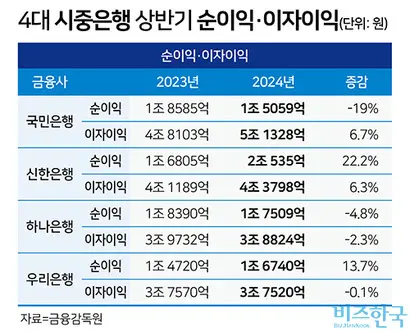
In the first half of this year, KB Financial earned 6.3577 trillion won in interest income, a 9% increase from the previous year (5.8337 trillion won). Attention is now on whether the annual interest income will exceed 10 trillion won. By sector, the bank’s interest income reached 5.1328 trillion won. The group’s non-interest income, which includes commissions, insurance operations, and gains/losses from securities and derivatives, was 2.5033 trillion won, down 12% from the previous year (2.8379 trillion won).
Shinhan Financial recorded a net profit of 2.7470 trillion won in the first half, trailing KB Financial by a mere 34.5 billion won. Notably, Shinhan Bank achieved a net profit of 2.0535 trillion won, the only one among the four major banks to surpass the 2 trillion won mark in first-half net profit. Shinhan Financial explained, "As loan assets increased, interest income grew, and with a decrease in loan loss provisions, the bank's net profit rose by 22.2% compared to the same period last year."
Shinhan Financial’s first-half interest income was 5.6377 trillion won, a 7% increase from the previous year (5.2680 trillion won). During the same period, non-interest income rose by 4% to 2.1146 trillion won (up from 2.0325 trillion won in the previous year) due to growth in commissions from credit cards, foreign exchange, and leasing.
Hana Financial recorded a net profit of 2.0687 trillion won in the first half, a 2% increase from the previous year (2.0209 trillion won). However, unlike KB and Shinhan, its first-half interest income decreased by 0.6% year-on-year (from 4.407 trillion won to 4.3816 trillion won). The banking sector’s net profit also fell, with Hana Bank recording 1.7509 trillion won in the first half, a 5% drop from the previous year (1.8390 trillion won). Instead, the non-banking sectors—securities and cards—saw improved performance. Hana Securities recorded a first-half net profit of 131.2 billion won, a 279% increase compared to 34.6 billion won in 2023, while Hana Card saw a 61% increase from 72.6 billion won to 116.6 billion won over the same period.
Woori Financial’s first-half net profit reached 1.755 trillion won; while it fell short of 2 trillion won, it was a 14% increase from the previous year (1.539 trillion won). Notably, second-quarter net profit hit 931 billion won, the highest ever for a single quarter. By sector, the bank’s net profit reached a record high of 1.674 trillion won, driving the group's earnings. At the second-half management strategy meeting on July 26, Woori Bank President Cho Byung-kyu reaffirmed, "Our goal of becoming No. 1 in net profit remains unchanged."
Woori Financial’s first-half interest income also saw a slight year-on-year decrease of 0.4% (from 4.413 trillion won to 4.395 trillion won). While commission income was 1.058 trillion won, the group suffered losses from deposit insurance premiums and fund contributions (-508 billion won) and depreciation of lease assets (-279 billion won). However, non-interest income rose by 45% compared to the same period last year (from 610 billion won to 885 billion won).
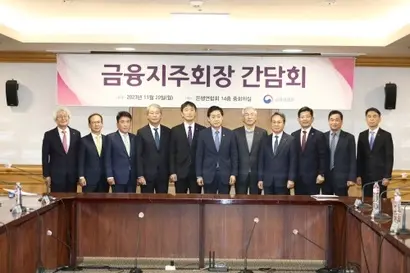
As financial holding companies achieve record-breaking results in defiance of the narrative of a "crisis," it has become difficult for them to avoid criticism over "interest-based profiteering" this year as well. This is because banks' interest income has grown as household debt and corporate loan delinquencies have increased since last year. The rising delinquency rates due to prolonged high interest rates are another reason for the negative public sentiment. According to the Financial Supervisory Service, the delinquency rate on won-denominated loans at domestic banks reached 0.51% at the end of May, the highest level in five years.
In fact, looking at the asset quality of those with increased interest income, delinquency rates are showing an upward trend even if the figures remain low. The non-performing loan (NPL) ratio for Kookmin Bank rose from 0.33% in the first quarter to 0.37% in the second quarter, and the delinquency rate increased from 0.25% to 0.28% during the same period. For Shinhan Bank, as of the second quarter compared to the end of 2023, the household loan delinquency rate remained at 0.25%, but the rate for small and medium-sized enterprises rose from 0.32% to 0.36%.
Amid this climate, financial groups made "coexistence" their primary new year goal for 2024. However, among the four major groups, Shinhan Financial was the only one to separately disclose the status and trends of its "coexistence/inclusive finance" support in its first-half (including Q2) performance materials. Shinhan Financial explicitly stated that it had provided a total of 2.3 trillion won in support in the second quarter, including 200 billion won in civil livelihood financial support, 1.9 trillion won in loans for the common people, and 200 billion won in social investments.
Other groups were less explicit: Hana Financial noted in the footnotes of its second-quarter expenses that it had "injected 61.2 billion won into civil livelihood finance," while Woori Financial stated as part of its ESG achievements that it "pushed for the operation of autonomous programs for civil livelihood finance, including contributions to the Korea Inclusive Finance Agency." KB Financial had specified 372.1 billion won for civil livelihood financial support for the self-employed and small business owners in 2024 and a 60 billion won coexistence support program for 2023-2025 in its 2023 annual performance report, but did not make separate notations in its 2024 quarterly materials.