

[비즈한국] The Korea Housing Institute (KHI) has announced the Housing Business Outlook Index for July 2024. According to the KHI’s survey of housing developers, the national index rose by 2.8p from the previous month to 85.5. Most regions, including Seoul, showed either an upward trend or remained stagnant. While some areas saw a decline, Incheon experienced a relatively large drop (down 22.3p, from 87.8 to 65.5).
Recently, alongside the decline in mortgage interest rates, housing prices have been trending upward, particularly in the capital region and some provincial areas. Additionally, the expansion of special housing supply for newborns and the easing of income requirements for loan products are having a positive impact on the market.
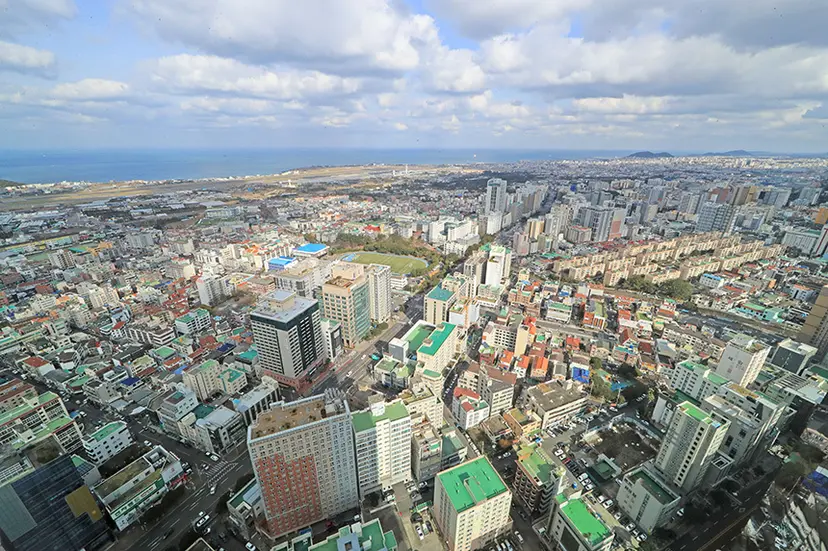
In Seoul, the upward trend in apartment sales prices is accelerating, and some regions outside the capital area have also maintained an upward trend in apartment prices since the second quarter.
The national material supply and demand index rose by 3.1p from the previous month to 95.2, and the financing index also increased by 5.1p to record 74.2. The rise in the financing index appears to reflect the possibility of securing surplus funds due to the overall decline in interest rates and a sharp drop in capital demand, despite the worsening procurement environment caused by recent government measures for a soft landing of real estate project financing (PF).
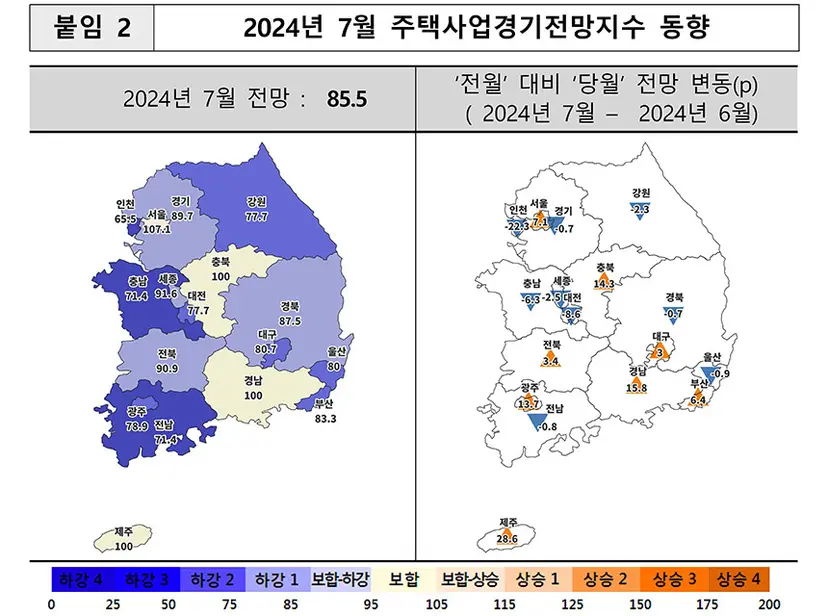
The capital region was projected at 87.4, a fall of 5.3p; while Seoul rose by 7.1p (from 100.0 to 107.1) and Gyeonggi fell slightly (down 0.7p, from 90.4 to 89.7), the significant 22.3p drop in Incheon (from 87.8 to 65.5) led to a decline in the overall index for the capital region.
The subscription market in Seoul is hot, with most offerings closing their rankings between January and June of this year, recording a competition rate of 133.24 to 1.
On the other hand, the stagnation of the Incheon housing market appears to have negatively affected its outlook, following the cancellation of the Yeongjong Sky City housing construction project—involving some 1,300 households—due to profitability issues on July 5, and the fact that unsold housing inventory reached a 10-year high.
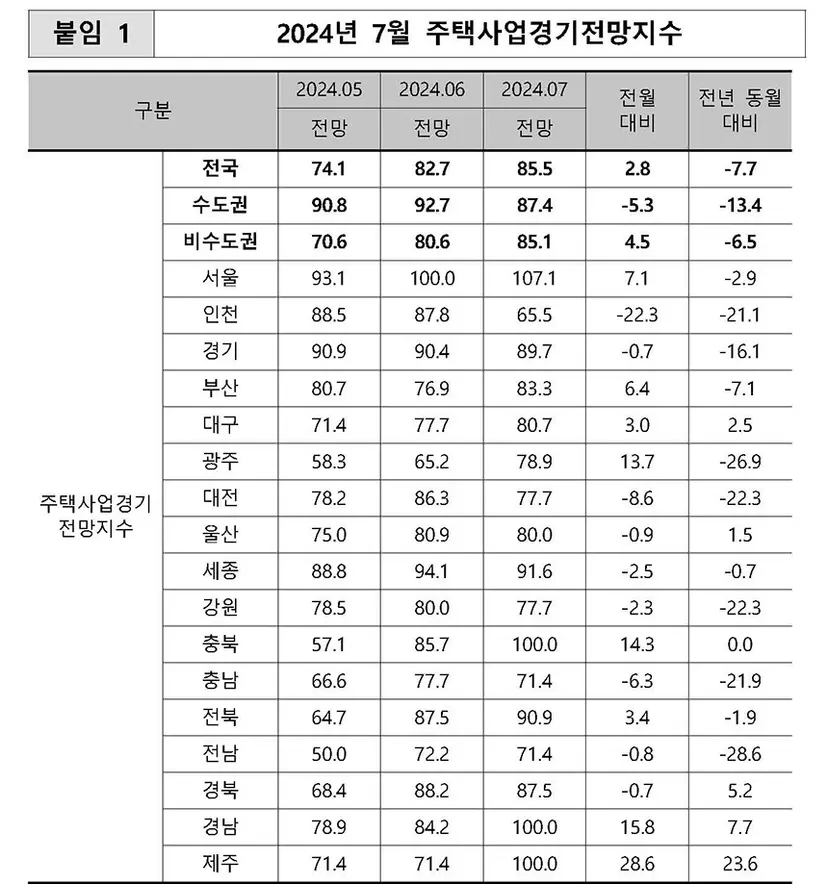
The non-capital region was projected at 85.1, an increase of 4.5p, with sharp rises in some areas including Jeju (28.6p), Gyeongnam (15.8p), Chungbuk (14.3p), and Gwangju (13.7p). Provincial metropolitan cities, including Sejong, rose by 1.8p (from 80.2 to 82.0), while provincial provinces rose by 6.5p (from 80.8 to 87.3).
Developer expectations seem to have increased as housing prices shifted to an upward trend, centered on regions with lower mortgage rates and housing supply shortages. According to Korea Real Estate Board data as of June 24, market recovery signs are emerging this year, with transactions increasing in provincial areas, particularly for small-sized apartments. Among the provinces, Gangwon, Jeonbuk, Jeonnam, and Gyeongbuk are showing a rise in housing prices.
Jeju’s figures seem to have been influenced by expectations of a recovery in the local construction market following plans for a complex in the English Education City and the establishment of new international schools, the recovery of the tourism market due to the influx of Chinese tourists, and the first decrease in unsold post-construction housing in 10 months.
Among metropolitan cities, the increases were led by Gwangju (up 13.7p, from 65.2 to 78.9), Busan (up 6.4p, from 76.9 to 83.3), and Daegu (up 3.0p, from 77.7 to 80.7), while the largest declines were seen in Daejeon (down 8.6p, from 86.3 to 77.7), Sejong (down 2.5p, from 94.1 to 91.6), and Ulsan (down 0.9p, from 80.9 to 80.0).
Gwangju’s index had remained at the lowest level compared to other regions last month at 65.2, but the recent figures seem to reflect expectations stemming from falling interest rates and rising housing prices in neighboring Jeonnam and Jeonbuk. Daegu’s outlook index has maintained an upward trend since February 2023, recovering to the 80s range since January 2024. This is because unsold inventory has shown a continuous downward trend since February last year, and the increase in post-construction unsold inventory halted after eight months. Furthermore, housing construction starts exceeded 1,000 units for the first time since November 2022, suggesting the long-stagnant housing construction market is reviving.
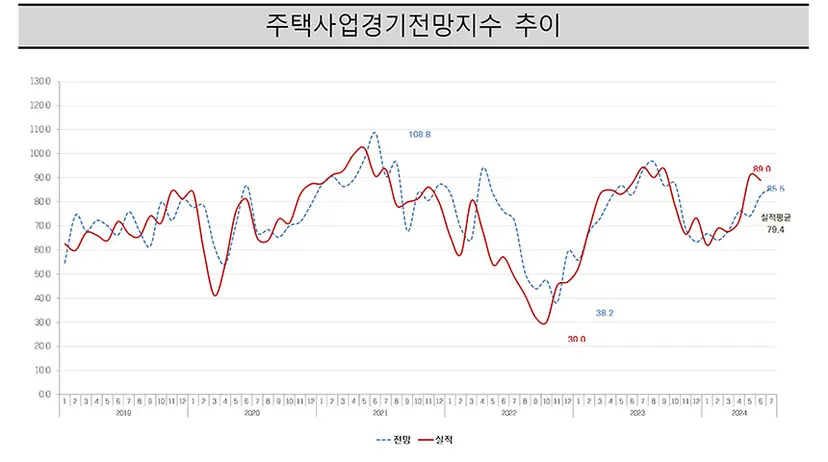
The national material supply and demand index rose by 3.1p from the previous month to 95.2, and the financing index also rose by 5.1p to reach 74.2. The material supply and demand index has maintained an upward trend for the past six months, which appears to be due to the gradual stabilization of supply chains and the easing of material shortages following a sharp decline in construction starts. The rise in the financing index reflects expectations for securing surplus funds due to the overall downward trend in interest rates and a sharp drop in capital demand, despite the worsening procurement environment caused by government real estate PF soft-landing measures.
Currently, the market climate is favorable in the capital region and remains difficult in the provinces, but there is a sense that the warmth from the capital region is spreading to the provinces. In particular, with positive figures appearing little by little even in Gwangju and Daegu, which were the most difficult markets, it may be time to shift our focus regarding the provincial market.
Kim Hak-ryeol, director of the Smart Tube Real Estate Research Institute, well-known by his pen name "Pashong," previously served as a team leader at the Real Estate Research Division of Gallup Korea. He operates and hosts the Naver blog "Pashong's World Exploration" and the YouTube channel "Stue TV." He is the author of books including "Absolute Principles of Seoul Real Estate (2023)," "The Future of Incheon Real Estate (2022)," "Kim Hak-ryeol’s Absolute Principles of Real Estate Investment (2022)," "Future Map of Korea Real Estate (2021)," "From Now On, Only Rising Places Will Rise (2020)," and "Korea Real Estate User Manual (2020)."