

[비즈한국] DL E&C375500 recently lost an appellate lawsuit filed against the government seeking 6.5 billion won in indirect construction costs incurred due to project delays. Previously, the company had argued for the payment of indirect costs based on the premise that the construction period of a continuous-budget contract, which had been converted to a long-term continuous contract at a local road construction site, was extended beyond the conversion point. However, unlike the first trial, the appellate court ruled that the existing continuous-budget contract and the subsequent long-term continuous contract were separate agreements, and dismissed DL E&C's claim for indirect construction costs.
It appears that when construction companies enter into consecutive continuous-budget and long-term continuous contracts, they should ensure that costs resulting from construction period extensions are reflected in the long-term continuous contract to minimize losses.
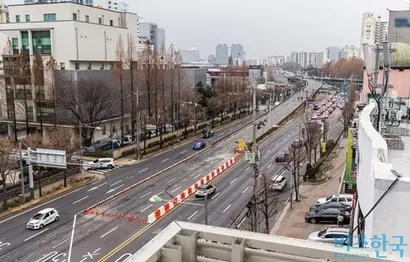
On the 4th, the 22-3 Civil Division of the Seoul High Court (Presiding Judge Shim Dam) overturned the first-instance ruling, which had partially favored the plaintiff, and dismissed DL E&C's claim in the lawsuit against the government for construction payments. Previously, in October of last year, DL E&C filed a lawsuit against the government demanding payment for indirect construction costs incurred at the National Highway Bypass (Mugye-Samgye) construction site in Gimhae, Gyeongnam, from January 2019 to December 2020.
DL E&C is the contractor for the National Highway Bypass connecting Ungdal-dong and Samgye-dong in Gimhae, Gyeongnam. In March 2008, the government and DL E&C entered into a long-term continuous contract for the project, with a total estimated construction cost of 192.8 billion won and a total duration of 2,880 days from the start date (February 2016). This contract was changed to a continuous-budget contract in January 2009, and then reverted to a long-term continuous contract in December 2018.
A long-term continuous contract is a method where a project is ordered for a total construction amount, but contracts are signed and executed annually (by phase) within the scope of each fiscal year's budget. It is structured to sign multiple contracts based on construction progress and budget availability when the total project budget is not secured in advance. This is in contrast to continuous-budget projects, where the entire budget is received from the government beforehand and executed over several years. In long-term continuous contracts, each phase is treated as an independent, separate contract, and total construction costs or project periods are recorded only incidentally.
The point of contention between DL E&C and the government is indirect construction costs. Indirect costs refer to statutory overhead or ancillary expenses that are necessary for construction but not directly input into the physical construction, such as insurance premiums or temporary facility costs. Unlike direct costs, such as material or labor costs, they have the characteristic of increasing as the construction period extends, rather than based on the volume of work. Disputes over these costs often arise when the project duration is delayed beyond the original contract due to the ordering party's responsibility.
DL E&C had already engaged in one dispute with the government over indirect costs at this site. This occurred because the construction period was extended as the government was delayed in securing the project site. The completion date for the 3rd phase of this site, which proceeded under a continuous-budget contract, was extended from the original December 2013 through 14 changes to December 2024, before being finally changed to December 2018 during the transition to a long-term continuous contract. In January 2019, DL E&C filed a lawsuit for indirect costs incurred over 1,840 days from December 2013 until just before the transition to the long-term contract in December 2018, and a compensation judgment of 7.7 billion won was finalized in November 2022.
Following that victory, DL E&C filed the current lawsuit, claiming that there were still unsettled indirect costs. The completion date for the project after the transition to the long-term continuous contract was the same as the previous continuous-budget contract completion date (December 2024) which had been maintained through 14 changes. DL E&C argued that this was merely a modification of the existing continuous-budget contract and that the government should compensate for 6.5 billion won in indirect costs incurred from January 2019 to December 2020, part of the extended period of the continuous-budget contract. The first-instance court previously recognized 3.9 billion won of this claim, partially favoring DL E&C.
However, the appellate court determined that such claims for additional indirect costs were unjustified. The court reasoned that because the government and DL E&C agreed to change the continuous-budget contract period to December 2018 and newly signed a long-term continuous contract, the continuous-budget contract ended on its termination date of December 2018. Thus, DL E&C's claim for additional indirect costs, based on the premise that the project period was extended from January 2019 to December 2020, was invalid.
The court stated, "Considering that there was room for DL E&C to request additional indirect construction costs from the government when signing the long-term continuous contracts for 2019 and 2020 to determine the construction price, it cannot be concluded that interpreting the continuous-budget contract as ending in December 2018—rather than being extended through the long-term continuous contract—violates the concept of justice or undermines the right to adjust contract amounts."