

[비즈한국] Due to the supply chain war between the U.S. and China and the strengthening of climate regulations in the U.S. and Europe, South Korean companies' overseas investments have surged rapidly over the past decade. Although these overseas investments appeared to slow down slightly last year, they have shown a renewed upward trend since the second half of the year, particularly in the manufacturing sector.
This is because, unlike the U.S. and Europe, which are pouring out subsidies to attract electric vehicle (EV), semiconductor, and battery companies, the South Korean government and political circles remain passive in providing direct support. Concerns are even emerging that the "ABC" (Auto, Battery, and Chip) pillars of South Korea's growth engine could crumble.
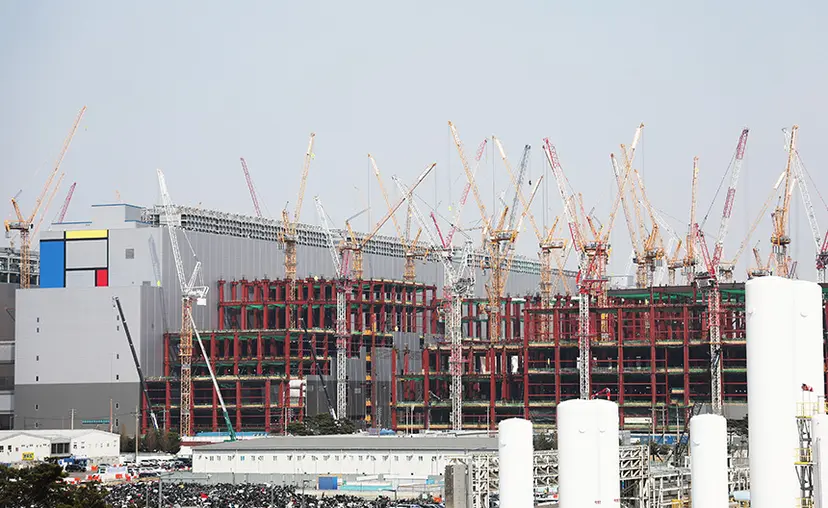
Through a tax law amendment announced on July 25, the government unveiled tax support measures to assist the semiconductor industry. This involves extending the application period of the so-called "K-Chips Act"—which includes tax credits for R&D costs in national strategic technologies and new growth/original technologies, as well as investment tax credits for national strategic technologies—by three years, from the end of this year to the end of 2027.
However, critics point out that this is excessively passive compared to other countries that are providing astronomical levels of support to semiconductor, EV, and battery companies. The fact that South Korean firms' overseas investments are continuously rising also strengthens the argument that the government needs to take a more proactive approach.
According to the National Assembly Budget Office and the United Nations Conference on Trade and Development (UNCTAD), the volume of South Korea’s outward foreign direct investment (FDI) has increased at a significantly faster rate compared to the G7 nations. Based on 2022 figures, South Korea's outward FDI volume increased 4.5-fold compared to 2010, which is a growth rate 2.5 times faster than the Organization for Economic Cooperation and Development (OECD) average of 1.8 times.
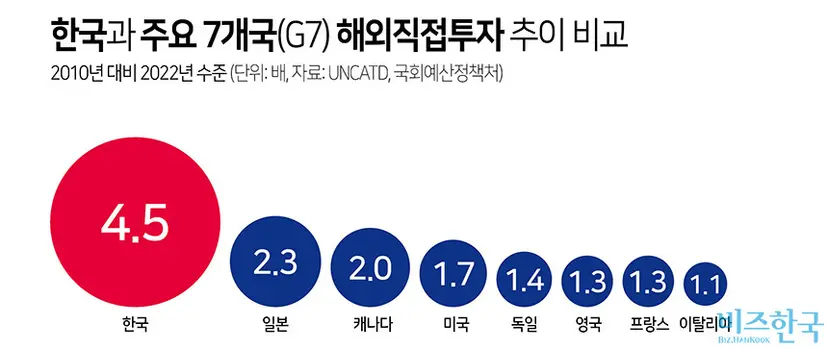
The speed of this increase is excessively high even when compared to the G7. In the case of neighboring Japan, outward FDI grew 2.3-fold over the same period, which is half the level of South Korea. Canada saw a 2.0-fold increase, the U.S. 1.7-fold, Germany 1.4-fold, the U.K. and France 1.3-fold each, and Italy 1.1-fold, all significantly lower than Korea.
Conversely, inward foreign direct investment—where foreign companies invest in South Korea—only increased 2.0-fold between 2010 and 2022. This is lower than the 2.2-fold average increase for OECD member countries during the same period. It was also a slower growth trend than the 3.1-fold increase in foreign investment inflow into the U.S., one of the G7 nations, during the same timeframe. While capital flowing out of the country has increased rapidly, the capital invested into South Korea has not seen significant growth.
In particular, after the trend reversed in the mid-2000s, the gap between South Korean companies' overseas investment and foreign companies' domestic investment has been widening further. Outward FDI jumped more than threefold from an annual average of $5.9 billion in 2001–2005 to $21.2 billion in 2006–2010. On the other hand, inward FDI, which was higher than outward FDI at an annual average of $6.6 billion in 2001–2005, slowed to just $7.5 billion in 2006–2010, falling behind outward FDI.
This trend has intensified over time; while outward FDI recorded an annual average of $30 billion from 2011 to 2015, inward FDI was only one-third of that at an annual average of $11.3 billion. From 2016 to 2020, the annual average for outward FDI was $52.3 billion, which is 3.9 times the $13.5 billion for inward FDI. Between 2021 and 2023, the annual average for outward FDI rose to $73.9 billion, maintaining the 3.9-fold ratio compared to the $18.7 billion in inward FDI during the same period.
The only reason the annual average for outward FDI between 2021 and 2023 did not exceed the $80 billion mark was that the 2023 figure dropped to $63.4 billion due to high interest rates and China's economic slowdown. Outward FDI had been on an upward trend, reaching $76.9 billion in 2021 and $81.5 billion in 2022, before dipping last year. The problem is that as the U.S. and Europe increase subsidy injections for EVs, semiconductors, and batteries in line with their global supply chain restructuring strategies, outward FDI in manufacturing, particularly in these high-tech industries, began to rise again starting in the second half of the year.
Last year, outward FDI in the manufacturing sector was $20.25 billion, a 19.7% decrease compared to $25.21 billion in 2022. However, the trends in the first and second halves of the year differed. While the first half of 2023 saw $10.23 billion, a 40.3% decrease compared to the same period the previous year ($17.105 billion), the second half reached $10.02 billion, a 24.3% increase compared to the same period the previous year ($8.06 billion), marking a return to an upward trend.