

[비즈한국] Savings banks are accelerating the pace of branch closures. Over 10 branches have already shut down since the beginning of this year. With closures happening rapidly even in Seoul, where foot traffic is high, concerns are rising that accessibility for financial consumers, including the elderly, is weakening. Although the Korea Federation of Savings Banks established new branch closure guidelines in May, raising the criteria, industry insiders suggest that closures driven by cost-cutting and digital transformation are inevitable.
In the first half of this year, 11 domestic savings bank branches were closed. According to disclosures by the Korea Federation of Savings Banks, a total of six branches were closed in the second quarter: two by OK Savings Bank, and one each by The-K, JT, Yungchang, and DB Savings Banks. This is one more than the five closed in the first quarter (two by SBI Savings Bank, and one each by JT Chinae, Shinhan, and Pepper Savings Banks). The locations are diverse as well; Seoul saw the highest number of closures with five, followed by two in Gyeonggi-do, and one each in Incheon, Jeonbuk, Jeonnam, and Chungbuk. No new branches were opened during the first half of the year.
Fewer than 10 branches closed annually, but 11 shut down in the first half of this year alone
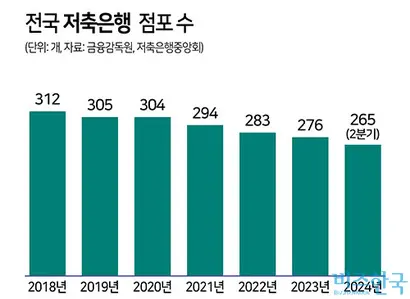
The savings bank industry is following the trend of major commercial banks in downsizing offline branches. According to statistics from the Financial Supervisory Service, the number of savings bank branches has steadily declined from 312 in 2018 to 305 in 2019, 304 in 2020, 294 in 2021, 283 in 2022, and 276 in 2023. While fewer than 10 branches closed annually over the past six years, the pace of closures has accelerated sharply this year, with 11 branches disappearing in just six months.
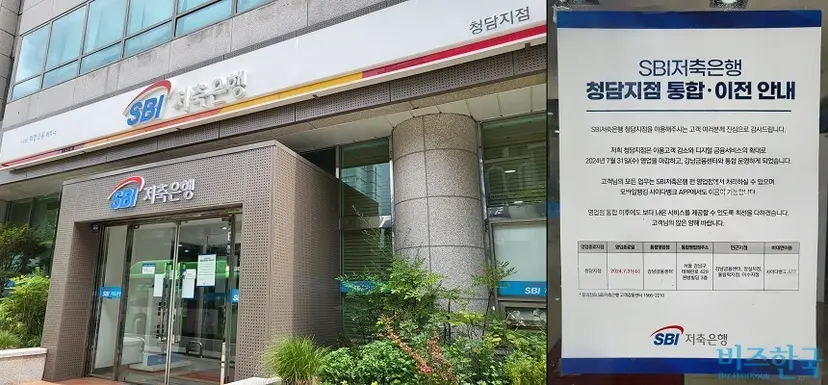
Branch closures are continuing into July. On the 12th, Sangsangin038540 Savings Bank closed its Bucheon branch and consolidated it with the Pyeongchon branch. Although both are in the Gyeonggi province, the Bucheon branch was in Wonmi-gu, Bucheon, and the Pyeongchon branch is in Dongan-gu, Anyang, meaning they serve completely different residential areas. On the 31st, SBI Savings Bank will close its Cheongdam branch in Gangnam-gu, Seoul. In the case of SBI Savings Bank, it also closed its Gangnam branch in January. The now-closed Cheongdam and Gangnam branches will be managed by the nearby Gangnam Financial Center, and customers will also be served at the Jamsil, Olympic, and Isu branches.
Savings banks stated that they are closing branches due to reasons such as a decrease in in-person customers, deteriorating profitability, and management efficiency. The industry views branch closures as an inevitable step to cut costs as the savings bank business climate worsens. An official from Savings Bank A explained, "Since the move toward digitalization began in 2018, the number of branches has been gradually decreasing," adding, "The recent severe downturn in the industry is also a reason."
Some argue that unlike commercial banks, savings banks have a smaller proportion of in-person customers. The aforementioned official stated, "From the perspective of savings banks, which have a different customer base than commercial banks, operating branches is not efficient. In many cases, it is a loss to run a branch," adding, "While people visit commercial banks for various reasons like opening deposits or loan consultations, savings bank customers usually only visit once to open a deposit and once more when it matures."
While the primary background for savings bank closures is worsening profitability, the digitalization of financial tasks is an unavoidable factor. As more consumers use apps to handle deposit opening or termination, savings banks, which focus mainly on receiving deposits, are directly affected.
In fact, when visiting bank branches around Seolleung Station in Gangnam-gu, Seoul, on the morning of the 25th, the atmosphere between commercial banks and savings banks was quite different. Around Seolleung Station, savings banks like Aekyoon, OK, Yegaram, JT Chinae, NH, DB, and BNK are clustered alongside commercial banks like Shinhan and Hana. In the case of the savings banks, there were almost no customers waiting. The atmosphere was relaxed, with only one or two customers handling business at the counters. On the other hand, commercial bank branches were packed with customers visiting during lunch hours, requiring waits, and even automated teller machines (ATMs) were fully occupied.
An official from Savings Bank B said, "Over 90% of customers visiting savings bank branches are there to open or close deposits," adding, "Don't commercial banks handle a wider variety of tasks beyond deposits and loans?" He continued, "In the past, savings bank apps were prone to errors and difficult to use, but they have improved significantly and are quite usable now," pointing out, "The trend is to make apps simple and easy for elderly customers, and the number of elderly customers who are proficient with mobile banking has increased compared to the past."
Closure guidelines implemented... Industry says, "No impact on the overall trend"
However, as criticism mounted that measures were needed for the large number of elderly customers who frequent savings banks, the Korea Federation of Savings Banks created and implemented new branch closure guidelines starting in May. According to the industry, the new guidelines have significantly strengthened criteria, such as scoring the conditions for branch closure. The guidelines apply based on the date of prior notification, not to locations closed since May.
Under the new guidelines, savings banks must submit a preliminary review report regarding branch closures to the Korea Federation of Savings Banks. It includes an evaluation scorecard that assesses the rationality of the closure based on the necessity of the closure, trends in deposit/loan changes, transaction volume trends, and the appropriateness of consumer support plans. Out of a total of 100 points, a score below 60 is judged as unsuitable. If deemed unsuitable, the bank must go through a remediation process and be reviewed again.
Consumer support plans include posting closure notices on the website and at the branch, as well as providing education on mobile and internet banking for the elderly. This involves having designated staff remain at the branch to guide customers on how to use these services. Previously, savings bank branch closures were reported to the Korea Federation of Savings Banks upon meeting certain conditions, such as a drop in in-person customers, but the inclusion of a scoring table in the guidelines makes it closer to a permit system.
However, it is uncertain whether this method will effectively slow down the pace of closures. An industry official remarked, "It is true that it has become more complicated at the working level because internal approval now requires the approval of the Korea Federation of Savings Banks," but added, "Companies likely plan and decide on branch closures long in advance, so it is questionable whether it will affect the closures themselves."
Some point out that education for the elderly is already taking place on the ground. An official from a savings bank that closed branches in the first half of the year said, "Several savings banks have already been implementing consumer protection support measures for a long time, such as operating dedicated counters for the elderly and disabled or simplifying apps," adding, "Even without those specific support measures, the guidelines are not a mandatory condition as long as other scoring criteria are met."