

[비즈한국] #1 Company A, a civil engineering and construction firm based in Yeongdeungpo-gu, Seoul, was fined 79 million won by the Seoul Metropolitan Government last May for subcontracting painting, wet construction, waterproofing, and stonework to an unregistered company at a new apartment construction site in Iksan, North Jeolla Province.
2 Company B, a civil engineering and construction firm in Hwaseong, Gyeonggi Province, received a 5-month business suspension and a 6.8 million won fine from the Gyeonggi Provincial Government last June for illegally subcontracting temporary fencing and drainage board installation to an unregistered firm at a private logistics center construction site in Icheon, Gyeonggi Province.
3 Company C, a construction firm in Miryang, South Gwentam, was fined 23 million won by the South Gyeongsang Provincial Government last March for outsourcing both the supply of steel materials and the on-site installation to an unregistered steel supplier.
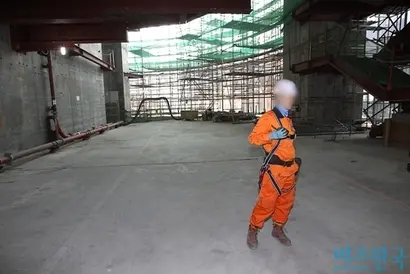
These are examples of construction companies caught subcontracting to "unregistered firms"—entities that have not registered for a construction business license. Amidst a significant deterioration in the cost-to-revenue ratios of the construction industry due to rising raw material prices and labor costs, it has been confirmed that the number of construction firms receiving administrative penalties for subcontracting to unregistered companies surged in the first half of this year compared to the previous year. Critics argue that to ensure construction quality and safety, the excessive drive to cut costs at construction sites must be reined in.
A BizHankook analysis of data from the Ministry of Land, Infrastructure and Transport's Construction Industry Knowledge Information System reveals that in the first half of this year, 95 construction companies were issued administrative penalties (based on initial announcements, including changes, corrections, and withdrawals) for illegal subcontracting to unregistered firms, an increase of 33 companies (53%) compared to the previous year. Of these, 48 were general construction firms and 47 were specialized construction firms.
Construction projects may only be performed by registered construction entities. Under the Framework Act on the Construction Industry, anyone wishing to engage in construction business must register with the relevant local government after meeting the prescribed requirements for capital, technical personnel, facilities, and equipment. A construction firm that has been awarded a project may only subcontract that work to a business entity that possesses the qualifications to perform such work.
Subcontracting to unregistered firms is only permitted for "minor construction projects" as an exception. According to the Framework Act on the Construction Industry, minor projects are defined as general construction projects with an estimated cost of less than 50 million won, or specialized projects with an estimated cost of less than 15 million won. Even in these cases, certain specialized construction projects—such as gas facilities, steel structures, cableways, elevators, railway tracks, and heating installations—are strictly prohibited from being performed by unregistered firms.
An official from a metropolitan local government stated, "When a local government or regional land management office overseeing a construction site detects a violation, the local government where the construction company's headquarters is located issues the penalty. Subcontracting to unregistered firms is a violation of the Framework Act on the Construction Industry that carries the highest risk of substandard construction, and we have recently seen an increase in cases of illegal subcontracting, including for auxiliary works."
Administrative penalties for subcontracting to unregistered firms are severe. Under the Framework Act on the Construction Industry, companies may face up to a one-year business suspension or a fine of up to 30% of the subcontracted project amount. Unregistered entities performing non-minor construction work face up to three years in prison or a fine of up to 30 million won. In the first half of this year, 44 firms received business suspensions, while 51 firms were issued monetary fines.
The increase in illegal subcontracting is rooted in rising construction costs and the resulting pressure to cut expenses. As of May this year, the Construction Cost Index reached 130.21 points, a 2% increase from May last year and an 18% increase from three years ago in May 2021. The index, which measures fluctuations in direct construction inputs such as materials, labor, and equipment, is surveyed and published monthly by the Korea Institute of Civil Engineering and Building Technology.
Choi Yong-hwa, head of the Technical Research Institute at the Korea Construction Safety Association, pointed out, "The primary reason for using unregistered firms at construction sites is cost reduction. Due to the recent surge in raw material prices, labor costs, and pressure on construction timelines, it is not difficult to find unregistered firms that accept subcontracts at low prices. If you include sites that have not yet been caught by authorities, the actual number of such cases is likely higher. Since unregistered firms lack guaranteed technical expertise, there is a high risk of industrial accidents and substandard construction."
There are also calls to strengthen penalties for construction firms that habitually subcontract to unregistered entities. The government initially proposed an amendment to the Framework Act on the Construction Industry in June 2021 that would revoke the business license of any construction firm caught subcontracting to an unregistered firm three or more times within five years; however, this bill was automatically scrapped when the 21st National Assembly's term expired.
An official from the Construction Policy Division of the Ministry of Land, Infrastructure and Transport said, "When the bill was initially proposed, there was a strong consensus within the industry regarding the issues of substandard construction and illegal subcontracting. We plan to re-propose an amendment in this session that includes provisions to strengthen penalties for illegal subcontracting to unregistered firms."