

[비즈한국] In 2015, physicists used the LIGO detector to sense ripples in spacetime left behind by the collision and merger of two black holes hundreds of millions of light-years away. The event, which left tremors known as gravitational waves, involved stellar-mass black holes, each about 20 to 30 times the mass of the Sun.
Since then, many gravitational wave detectors, including LIGO, have captured collisions of various stellar-mass black holes. However, these were all relatively small and light, weighing only dozens of times the mass of the Sun. What resides at the center of galaxies are incomparably larger supermassive black holes, boasting masses millions or billions of times that of the Sun. Various mysteries remain surrounding these giants, such as how they formed and whether they truly grow by closing the distance during galaxy mergers until they finally collide.
Now, however, the James Webb Space Telescope (JWST) has successfully captured a collision between a pair of supermassive black holes in the most distant universe ever observed! This scene takes place in a very young universe, just 740 million years after the Big Bang. That was a staggering 13 billion years ago! This discovery could provide vital clues as to how supermassive black holes at the centers of galaxies have grown since the early universe.
A great deal of matter is captured by the intense gravity surrounding a supermassive black hole at the center of a galaxy. This matter swirls at extremely high speeds and becomes heated, forming what is known as an accretion disk. These disks can reach such high temperatures that they excite the surrounding hydrogen to a high degree, emitting clear light at specific wavelengths. Crucially, these accretion disks are not stationary; they are rotating at incredible velocities.
Due to this rapid rotation, the hydrogen emission lines emanating from the accretion disk as observed from Earth experience the Doppler effect, causing wavelengths to shorten or lengthen. When viewed from Earth, the part of the disk moving away appears shifted toward longer wavelengths (redshift), while the part moving toward us appears shifted toward shorter wavelengths (blueshift).
If the accretion disk were stationary, it would show a sharp spectral signal at a specific wavelength. Because it rotates rapidly, however, the spectrum spreads out across a wider range of wavelengths. This phenomenon is called spectral line broadening. The faster the accretion disk rotates, the wider the line broadening becomes.
Active galaxies, which harbor giant black holes at their centers that consume large amounts of matter while spewing out enormous energy, show particularly characteristic spectral patterns. The region immediately surrounding the central black hole rotates at extremely high speeds, resulting in a very flat and broad spectral line profile. Conversely, in regions further away from the central black hole, the rotation speed of hydrogen clouds decreases, and the spectral line width becomes narrower. In particular, actively growing galaxies display both broad and narrow spectral lines simultaneously.
In this recent observation, astronomers used the James Webb Space Telescope to capture Sz7, a very faint protogalaxy estimated to have existed in the early universe about 13 billion years ago. They observed the center of this galaxy using NIRSpec, Webb’s spectroscopic instrument. Rather than using the traditional method of blending the spectrum of the entire galaxy, this observation employed a technique called Integral Field Unit (IFU) spectroscopy, which allows for the spectral analysis of individual pixels within the galaxy's image.
By utilizing this, researchers can go beyond merely inferring how many stars are being born or how powerful the black hole is in the galaxy as a whole; they can distinguish and determine, with much higher resolution, the star formation rate and black hole activity within specific regions of the galaxy.
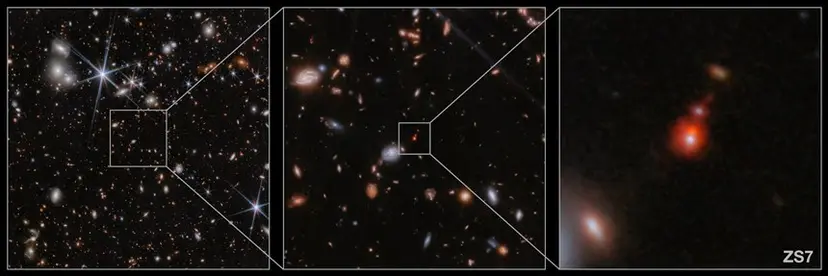
Astronomers identified a distinct spectral pattern in the center of the Zs7 galaxy showing both broad and narrow line widths. Surprisingly, this spectral pattern was not observed in just one location; it was also detected at two points separated by some distance from the galaxy's center! Data from a position slightly to the upper right of the galaxy's center in the photo clearly shows both broad and narrow hydrogen spectral lines. Conversely, in the exact center of the galaxy shown in the image, only the narrow spectral line profile is confirmed.
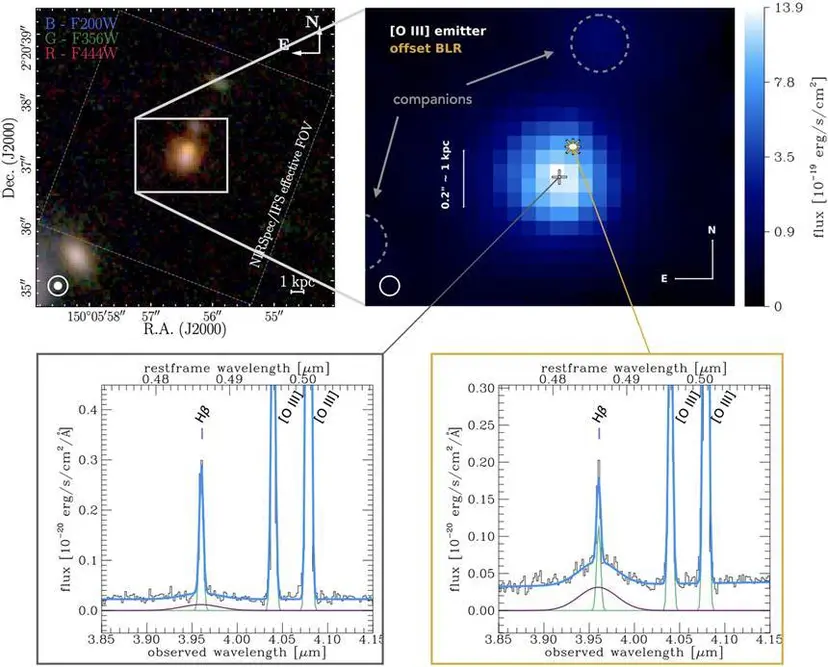
Based on this, astronomers inferred that at least two supermassive black holes coexist at the center of this galaxy—one at the core and another slightly offset. By utilizing the observation data showing both broad and narrow lines, astronomers estimated the mass of the offset supermassive black hole to be about 50 million times the mass of the Sun. This is more than 10 times heavier than the black hole at the center of our own galaxy, which is about 4 million solar masses! It shows that a supermassive black hole much heavier than our own existed in the very early universe, when the cosmos was only 700 million years old.
The fact that two such massive supermassive black holes are gathered in close proximity suggests that two galaxies collided in the early universe, causing the supermassive black holes hosted by each galaxy to merge. Of course, many unsolved secrets remain regarding the collision and merger of supermassive black holes. Unlike the collision of much lighter stellar-mass black holes, the outcome of supermassive black hole mergers remains uncertain. This is due to the "final parsec problem," which suggests that if two supermassive black holes approach within a few light-years of each other, their orbits might stop shrinking and instead maintain a stable orbit, never leading to a final merger. Therefore, it is not yet certain whether these massive black holes at the centers of galaxies are indeed growing by merging with one another.
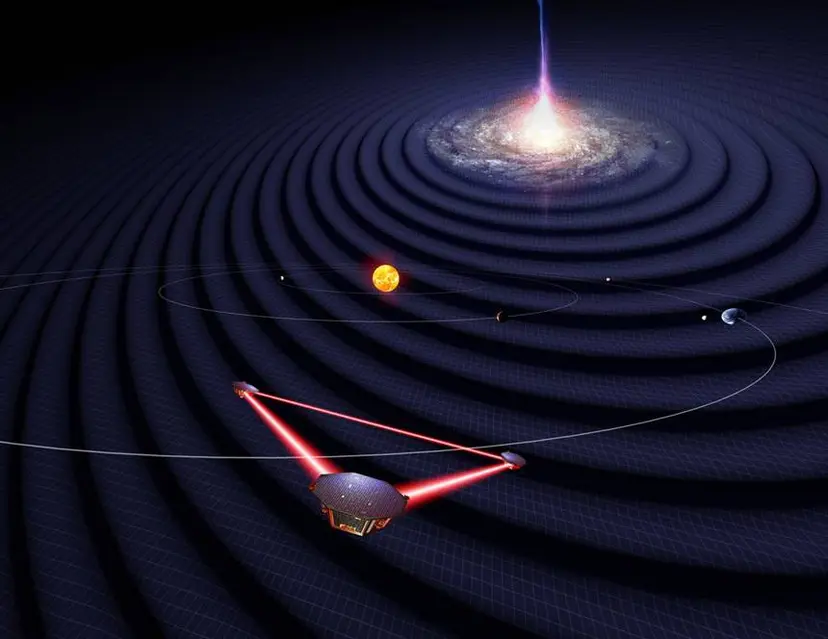
Since the first observation in 2015, humanity has been using gravitational wave detectors installed across Earth to sense collisions between relatively light stellar-mass black holes hundreds of millions of light-years away. When the spacetime ripples left by those collisions travel for hundreds of millions of years and pass by Earth, we verify the existence of gravitational waves through the minute tremors in spacetime. It is similar to the heart of an angler waiting for a fishing rod to twitch. We are now enjoying a new era of observing the universe not only through classical electromagnetic waves—light—but also through a new type of wavelength: gravitational waves.
However, there are still limitations. The size of a gravitational wave net or "fishing rod" that can be installed on Earth cannot exceed the size of the Earth itself. To detect the more subtle spacetime ripples spreading from further reaches of the universe, a gravitational wave net larger than the scale of Earth is required. Therefore, astronomers are preparing for the LISA mission, a space-based gravitational wave detector scheduled for 2035 that will leave Earth to fly in formation in orbit around the Sun. With the LISA Pathfinder, a preliminary project that successfully tested the technical feasibility of LISA, the plan is proceeding smoothly.
If this mission proceeds, we will enter an era where we can detect not only the collisions of stellar-mass black holes in the relatively nearby universe, but also the gravitational wave signatures left by the collisions of supermassive black holes in the early universe billions of years ago. How much more is the universe undulating that we will be able to feel with more sensitive gravitational wave detectors? The universe is already constantly rippling as a whole due to collisions of black holes, large and small, occurring everywhere. It is just that the tremors have been so minute that the spacetime of the universe has felt calm to us. But once we set out our new fishing rods capable of detecting more sensitive tremors and begin to feel the universe, it will no longer be seen as a quiet and calm world.
Through this, we will be able to secure new clues to many unanswered questions: how the massive supermassive black holes living at the centers of galaxies from the early universe until today acquired their current immense size, and how these collisions and mergers ultimately conclude.
Reference
https://academic.oup.com/mnras/article/531/1/355/7671512
About the author, Ung-bae Ji: He loves cats and the universe. After watching 'Galaxy Express 999' as a child, he dreamed of sharing the beauty of the universe. He currently researches galaxy evolution through interaction at the Center for Galaxy Evolution Research and the Near-Universe Cosmology Laboratory at Yonsei University. He engages in various science communication activities, including lectures and writing, and has authored books such as 'The Astronomer I’m Dating', 'Thinking About the Universe All Day', and 'Stars, the Science of Light'.