

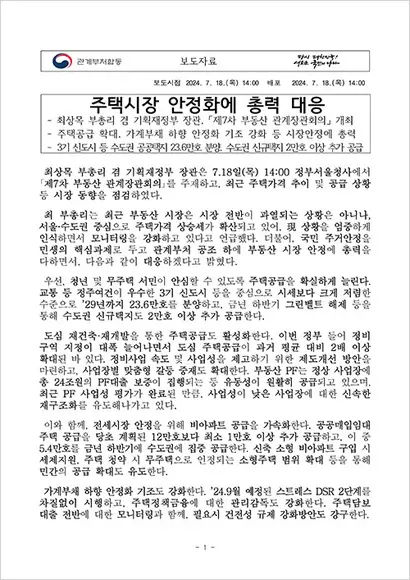
[비즈한국] On July 18, the 7th Real Estate Ministers' Meeting was held at the Government Complex Seoul. During this meeting, the government evaluated market trends, such as recent housing price fluctuations and supply conditions, and proposed future directions. The government stated that while the overall real estate market is not currently overheating, the rise in housing prices is spreading, primarily in Seoul and the metropolitan area. They emphasized that they are taking the current situation seriously and are strengthening monitoring efforts. Furthermore, placing housing stability for the public as a core priority for livelihood, they proposed to do their utmost to stabilize the real estate market in cooperation with relevant ministries through the following measures.
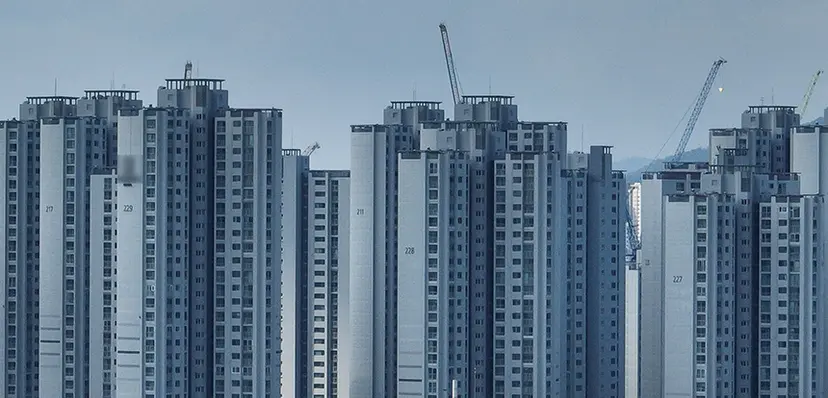
First, the government announced a clear plan to increase housing supply to provide peace of mind for young people and those without homes. They stated that they would supply 236,000 units by 2029 at prices lower than the market rate, focusing on 3rd-generation new towns with excellent residential conditions such as transportation, and that they would provide over 20,000 additional units in new metropolitan area sites through measures such as lifting Greenbelt restrictions in the second half of this year.
Housing supply will also be revitalized through urban reconstruction and redevelopment. Since this administration took office, the designation of maintenance zones has increased significantly, expanding urban housing supply to more than double the past average. The government plans to prepare institutional improvements to enhance the speed and profitability of maintenance projects and expand customized conflict mediation for each site. Regarding real estate Project Financing (PF), liquidity is being supplied, such as the execution of 24 trillion won in PF loan guarantees to normal business sites. With the feasibility assessment of PF projects recently completed, they evaluated that they are inducing rapid restructuring for sites with low profitability.
In addition, they plan to promote the supply of non-apartment housing to stabilize the 'jeonse' (lump-sum deposit rental) market. They will supply at least 10,000 additional public purchase rental housing units beyond the planned 120,000, with 54,000 of those concentrated in the metropolitan area in the second half of this year. The plan is to induce private sector supply expansion through tax support for purchasing new small non-apartment units and expanding the scope of small housing recognized as non-ownership during housing subscription applications.
Downward stabilization of household debt will also be strengthened. The government will implement the second stage of the stress Debt Service Ratio (DSR) scheduled for September 2024 and strengthen supervision of housing policy finance. Along with monitoring overall mortgage loans, they will devise plans to strengthen soundness regulations if necessary.
To quickly implement and monitor these measures, a vice-ministerial task force from relevant ministries will be operated weekly, and a plan for further housing supply expansion will be announced in August.
The Ministry of Land, Infrastructure and Transport announced that as a result of efforts to expand housing supply, such as the public offering of 'leading districts' for 1st-generation new town maintenance and the move-in of 'deundeun' (reliable) jeonse housing, apartment construction starts in Seoul and the metropolitan area increased in January-May this year compared to the previous year. They also announced that move-in volumes for Seoul apartments will be 38,000 units in 2024 and 48,000 units in 2025, which is higher than the average of the last 10 years. It is stated that 20,000 units will be supplied in 2024 and 33,000 units in 2025 from preferred reconstruction and redevelopment sites. They emphasized that a total of 236,000 units in main subscriptions will proceed in public housing sites, including 3rd-generation new towns, starting with Incheon Gyeyang in September 2024.
Regarding the analysis that the market is already overheated due to rising 'gap investments' and increased investment in Seoul apartments by residents in provincial areas, the government explained that according to funding plans, the ratio of gap investments where the buyer assumes the jeonse deposit is 37%, which is significantly lower than in previous years. For reference, the gap investment ratio for Seoul apartments over the past few years was 60.1% in 2021, 57.0% in 2022, 38.9% in 2023, and 37.3% as of May 2024.
Therefore, they explained that the ratio of buyers of Seoul apartments residing outside of Seoul is at the 20% level, lower than in the past, meaning gap speculation demand is limited. However, as price increases continue, centered on new complexes in preferred areas, they announced they would monitor whether investment demand surges.
Let's summarize the contents of the announcement on the all-out response to housing market stabilization.
1. Confirmed that it is a rising market centered on Seoul.
2. Acknowledged that this is a result of supply shortages.
3. Therefore, they will provide more supply, quickly.
4. However, apartments in the Seoul area cannot be supplied in the short term.
5. So, they intend to push strongly for 3rd-generation new towns and non-apartment housing rather than reconstruction and redevelopment.
6. Also, they will lift Greenbelt restrictions to designate two new housing sites.
7. Do not worry too much, as sufficient quantities will be supplied by 2029.
8. They are working hard now, but there are limitations to physical speed.
9. So, they hope people do not panic-buy until sufficient supply is provided.
This covers the main points of the ministers' meeting announcement. I have read the announcement materials three times carefully. I am not sure if these are supply measures that can resolve demand in Seoul, even if I don't know about other regions. It seems inevitable that the number of provincial demanders looking to buy in Seoul will only increase.
While there may be short-term fluctuations, it is a fact that we are seeing a bull market pattern where both transaction volume and prices are rising. Because presale prices continue to rise, the popularity of existing, older apartments is actually increasing. Unless there is a special issue, the upward trend of Seoul apartments due to a decrease in listings seems bound to continue. Demand that had postponed house purchase decisions over the past three years is actively participating in the housing market.
A strengthening of buying sentiment due to anxiety over supply shortages and rising jeonse prices is occurring, and as this anxiety expands, transaction volume increases, so there is a need to disperse the concentrated demand. The conclusion is that there is no choice but to disperse the demand flocking to Seoul to provincial areas. There is likely no other effective policy right now besides this method.
Kim Hak-ryeol, head of the Smart Tube Real Estate Research Institute, famous by his pen name 'Pashong,' previously served as a team leader at the Real Estate Research Division of Gallup Korea. He operates and hosts the Naver blog 'Pashong's World Exploration' and the YouTube channel 'StuTV.' His authored books include 'The Absolute Principles of Seoul Real Estate (2023),' 'The Future of Incheon Real Estate (2022),' 'Kim Hak-ryeol's Absolute Principles of Real Estate Investment (2022),' 'Future Map of South Korean Real Estate (2021),' 'From Now On, Only Places That Will Rise, Rise (2020),' and 'South Korean Real Estate User Manual (2020).'