

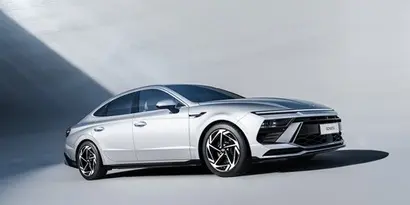
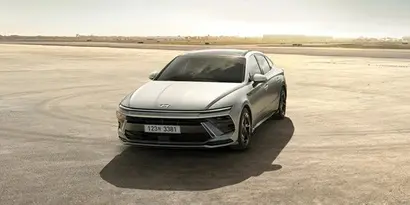
[비즈한국] Hyundai's Sonata, once dubbed the "people's car," is rebounding after traversing a tunnel of sluggish sales. In June, the Sonata ranked first in monthly sales among domestic sedan models. The superficial reason for this top spot was the surge in demand for new mid-sized taxis following the re-launch of the Sonata taxi model. However, the fundamental factor that shifted the sales graph upward prior to that appears to be the comprehensive front-end facelift carried out in 2023.
The Sonata was not only the most popular model in the mid-sized segment but also the one that boasted the most advanced design. This trend was maintained for over 20 years, beginning with the 1988 release of the 2nd generation (Y2), which is considered the true start of the Sonata. At the time of the Y2 Sonata's debut, its main domestic competitors were the Kia000270 Concord and the Daewoo Royale series. These competitors, which felt dated as they were based on a previous generation of vehicles from Japan’s Mazda and Germany’s Opel, were no match for the Sonata, which kept pace with global trends through its aerodynamic styling. In the case of Daewoo Motor, while it built its reputation as a kingdom of mid-sized cars throughout the 1980s with the Royale series, it became complacent with its market share, repeatedly churning out variations like the Royale Salon, Royale Prince, Royale Duke, and Royale XQ, ultimately missing the timing for new car development and providing an opening for the reversal.
The Sonata 2, launched in the spring of 1993, continued to lead the era with its advanced style. Its exterior, which appealed to everyone from the youth to the middle-aged by smoothing out surfaces while maintaining a moderate sense of authority, is still highly regarded today. The Daewoo Prince had yet to fully shed the shadow of the Royale Prince, and it took two years for Kia to follow up with the streamlined Credos. The EF Sonata (1998) changed the paradigm of domestic mid-sized car design with a stately feel that moved away from previous sportiness, while the NF Sonata (2004) broke away from that stately form, returning to clean straight lines to lead the trend once again.
During a similar period, Kia's mid-sized cars always remained the runner-up. Although they debuted the Optima using the EF Sonata platform and the Lotze using the NF Sonata platform, they could not escape the shadow of the Sonata. The YF Sonata (2009), which applied Hyundai's new design philosophy, "Fluidic Sculpture," boasted sleek body lines unlike any previous generation. While there may be differing opinions on design preferences, no one would deny that the Sonata was always the benchmark for mid-sized car design.
The status of the Sonata began to be threatened after the 2010 debut of the Kia K5. The K5, reflecting the touch of Peter Schreyer, caused a sensation with bold lines that were unimaginable for domestic mid-sized cars at the time. Coincidentally, the design innovation of the Sonata stopped at that point. The LF Sonata was released with a generic look, and the DN8 hit the lowest point in the history of Sonata exteriors. From the front to the rear, one cannot find any inspiration even when looking at it now. The side character lines look forced, as if folded from paper, and the concave-convex details above the rear combination lamps are even sloppy. Eventually, aware of the negative public sentiment, Hyundai changed the front in 2023 by applying the linear Seamless Horizon Lamp.
The contrast between a few years ago, when there were rumors of discontinuation due to poor sales, and the recent resurgence in interest following the design facelift, reminds us of the unchanging truth that a beautiful design that appeals to consumers is the best marketing. It is often said that the secret to longevity is not following past success formulas. However, in the case of the Sonata, following the old model of setting the standard for not only quality but also design appears to be the surest secret for the brand's long life.
About the writer Han Dong-hoon?
A typeface designer. He is interested in all fields related to letters, including writing, calligraphy, and designing and teaching typography. He currently designs various corporate exclusive fonts and retail fonts at the type studio AlignType. He has contributed to 'Monthly Design' and the quarterly 'Design Review,' and conducts typography design lectures on both online and offline platforms. In 2021, he published the essay collection 'The Universe Inside Letters.'