

[비즈한국] Hanwha Aerospace012450 has unveiled a new wheeled self-propelled howitzer. Three months after losing to the German KNDS RCH 155 wheeled howitzer in the UK’s Mobile Fires Platform (MPF) project last April, the company is already proceeding with the initial design of a competing model. The K9 self-propelled howitzer, Hanwha Aerospace's flagship export product, has gained significant popularity due to its outstanding performance. The introduction of this new model is expected to meet customer demand for a more affordable, agile, and wheeled-chassis howitzer, signaling a green light for future exports.
The K9 self-propelled howitzer is Hanwha Aerospace’s most successful export product. With over 1,700 units produced as of last year, the K9 has been exported to more than nine countries, capturing over 36% of the 155mm self-propelled howitzer market. On July 10, the company achieved a major milestone with the export of 54 units to Romania. The K9 is planned to be upgraded to the A2 version, which features unmanned automatic loading, and the A3 version, which enables manned-unmanned teaming.
Why is Hanwha venturing into the development of a wheeled self-propelled howitzer? While the K9 has various strengths, the loss to KNDS’s RCH 155 wheeled howitzer in the UK’s MPF project served as a catalyst.
The K9 is a tracked self-propelled howitzer, much like a tank. Because it uses continuous tracks, which are more durable and provide better traction than wheels, it offers superior mobility in rugged mountainous or off-road terrain. It is also well-suited for "shoot and scoot" tactics, where the howitzer fires a few rounds and immediately moves to the next position to avoid enemy fire. Because it does not require a spade—a component used to absorb the shock of firing—to be planted in the ground, it can fire almost immediately, significantly reducing the time required for deployment.
However, like armored vehicles and tanks that use tracks, tracked howitzers are more expensive to operate and maintain and require more personnel compared to wheeled versions. Furthermore, while tracked howitzers require separate transport trailers for long-distance movement during peacetime, wheeled howitzers can drive hundreds of kilometers on their own, which is a distinct advantage.
The RCH 155, which beat the K9 in competition, was the first 155mm self-propelled howitzer capable of firing while moving, allowing it to better respond to enemy artillery or drone attacks. While it may lack some of the cost-effectiveness that is the primary advantage of wheeled howitzers compared to the tracked K9, and while it is heavier than other wheeled howitzers, it is clear that it remains a formidable competitor to the K9 in the future.
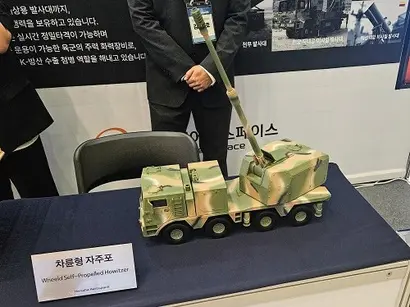
Hanwha Aerospace revealed that it is developing an export-oriented wheeled self-propelled howitzer using its own budget to prepare for future competition. At the '2024 Defense Quality Comprehensive Academic Conference' held in Changwon on July 19, Hanwha Systems272210 showcased a wheeled armored vehicle featuring a turret adapted from the K9A2 next-generation howitzer, mounted on a KTSSM launch vehicle chassis. By inheriting the fully automated features of the K9A2, which eliminates the need for manual loading, this wheeled howitzer can be operated by a crew of two or three while maintaining the K9A2's excellent rate of fire. Moreover, the KTSSM launch vehicle platform is bulletproof and has already proven its superior mobility in desert and mountainous environments through exports to domestic and Middle Eastern regions, meaning it is expected to meet 100% of the mobility requirements for a wheeled howitzer.
The range of this export-oriented wheeled howitzer is expected to exceed that of the RCH 155. Currently, it is equipped with the same 52-caliber gun as the K9A2, but it can also be equipped with the longer 58-caliber barrel planned for future K9A2 upgrades. In this configuration, the wheeled howitzer is expected to have the capability to precisely strike enemy targets over 70km away when using guided munitions.
One difference between this wheeled howitzer and the German RCH 155 is that it requires a spade for firing. Because of this, the time from stopping to firing the first round is expected to be slightly slower than the RCH 155. However, this design follows the same approach as the HX3 wheeled howitzer from another German company, Rheinmetall, and is more cost-effective than the RCH 155.
According to Hanwha Aerospace, the turret on the new wheeled howitzer is modular and can be mounted on various vehicle platforms. The company stated that if required by future export customers or the Defense Acquisition Program Administration, it could also be mounted on the TAIGON armored vehicle rather than the KTSSM chassis. In such a case, it is expected to possess capabilities virtually identical to those of the RCH 155.
Currently, development of the export-oriented wheeled howitzer is being funded by Hanwha Aerospace's own budget, but the company plans to submit it as a research project for upcoming government-announced export weapon system development programs. If selected, it is expected to significantly boost Hanwha Aerospace's product competitiveness in the global market, much like the AS21 Redback.