

[비즈한국] During the last presidential election, President Yoon Suk Yeol included "creating sustainable, high-quality jobs" as one of his top 10 campaign pledges. His vision was to boost private-sector employment by improving the business environment, rather than increasing public-sector hiring as the previous Moon Jae-in administration had done. The keyword representing this approach is "private-led growth." Perhaps thanks to the focus on private-led growth, the Korean economy has recently shown signs of recovery with improvements in the growth rate, centered around the private sector. International organizations are also successively raising their growth forecasts for Korea this year.
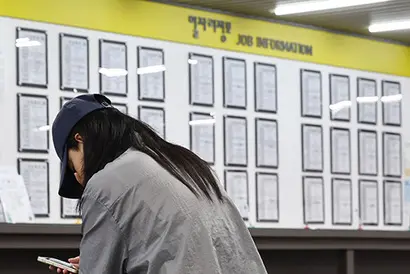
The problem is that while the economy is improving, the job market is not seeing the same momentum. Employment elasticity, which measures how much economic growth translates into job creation, plummeted to one-fifth of the level seen in the same period last year during the first quarter of this year. As "jobless growth" worsens, the "sustainable, high-quality job creation" that President Yoon promised is failing to materialize properly.
President Yoon Suk Yeol presented 10 major pledges during the last presidential election. The first, reflecting the late stages of the COVID-19 pandemic at the time, was "Emergency relief for COVID-19 recovery and a post-COVID plan," and the second was "Creating sustainable, high-quality jobs." To achieve this, he proposed laying the foundation for job creation through deregulation and an employment-friendly environment, and creating private-led jobs driven by corporate growth.
Since taking office, President Yoon has consistently expressed his intention to create high-quality jobs through private-sector leadership. Even when he officially declared a "national demographic emergency" on June 19, he cited the creation of quality jobs as one of the solutions for recovering from low birth rates. Thanks to the pro-business environment created by the President to foster high-quality jobs, the Korean economy, which had been suffering from the "three highs" (high inflation, high interest rates, and high exchange rates), is showing signs of gradual improvement. However, the job market is not improving at the same pace as the broader economy.
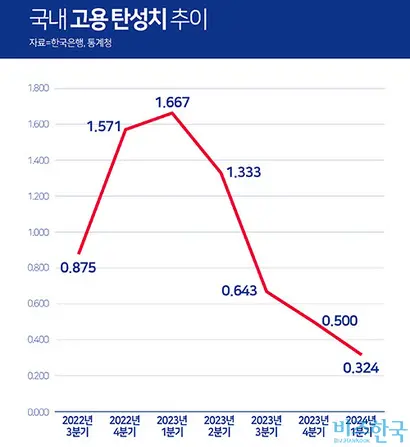
According to Statistics Korea and the Bank of Korea, the employment elasticity calculated from economic growth and employment growth rates was 0.324 in the first quarter of this year. This is only one-fifth of the 1.667 recorded in the first quarter of 2023, just a year ago. This is the lowest figure since the economy moved past the aftermath of the COVID-19 pandemic. Employment elasticity is the percentage change in employment divided by the percentage change in economic growth, serving as an indicator of how effectively economic growth generates jobs. A high employment elasticity suggests that employment grew significantly relative to the scale of growth, while a low figure suggests that job growth lagged behind economic growth.
Employment elasticity recorded 0.359 in the second quarter of 2021 as employment began to rise again after the COVID-19 shock, then climbed to 1.226 in the first quarter of 2022. After a temporary stagnation, it turned upward again starting in the third quarter of 2022 (0.875) and reached 1.667 in the first quarter of 2023. However, it subsequently fell, dropping to 1.333 in the second quarter, 0.643 in the third quarter, 0.500 in the fourth quarter, and finally crashing to 0.324 in the first quarter of this year.
This is because, unlike the economic growth rate which has improved since the second quarter of last year, the employment growth rate has remained stagnant. While the economic growth rate (year-on-year) rose from 0.9% in the second quarter of last year to 1.4% in the third, 2.2% in the fourth, and 3.4% in the first quarter of this year, the employment growth rate remained at a mere 1.2% in the second quarter of last year, 0.9% in the third, 1.1% in the fourth, and 1.1% in the first quarter of this year. Furthermore, with the employment growth rate stuck at just 0.5% in the second quarter of this year, there are concerns that employment elasticity will fall even further.
The downward trend in employment elasticity is highly likely to continue throughout the year, not just for the first and second quarters. In its "2024 Second Half Economic Policy Direction" announced on the 3rd, the government projected this year's economic growth rate at 2.6%. This is a 0.4 percentage point upward adjustment from the 2.2% projection presented in last year's "2024 Economic Policy Direction." While the government raised its economic growth forecast, it maintained the original projection of 230,000 new jobs.
Given that the number of employed people last year was 28.416 million, if the number of employed people grows according to the government's forecast, the employment growth rate for this year will be 0.8%. Based on these government projections for growth and employment, this year's employment elasticity is expected to reach only 0.311. This is only one-third of the level of last year's employment elasticity (0.857).