

[비즈한국] Damage from "dark patterns" (deceptive business practices) in subscription services is on the rise. In particular, as many platforms fail to provide proper notifications regarding recurring payments, consumer harm is increasing. While the government has decided to regulate dark patterns in subscription services starting next year to prevent such harm, critics point out that the obligation to provide prior notice for recurring payments is missing, necessitating further complementary measures.

"They Send Ads Every Day, But No Notice for Recurring Payments": Consumers Struggle to Get Refunds
A Mr. Kim was surprised recently while checking his credit card statement. A charge of nearly 200,000 KRW had been made on a card he rarely uses. Looking into the details, he found it was a payment for an annual subscription to an online lecture platform, 'A', which he had used the previous year. Company A is one of the leading online lecture platforms in Korea. It gained popularity since the COVID-19 pandemic, as annual subscribers could freely take any of the 5,000+ courses on the site.
He stated, "I bought an annual subscription a year ago when I used the online lecture platform. I had to register my card on the site back then. The payment was processed automatically one year after the initial transaction. I didn't know the payment would repeat every year," adding, "It was a card I don't use often, and I happened to find the charge while looking through the statement, so I was barely able to get a refund. If I hadn't checked the card usage details properly, I might have let it pass without knowing."
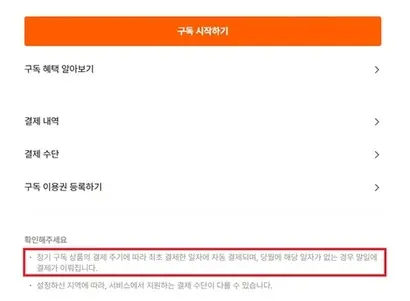
Mr. Kim explained that he never thought an annual subscription would automatically renew every year. In reality, when signing up for platform A, while the benefits of the annual subscription were actively promoted, the notice that payment would automatically proceed upon expiration was displayed in a way that was difficult to notice.
A Ms. Lee also shared her frustration, having struggled to get a refund for an auto-renewed annual fee from the same online lecture platform. She said, "Platform A periodically sends advertisements via social media. But before the auto-renewal, there was no notice that a payment would be made, nor was there any notification after the payment that a new subscription had been initiated," adding, "Even after the auto-payment, they continued to send promotional discount offers as if I wasn't even using the service, so I never thought a payment had actually gone through. There was absolutely no payment notice sent via email or other means."
Online, it is easy to find posts regarding cancellations of recurring payments on platform A. Users are sharing their grievances about annual subscriptions paid without their knowledge, as well as the cancellation and refund procedures. Mr. Kim noted, "When I wrote about my dissatisfaction with the auto-payment process on my personal blog, people who experienced similar issues left comments one after another. It seems many others are going through the same thing." BizHankook inquired with company A about its automatic annual subscription payment method, but the company did not provide a response.

Government Initiates Dark Pattern Regulations, But No Duty for Recurring Payment Notices: "Regulations for Recurring Payments are Needed"
As deceptive billing resulting from the expansion of the "subscription economy" increases, an amendment to the Act on the Consumer Protection in Electronic Commerce (E-commerce Act) to prevent such practices passed the National Assembly plenary session earlier this year. On the 18th, the Fair Trade Commission (FTC) announced that it would pre-announce the proposed amendments to the Enforcement Decree and Enforcement Rules of the E-commerce Act. The period for public legislative notice will run until August 27, and after collecting opinions from relevant ministries and completing the legislative process, the amendment is expected to be finalized within the second half of the year.
This amendment to the E-commerce Act contains regulations on types of online transactions that have caused numerous consumer complaints, such as hidden renewals, interference with cancellations/withdrawals, and repetitive interruptions. Violations of these regulatory clauses may result in business suspensions or administrative fines.
In the case of recurring payments, the consumer's prior consent is now mandatory for any price increases or the conversion of a free service to a paid one. There is an obligation to notify consumers 30 days in advance of a price increase for recurring payments, and 14 days in advance for a conversion to a paid service.
On the other hand, if a re-payment is made for the same amount as the initial recurring payment, there are no repercussions for the company if they do not provide a payment notice to the customer. An FTC official stated, "Usually, people do not re-consent to annual fees every year. Once a customer has agreed to recurring payments initially, they can cancel at any time at their own discretion, so there is no obligation to provide notice for re-payments."
Consumers point out that subscription platforms are abusing the lack of regulations on re-payments to engage in "thief billing." One consumer remarked, "They send notifications for product advertisements via text and social media constantly, yet their intent is suspicious when they fail to provide proper notifications for important payments," adding, "There are many consumers who live without even knowing if they have been re-billed. Many companies are generating revenue this way. They have an obligation to accurately inform consumers before a payment is processed."
Lee Eun-hee, a professor of consumer science at Inha University, also pointed out, "Consumers must be able to confirm and be aware of whether they intend to proceed with a re-payment. Since payments being made without consumers' knowledge is a potential issue, regulations regarding this are necessary."