

[비즈한국] With drone threats becoming a reality due to the war in Ukraine and North Korean drone incursions, the "anti-drone" industry—which deals with illegal and armed drones—is gaining significant attention in South Korea.
Currently, South Korea’s anti-drone industry is heavily focused on "soft kill" methods, which utilize radio waves. This has led to persistent criticism that the country is neglecting the development of "hard kill" anti-drone solutions.
Why is the "soft kill focus" in the Korean anti-drone industry a problem? It is because the limitations of soft kill solutions are clear, and they are difficult to use against offensive, military-grade drones during wartime.
Soft kill refers to neutralizing enemy drones through non-physical means. The most common method is the GNSS jammer, which disrupts satellite navigation signals like GPS. GNSS jammers are easy and simple to develop, as they deceive drones with fake GPS signals or block them entirely. However, they can be easily circumvented if a drone is programmed to only receive GPS signals from above or is equipped with navigation equipment capable of flying without GPS.
Furthermore, misusing GNSS jammers poses safety risks. For instance, if a jammer is mounted on an airplane or helicopter, it could inadvertently cause that aircraft's own navigation equipment to malfunction, risking a crash of the very platform intended to carry out the anti-drone mission.
Additionally, there are directed-energy (DEW) anti-drone systems, which are a hybrid between soft and hard kill. The "Laser Air Defense Weapon Block-I," recently developed by the South Korean military, can be considered a type of DEW anti-drone weapon. However, this method also faces a critical flaw.
Laser or directed-energy weapons must focus their beam on a drone until it crashes. This becomes difficult to intercept if a drone moves evasively like an airplane, or if it has metal or glass coatings on its plastic frame, as the energy must be concentrated on a single point for an extended duration to bring it down.
While "soft kill" solutions may be effective against small, lightweight civilian drones due to their ease of production, they are virtually useless against maliciously modified civilian drones or combat-grade drones.
"Hard kill," unlike soft kill, involves physically striking or using explosive force to disable a drone. While there are several types of missiles designed to strike small drones, they can cause collateral damage through debris. Moreover, shooting down drones with missiles is prohibitively expensive. Consequently, most hard kill methods are performed via "ramming"—using an anti-drone platform to physically collide with the target.
Although hard kill is a relatively new concept in the Korean anti-drone industry, global players have long been developing and mass-producing such systems. RTX’s "Coyote®" drone is the most well-known drone interceptor. Although it looks like a missile, it is an Unmanned Aircraft System (UAS). As the core interceptor of the U.S. Army’s Low-Altitude Anti-Drone Defense System (LIDS), the Coyote is launched upon detecting a drone via AESA radar and intercepts it by direct collision. The manufacturer claims it has already proven its effectiveness in combat in the Middle East and is more affordable and safer than standard missiles.
Anduril Industries, Inc., one of the most prominent new defense companies in the U.S., has also developed and demonstrated a hard kill drone interception system. The "Anvil-M" is an interceptor drone specifically modified for drone interception. Integrated with Anduril’s anti-drone detection system, it automatically engages targets. The advantage of a "drone-killing drone" over missiles or autocannons is the reduction of collateral damage. In the case of Anvil, once a target is identified as a suspected hostile drone, the system follows the target until the user decides to attack, at which point it closes in and collides with the enemy UAV. Because the operator can identify and authorize the attack right up until the moment of impact, it reduces collateral damage and prevents accidental strikes on friendly assets.
The first Korean company to mention in the race against U.S. hard kill anti-drone systems is Nearthlab. A manufacturer of industrial drones, Nearthlab showcased a hard kill anti-drone solution in collaboration with radar manufacturer Tori’s Square at "Drone Show Korea 2024" in Busan this past March. It uses a high-speed, direct-collision drone specifically designed for interception. Capable of speeds up to 250 km/h, the interceptor features a missile-like airframe equipped with four motors and propellers, tracking and destroying targets using an onboard FPV camera. Nearthlab has already successfully demonstrated the interception of a DJI Phantom-class drone hovering in the air.
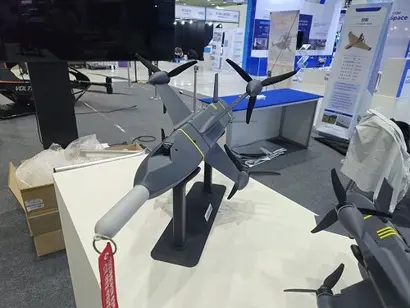
UAMtech, a company founded by a professor at Kyungwoon University, has also unveiled a hard kill anti-drone system. Named "Bigeok," a rapid-maneuvering flight projectile, it was introduced at the "2024 Unmanned System Industry Expo" on the 17th. Much like Nearthlab’s solution, it is propelled by four motors and propellers with a similar top speed of 230–250 km/h.
There are two key differences compared to Nearthlab. The first is its significantly improved maneuverability, achieved through four tail fins, allowing it to better intercept rapidly evading drones. UAMtech demonstrated footage of the Bigeok tracking and destroying a moving target after an abrupt maneuver, a step forward from Nearthlab’s demonstration against stationary multi-copters.
The second feature is that Bigeok is designed to be deployed as a "drone within a drone." Two Bigeok units are intended to be carried by UAMtech’s "Cobra-2" drone, a VTOL (Vertical Take-Off and Landing) UAV developed by improving a scale model of the KUS-VX, which was co-researched with Korean Air003490. While similar in shape to the Strix drone developed by BAE Systems Australia, the Cobra-2 boasts superior performance due to its proprietary flight control system and refined aerodynamic design.
UAMtech stated that it plans to deploy the Cobra-2 equipped with Bigeok units to intercept drones, much like a fighter jet carrying missiles. This "drone-carrying-a-drone" hard kill system is the first of its kind in the world, offering the advantage of extended range and reduced response time compared to ground-launched hard kill drones.
While these two companies are currently the only ones offering hard kill solutions in the Korean anti-drone industry, a competitive landscape is clearly emerging. While soft kill systems remain important, their reliance on radio waves poses legal issues and significant safety risks, as they can cause electronic failures in the very vehicles or helicopters carrying the jammers. It is hoped that South Korea's nascent anti-drone industry will successfully master both "hard kill" and "soft kill" capabilities, fostering healthy competition among the players in the field.