

[비즈한국] On July 19, the Virtual Asset User Protection Act (Virtual Asset Act) will go into effect. While the virtual asset market has previously followed the 'Act on Reporting and Using Specified Financial Transaction Information' (Special Financial Transaction Act), which focuses on anti-money laundering, the implementation of the Virtual Asset Act introduces stricter requirements for user protection and business supervision, significantly increasing the responsibilities of service providers. While the industry anticipates the mainstreaming of virtual assets as a positive step for market maturation, it remains uncertain whether businesses already struggling through a downturn can withstand the pressure.
Financial authorities have finalized legal preparations ahead of the Act's implementation. The 'Enforcement Decree of the Virtual Asset Act,' which includes details such as the management of user deposits, passed the Cabinet meeting on June 25. Subsequently, on July 10, the Financial Services Commission (FSC) resolved the enactment of the 'Regulations on Supervision of Virtual Asset Businesses' and the 'Regulations on Investigation of the Virtual Asset Market.' As a result, virtual asset exchanges, wallet providers, and custodians will now be subject to oversight by financial authorities.
While the institutionalization of virtual assets is a long-held ambition for the industry, it simultaneously increases the obligations and responsibilities of operators. Virtual asset businesses must now purchase insurance or set aside reserves to cover potential damages from incidents such as hacking or system failures. Furthermore, they must pay user deposit fees (similar to interest) and hold assets of the same type and quantity as the user's holdings to ensure protection against accidents.
In particular, exchanges are required to conduct constant monitoring for abnormal transactions to prevent unfair activities like price manipulation and fraudulent trading, and they must report the results to financial authorities. According to relevant guidelines, exchanges must establish internal organizations and protocols for monitoring and implement IT systems for detection. While the FSC states that most exchanges have met these requirements, such regulations place an inevitable burden on operators lacking sufficient funds or personnel.
The virtual asset market has experienced a 'crypto winter' (downturn) for about two years, leading to a widening wealth gap between operators. Lawmakers are also closely watching the potential problems arising from this oligopolistic structure. According to the office of Representative Min Byung-duk (Democratic Party of Korea), K-Bank, which partners with the top exchange Upbit, accounts for 70% of the commission-based market share. Representative Min pointed out, "The domestic virtual asset trading market is among the top 10 in the world, yet it faces the peculiar phenomenon of a single company's dominance," adding, "This raises concerns about the distortion of listing markets and coin prices, insufficient protection for investors, and competition focused primarily on lowering fees."
An examination of the National Pension Service (NPS) subscriber records for the five domestic won-market exchanges (Upbit, Bithumb, Coinone, Korbit, and Gopax) revealed that small and medium-sized firms are suffering from labor shortages. Two out of the five companies had fewer than 100 employees. Notably, the gap between the industry leader and the remaining exchanges has widened to a level that is difficult to bridge.
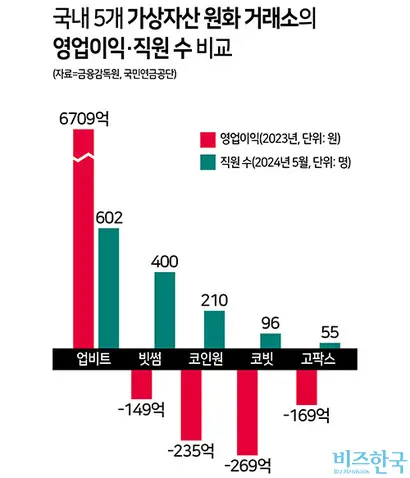
Analyzing NPS subscriber counts from 2022 to 2024 (as of May each year) shows that the number of employees at Streami, the operator of Gopax, dropped from 107 in 2022 and 96 in 2023 to 55 this year—nearly a 50% decrease in one year. Following Gopax, Korbit saw the next sharpest decline. Korbit maintained 119 employees in 2022 and 2023, but the number fell to 96 this year, a 19% decrease compared to the previous year.
These results differ from the average of the industry-wide survey. According to the 'Survey on the Status of Virtual Asset Businesses' for the second half of 2023, the 22 domestic exchanges (including both won and coin markets) had a total of 1,665 employees, with an average of 271 per won-market exchange. This illustrates the 'fallacy of averages,' which hides the stark differences in current conditions.

The crises faced by these two exchanges are also reflected in their performance. Korbit's operating revenue dropped from 22.6 billion KRW in 2021 to 4.3 billion KRW in 2022 and 1.7 billion KRW in 2023. Its operating loss widened from 2.7 billion KRW in 2021 to 35.8 billion KRW in 2022, before narrowing to 26.9 billion KRW in 2023. Streami's operating revenue plummeted 95% from 31.5 billion KRW in 2021 to 1.6 billion KRW in 2022, recovering slightly to 3.1 billion KRW in 2023. Operating profit turned to a loss from 13.6 billion KRW in 2021 to -76.5 billion KRW in 2022, though the loss was reduced to -16.9 billion KRW in 2023.
Streami specifically suffered a direct hit from the bankruptcy of the global exchange FTX. Gopax operated a virtual asset deposit service called 'GoFi' and entrusted investment funds to the overseas manager 'Genesis Global Capital.' Genesis then entrusted those funds to FTX, which filed for bankruptcy in November 2021, making the recovery of funds difficult. With Genesis also going bankrupt, Gopax was left with the responsibility of repaying investors. Although the Chinese-owned exchange Binance acquired Gopax and repaid some of the funds, approximately 60 billion KRW remains unpaid. Furthermore, the financial authorities have not approved the change in the Virtual Asset Service Provider (VASP) registration for over a year following Binance's rise to major shareholder status, making further repayments difficult. Amid these circumstances, the company has begun cost-cutting measures, and it is reported that some employees have left voluntarily.
While lower-tier operators are in crisis, top-tier operators have grown. The number of NPS subscribers for Dunamu, which operates the number one exchange Upbit, grew from 465 in May 2022 to 555 in May 2023, and 602 in May 2024. Dunamu was the only one of the five won-market exchanges that did not report an operating loss. Dunamu's consolidated operating profit saw a slight decline from 810.1 billion KRW in 2022 to 640.9 billion KRW in 2023, but it remained profitable. Notably, its net profit increased from 130.8 billion KRW to 805 billion KRW.
The second and third-ranked players have also expanded their organizations in anticipation of market growth. Bithumb Korea increased its staff from 341 in 2022 and 368 in 2023 to 400 this year. Following them, Coinone recorded 154 employees in 2022, 189 in 2023, and 210 last May. Although both companies have consistently added personnel, they could not avoid losses; in 2023, Bithumb Korea recorded an operating loss of 14.9 billion KRW, and Coinone recorded 23.5 billion KRW.
However, the industry expects that while entering the institutional sphere may be a burden in the short term, it will stabilize the market in the long run. An official from a mid-sized exchange stated, "I believe the virtual asset market has yet to fully bloom. Once we gain the trust of users, the market itself can expand," adding, "As even the traditional financial sector is moving to accept virtual assets, I hope that the direction of policy does not lean solely toward excessive regulation."